0. Preface
This sample is a 4.3 MB signed Go executable filed under Vidar. The payload inside it reports version 2.8, which makes it the oldest Vidar build I have taken apart so far: it is an earlier release of the same codebase as the 3.0 payload from the ClickFix BMP-steganography chain, built the same way and sharing most of its strings. The loader around it is a different template from the Go loaders in the 3.5–4.1 posts.
Four things in it are worth writing down:
- The loader hooks
GetUserNameAbefore it does anything else. It patches the first 14 bytes of the API with a jump to a Go callback that always returns the string5a3f1c7ef2c5a6d3. Vidar only callsGetUserNameAwhen it buildsinformation.txt, so every log stolen through this loader reports that string as the user name. - One cipher function decodes everything in the loader. All 54 strings and the 1.17 MB payload go through the same five-pass routine with a per-call 32-bit key. It is a variant of the add/reverse/add/swap/add crypter from the 4.x loaders.
- The payload’s string seed is a constant. In the 3.0 post I took the 32-bit seed that all the string builders depend on from a memory dump, and described the on-disk payload as crypted. It isn’t. The seed is an immediate in a short function, gated only on two PEB fields. With that, the on-disk payload decodes completely: 835 strings here, and 834 from the 3.0 file, which is 266 more than the earlier post recovered.
- The payload carries a small helper DLL. A 10,944-byte
files_helper.dllis XOR-encrypted in.rdata, re-randomised on every drop, and run asrundll32.exe "<dll>",Collect <job>to copy locked browser databases.
Everything was done statically: objdump, kuna and Python for both stages, and Unicorn to emulate the Go cipher and Vidar’s string builders. Nothing was executed, and neither the dead drops nor the C2 were contacted.
C2, up front: hxxps://116.202.186[.]230 as a direct endpoint, plus dead drops at t.me/x0xprs and Steam profile 76561198664897346 (separator word ki5goq).
1. The Threat at a Glance
| Attribute | Assessment |
|---|---|
| Malware type | Go in-memory loader → Vidar 2.8 infostealer |
| Sample | 957991aa93aa4b9cb7113daaee044326f97e21e0dd725ae59123ffae7513bb4a (4,334,960 bytes) |
| Loader | PE32+ GUI, Go 1.25.4, Authenticode-signed with a self-signed hodewarin.com certificate; working “Kiln Registry” decoy program |
| Payload | 1,175,216-byte MSVC PE, decoded from a Go byte-array literal and mapped into the loader’s own process |
| Anti-analysis | Loader: junk-padded functions, encrypted strings. Payload: no imports, no plaintext strings, a seed that changes under a bare emulator, a 13-point sandbox score |
| C2 | hxxps://116.202.186[.]230; dead drops t.me/x0xprs and steamcommunity.com/profiles/76561198664897346 (separator ki5goq) |
| Payload build | Vidar 2.8, build ID 51d8e58cd2d7a2ccdffccd1d42246875 |
| Mutex | Gernsoalse |
| Confidence | High — both stages, the helper DLL and the full configuration were recovered statically, and the decoders reproduce byte-exact output |
2. Infection Chain Overview
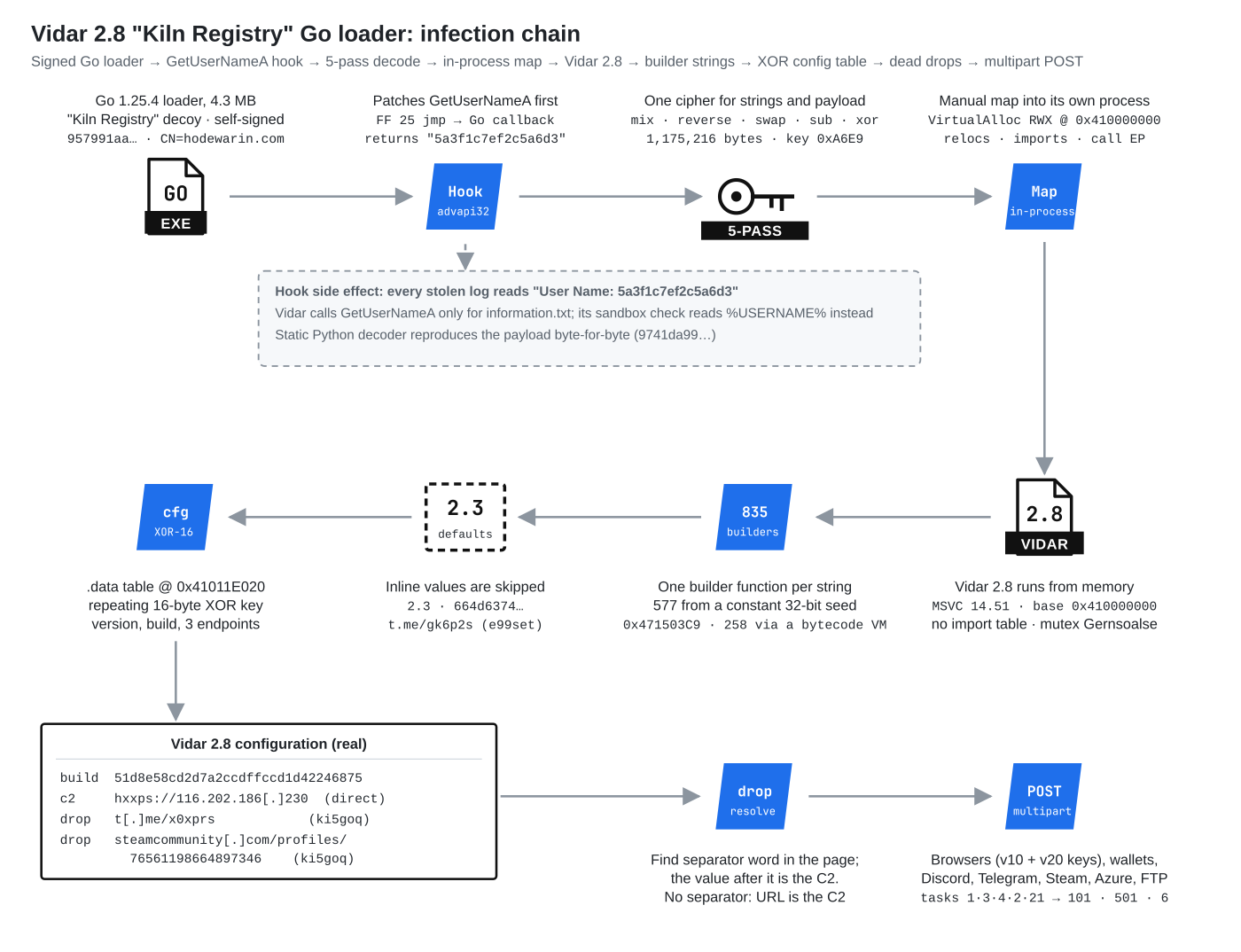
| Stage | File | SHA-256 | Role |
|---|---|---|---|
| 1 | Go loader | 957991aa93aa4b9cb7113daaee044326f97e21e0dd725ae59123ffae7513bb4a | Hooks GetUserNameA, decodes the payload, maps and runs it in-process |
| 2 | Vidar 2.8 (memory only) | 9741da99cde62836b09923f00611e6e49f45176f389385cc8085fe717a80851b | Infostealer |
| 2a | files_helper.dll (embedded, pre-morph) | f8cbf81b94abe808d32c336bd38c09f211f18930368f9703190aba26a29a4892 | Copies locked browser files; the dropped copy has a different hash every time |
3. Stage 1 - The Go Loader
The file is a PE32+ GUI executable. The go1.25.4 build string and Detect It Easy’s Compiler: Go(1.18.X-1.24.0) label both say Go. The pclntab and the COFF symbol table are intact, so nearly every function has a name: kuna lists 2,145 functions, 31 of them in package main.
Those 31 functions account for 607 KB of a 1.3 MB .text. Eight of them are larger than 20 KB, and almost all of that is filler: maps that are filled and read back, runtime.rand calls, and print calls on values nobody uses. main.main alone is 106 KB and reserves a 1.2 MB stack frame.
The signature
The Authenticode blob holds one self-signed certificate:
subject=C=US, ST=I2Vb6, L=G5iOmH3G8, O=gPSe5aud8tv, CN=hodewarin.com
issuer =C=US, ST=I2Vb6, L=G5iOmH3G8, O=gPSe5aud8tv, CN=hodewarin.com
serial 3B1CE44242F21D27 · RSA-4096 · CA:TRUE · SAN DNS:hodewarin.com
EKU: TLS Web Server Authentication, TLS Web Client Authentication
This is a different habit from the 3.5–4.1 loaders, which used an invented two-word company name and a genuine DigiCert timestamp. Here the certificate looks like a TLS certificate for a domain, with random strings in the state, locality and organisation fields and no code-signing usage. The file digest is SHA-1 and there is no countersignature. The signingTime attribute and the certificate’s notBefore are the same second, 2026-08-02 15:56:06 UTC, so the certificate was generated when the file was signed. Neither value is authenticated, but they agree with the payload’s version (section 6).
The decoy
The real loader sits inside a working console program. It defines a kiln registry type with methods, fills it with chambers (Ember, Ash, Clay-Pit, Forge, Cinder) and clay bodies (Stoneware, Porcelain, Earthenware, Raku), and prints report sections titled Kiln Registry, Quality And Energy, Temperature Ranking, Firing Log, Clay Digests and Studio Summary through a buffered writer. It has error paths (chamber already installed: %s, cracked exceeds total pieces) and uses sort, strconv, time and fmt in ordinary ways.
None of this is visible. The binary is a GUI-subsystem executable, so there is no console for the report to go to. Its purpose is to give the file a plausible call graph and string set around the handful of functions that matter. 45 of the 54 encrypted strings belong to the decoy.
What main.main does
Following only the calls whose results are used:
| Order | Function | Role |
|---|---|---|
| 1 | main.umksnvobnli | patches advapi32!GetUserNameA (section 4) |
| 2 | main.Ewxnbxetlulfxdnxbts, main.Sbbbnwblwwdpb, … | decoy: builds the registry and prints the first report sections |
| 3 | rep movsq, then main.vumykjgfuatattsbaui | copies the 1,175,216-byte ciphertext to the stack and decodes it (section 5) |
| 4 | main.kmjspatkfibu | PE header parser |
| 5 | main.lsrdc | VirtualAlloc(ImageBase, SizeOfImage, MEM_COMMIT|MEM_RESERVE, PAGE_EXECUTE_READWRITE); retries with a NULL address if the preferred base is taken |
| 6 | inline copy, main.ahpiqgli | section copy; base relocations if the image moved |
| 7 | main.uwbricam | imports through LoadLibrary and GetProcAddress (main.myietrjyjm for ordinals) |
| 8 | syscall.Syscall (in main.main, 0x14013E080) | calls the payload entry point on the loader’s own thread |
The mapper is thinner than the 4.x one. It doesn’t register unwind data, set up TLS or create an activation context, and it leaves the whole image PAGE_EXECUTE_READWRITE. The payload has no import table, so step 7 does nothing for this payload. The remaining decoy sections after step 8 are never printed, because Vidar ends with NtTerminateProcess on its own process.
The loader contains no sandbox or timing checks, no persistence and no network code.
4. Stage 1 - The GetUserNameA Hook
The first call in main.main, before the decoy and before the payload is touched, is main.umksnvobnli. It decodes five strings (advapi32.dll, GetUserNameA, kernel32.dll, VirtualProtect, 5a3f1c7ef2c5a6d3), wraps a closure in a native callback thunk with syscall.compileCallback, and overwrites the start of the API:
; main.umksnvobnli
call   syscall.compileCallback           ; rax = native thunk for func1.func2
mov    [rsp+0x68], rax
mov    word  [rsp+0x30], 0x25ff          ; FF 25 00 00 00 00 = jmp qword [rip+0]
...
call   runtime.growslice                 ; 6 -> 14 bytes
mov    rdx, [rsp+0x68]
mov    [rax+6], rdx                      ; absolute target after the jmp
...
; VirtualProtect(GetUserNameA, 14, PAGE_EXECUTE_READWRITE, &old)
mov    qword [rax+0x8], 0xe
mov    qword [rax+0x10], 0x40
call   syscall.(*LazyProc).Call
; for i in 0..13: GetUserNameA[i] = patch[i]
movzx  ebx, byte [rsp+0x2f]
mov    [rcx], bl
The old protection is never restored, so that page of advapi32 stays writable and executable. The callback is short:
; main.umksnvobnli.umksnvobnli.func1.func2(lpBuffer, pcbBuffer)
mov    esi, [rbx]                        ; *pcbBuffer
mov    rdi, [rdx+0x10]                   ; len("5a3f1c7ef2c5a6d3") = 16
mov    rdx, [rdx+0x8]                    ; string data
loop:  movzx r8d, byte [rdx+rax] ; mov [rcx+rax], r8b ; inc rax
       cmp rax, rdi ; jge done ; cmp rax, rsi ; jl loop
done:  mov byte [rcx+rdi], 0             ; if it fits
       lea rcx, [rdi+1] ; mov [rbx], ecx ; *pcbBuffer = 17
       mov eax, 1                        ; TRUE
From this point on, any code in the process that asks for the user name through GetUserNameA gets 5a3f1c7ef2c5a6d3.
What it changes for the payload
I looked for every use of the user name in the payload. There are two:
information.txt. The system-information builder resolvesGetUserNameAby hash (0xD12B1AB8), calls it, and formats the result asUser Name: %s. This is the only call to the API in the payload. It falls back to theUSERNAMEenvironment variable only if the call fails.- The sandbox score. The user-name check that compares against
John,sandboxandWDAGUtilityAccountreads theUSERNAMEenvironment variable withGetEnvironmentVariableA. The hook doesn’t touch it.
So the effect on this payload is narrow and specific: the User Name field of every log produced through this loader reads 5a3f1c7ef2c5a6d3 instead of the real account name. The machine name, HWID and everything else are real, and the profile paths of the stolen files still give the real name away.
The code doesn’t say why. A 16-hex-digit constant in a field the stealer panel displays looks like a tag that identifies the loader build or the traffic source. The other reading is that the hook is a generic feature of this loader template, meant to defeat user-name blocklists in whatever payload it carries, and that it simply misses with Vidar. I can’t tell the two apart from one sample.
5. Stage 1 - One Cipher for Strings and Payload
Finding the payload
The 4.x loaders each had a dedicated decoder function that took no arguments and returned the payload. This one has no such function. The ciphertext is copied onto the stack inside main.main and handed to the same routine that decodes the strings:
; main.main
lea    rdi, [rsp+0xf0]
lea    rsi, [rip+0x101b15]               ; .rdata 0x140232158
mov    ecx, 0x23dd6
rep movsq                                ; 0x23DD6 qwords = 1,175,216 bytes
...
lea    rax, [rsp+0xf0]
mov    ebx, 0x11eeb0                     ; len
mov    rcx, rbx                          ; cap
mov    edi, 0xa6e9                       ; key
call   main.vumykjgfuatattsbaui
String call sites have the same shape with a smaller buffer built from immediates:
mov    dword [rsp+0x34], 0x530d1929
movabs rdx, 0x9aa8df7b1f56770e
mov    [rsp+0x38], rdx
lea    rax, [rsp+0x34]
mov    ebx, 0xc
mov    rcx, rbx
mov    edi, 0x911b5                      ; a different key at every call site
call   main.vumykjgfuatattsbaui          ; -> "kernel32.dll"
There are 55 call sites: 54 strings and the payload.
Getting it out
I reused the Unicorn harness from the earlier Go loaders. It maps the PE, gives the goroutine a fake g in r14, and stubs the allocator, map, rand and print runtime calls in Python. For each call site the script walks back over the instructions that build the buffer and emulates from there to the return.
The first trial decoded only the first 4 KB of the payload buffer to check the harness, and produced garbage. The full buffer came back in 1.5 seconds starting with MZ. The reason is pass 2 below: the cipher reverses the buffer, so a prefix can’t be decoded on its own.
The cipher
main.vumykjgfuatattsbaui is 98 KB, but only five loops write to the buffer. I found them by logging every byte write into the heap during emulation:
; pass 1 @ 0x1400DFD30   key % 53 and key % 97 via the usual multiply-by-reciprocal
;   even i:  b[i] = b[i] - key%53 - 17*i      (lea rdx,[rdi+rdi]; lea rdx,[rdi+rdx*8])
;   odd  i:  b[i] = b[i] ^ key%97 ^ 31*i      (shl rdi,5; sub rdi,rdx)
movabs rax, 0x4d4873ecade304d5 ; imul rdx ; sar rdx,4 ; ... ; imul rdx,rdx,0x35
movabs rax, 0xa8e83f5717c0a8e9 ; imul rdx ; ... sar rdx,6 ; ... ; imul rdx,rdx,0x61

; pass 2 @ 0x1400E1C4C   reverse the buffer
; pass 3 @ 0x1400E3AE8   swap adjacent byte pairs
; pass 4 @ 0x1400E5990   b[i] = b[i] - (key >> 8) - 3*i     (sar r8,8; lea r8,[rbx+rbx*2])
; pass 5 @ 0x1400E7830   b[i] = b[i] ^ key ^ 5*i            (lea r8,[rbx+rbx*4])
As a standalone decoder:
def dec(buf: bytes, key: int) -> bytes:
    b = bytearray(buf); n = len(b)
    k1, k2 = key % 53, key % 97
    for i in range(n):
        b[i] = (b[i] - k1 - 17 * i) & 0xff if i % 2 == 0 else (b[i] ^ k2 ^ (31 * i)) & 0xff
    b.reverse()
    m = n & ~1
    b[0:m:2], b[1:m:2] = b[1:m:2], b[0:m:2]
    for i in range(n):
        b[i] = (b[i] - (key >> 8) - 3 * i) & 0xff
    for i in range(n):
        b[i] = (b[i] ^ key ^ (5 * i)) & 0xff
    return bytes(b)

payload = dec(pe[0x231358:0x231358 + 0x11eeb0], 0xa6e9)   # .rdata 0x140232158
This reproduces the emulated output exactly: SHA-256 9741da99cde62836b09923f00611e6e49f45176f389385cc8085fe717a80851b.
The skeleton is the one from the 4.x loaders: a position-dependent pass, a full reverse, a pair swap and more position-dependent passes (the constants for those builds are tabulated in the MSI write-up). The differences here are that the key is an argument instead of three baked-in constants, pass 1 treats even and odd offsets differently, the last pass is an XOR, and the same routine is used for strings. Since this loader was signed in August and carries an older payload than any of the 4.x loaders, it reads as an earlier design of the same crypter and not a later one.
6. Stage 2 - Vidar 2.8 Strings: 835 Builders and a Constant Seed
The decoded PE:
| Property | Value |
|---|---|
| Compiler / linker | MSVC 19.29.30140, linker 14.51 |
| Link timestamp | 2026-06-01 13:37:40 UTC |
| ImageBase | 0x410000000 |
| Entry point RVA | 0xE0070 |
| Sections | .text, .rdata, .data, .reloc |
| Import table | none |
| Functions (exception directory) | 1,432 |
.data | 0x1200 bytes on disk, 0x11BD00 in memory |
This is the same shape as the 3.0 payload from the ClickFix chain: four sections, no imports, a .data section that holds little more than the config table, and a .reloc of 20 bytes. That build was linked on 2026-08-05 and its inline default version string was 2.8. This one is linked two months earlier, reports 2.8 from its config table and carries 2.3 as its inline default. The entry point runs an initialiser, then the main routine, then NtTerminateProcess(-1, …).
strings finds nothing useful in it. Every string the payload uses is produced by its own function.
The two kinds of builder
Each builder allocates a buffer, computes the bytes, copies them out, caches the pointer in a global and returns it. 577 of them compute the bytes from a shared 32-bit seed:
// sub_4100065F4  ->  L"POST"
if (dat_41011fbd0) return dat_41011fbd0;          // cached
buf  = alloc(10);
seed = sub_4100d3cb4();                           // s0..s3 = seed bytes, low to high
t[0] = 0x19 - s0;   t[1] = 3 - s1;   t[2] = s2 ^ 0x5a;   t[3] = s3 + 0xb9;
t[4] = 0x1c - s0;   t[5] = s1 ^ 3;   t[6] = s2 ^ 0x41;   t[7] = s3 ^ 0x47;
copy(buf, t, 8);  *(uint16_t *)(buf + 8) = 0;
The other 258 pass a bytecode program to a small interpreter (sub_4100D3F68). It registers 14 handlers in a 256-entry table at 0x41011F0A0 on first use and dispatches on each program byte. These tend to be the longer strings: their median length is 23 characters, against 9 for the seed-based ones.
The seed
Every string depends on what sub_4100D3CB4 returns. It caches the result of this function:
; sub_4100D3CE4
mov    rax, gs:[0x60]                    ; PEB
mov    rax, [rax+0x30]                   ; ProcessHeap
...                                      ; ok  = (ProcessHeap != 0)
mov    rax, [rax+0x10]                   ; ImageBaseAddress
...                                      ; ok &= (ImageBaseAddress != 0)
cmp    dword [rsp], 0
je     bad
mov    dword [rsp+0xc], 0x471503c9
jmp    out
bad:   mov dword [rsp+0xc], 0xdeadbeef
out:   mov eax, [rsp+0xc]
The seed is 0x471503C9. It isn’t derived from the machine, the file or the loader. The PEB test is there to catch an emulator that runs the builders without a process environment: with a zeroed PEB, every string is computed from 0xDEADBEEF and comes out as garbage. The L"POST" example above works out by hand with seed bytes C9 03 15 47.
Recovery
The recovery script takes the 835 functions that call the byte copier 0x4100059F0, and runs each under Unicorn with:
- a fake TEB and PEB at
gs:[0x60]withImageBaseAddressandProcessHeapset; - the allocator
0x4100DF9FCreplaced by a bump allocator, because the real one callsHeapAllocthrough pointers that are only resolved at runtime.
All 835 return a string. A selection:
kernel32.dll  ntdll.dll  winhttp.dll  rstrtmgr.dll  crypt32.dll  dpapi.dll  bcrypt.dll
2.3
664d63743825f6f7fc94f638412af32d
https://t.me/gk6p2s
e99set
Gernsoalse
locaAp
4f8a2b1c9d3e7f6a0b5c1d8e2f9a4b7c6d3e0f1a2b5c8d9e0f1a2b3c4d5e6f7a
%s=== Sandbox Check ===%s
sb: score        %d / %d (need 8)
Dead drop: sepword '%s' не найден
Кодовое слово не найдено, пробуем напрямую: %s
"%s" --no-first-run --disable-extensions --headless --disable-logging --log-level=3 --user-data-dir="%s" about:blank
  v20: APC decrypt pid %lu...
  v20: ключ извлечён (pid %lu)
rundll32.exe "%s",Collect %s
  files_helper: drop+rundll32 (%u bytes blob)
Work Dir: In memory
Going back to the 3.0 build
In the 3.0 post I read the seed (0x6B519DF3) out of a memory dump and wrote that the on-disk payload was crypted and only analysable after it had decrypted itself. This build shows that was wrong: nothing in the file is waiting to be decrypted. The on-disk 3.0 file has the same function, with the seed as an immediate:
360033d6f:  mov dword [rsp+0xc], 0x6b519df3
360033d79:  mov dword [rsp+0xc], 0xdeadbeef
I ran the same recovery script against that file with its four addresses swapped in. It returned 834 strings: the 568 from the earlier post plus 266 more. The earlier call-graph filter only selected builders that call the seed getter directly, so it skipped every VM-based builder. The strings it missed include the multipart request templates, cmd.exe /c rmdir /s /q "%s", the headless-browser command line, ENC domain decrypted OK and earlybird: spoof parent=%s pid=%lu. No memory dump is needed for either build.
7. Stage 2 - API Hashing
The payload has no import table. It walks the PEB loader list for module bases and resolves exports by hash in sub_4100E8E7C(module, hash), which also follows forwarded exports. The hash function has the FNV-1a shape with its own constants:
def api_hash(name: bytes) -> int:
    h = 0x99E60639
    for c in name:
        h = ((c ^ h) * 0x1000181) & 0xFFFFFFFF
    return h
The 3.0 build used basis 0x63975773 and prime 0x10003F1, so both constants change between builds and hash tables don’t carry over.
Matching every 32-bit immediate in .text against the export names of wine’s x86-64 DLLs resolves 184 constants: 88 in kernel32, 37 in ntdll, 13 in winhttp, 11 in advapi32, 8 in bcrypt, 7 in gdi32, 5 in gdiplus, 4 each in rstrtmgr and user32, 3 in crypt32, 2 in ole32, and the two module names. Of the 128 distinct hashes that appear at direct resolver call sites, one stays unresolved (0x01F34067).
The set describes the payload well before any function is read: WinHttp* for transport, BCrypt* for AES-GCM, Rm* for Restart Manager, NtCreateProcessEx, NtReadVirtualMemory, NtQueueApcThread and NtQueueApcThreadEx2 for the browser-key work, and CreateDesktopA for a hidden desktop.
8. Stage 2 - Configuration
The config table is the reason .data has any bytes on disk at all. It starts at 0x41011E020 and uses the layout that every later build keeps:
| Offset | Field |
|---|---|
+0x10 | 16-byte key (d75b68f9e6d259413b98b34db80a6f33) |
+0x20 / +0x40 | version / its length |
+0x41 / +0x81 | build ID / its length |
+i*0x243 + 0x82 / +0x182 | URL / length |
+i*0x243 + 0x183 / +0x1C3 | separator word / length |
+i*0x243 + 0x1C4 / +0x2C4 | User-Agent / length |
+0x1057 | record count (capped at 7) |
There is no cipher-mode byte yet; that arrives in 4.x. Every field is XORed with the 16-byte key, repeated:
// sub_410108AA0
do {
    out[i] = key[i & 0xf] ^ field[i];
} while (++i < len);
Which configuration runs is decided by one byte. sub_4101082A4 tests the first byte of the key: if it is non-zero it calls the table reader, otherwise it calls the routine that loads the inline defaults. In the 4.x builds both run and the inline entry survives as an extra fallback endpoint. Here it is one or the other, and with a key present the inline values are never used.
{
 "version": "2.8",
 "build_id": "51d8e58cd2d7a2ccdffccd1d42246875",
 "record_count": 3,
 "endpoints": [
  {"url": "https://116.202.186.230", "sepword": "",
   "user_agent": "Mozilla/5.0 (Windows NT 10.0; Win64; x64; rv:156.9) Gecko/20100101 Firefox/156.9"},
  {"url": "https://t.me/x0xprs", "sepword": "ki5goq",
   "user_agent": "Mozilla/5.0 (Windows NT 10.0; Win64; x64) AppleWebKit/537.36 Safari/537.36 Edg/144.0.0.0"},
  {"url": "https://steamcommunity.com/profiles/76561198664897346", "sepword": "ki5goq",
   "user_agent": "Mozilla/5.0 (Windows NT 10.0; Win64; x64) AppleWebKit/537.36 Safari/537.36 Edg/144.0.0.0"}
 ]
}
| Field | Running value | Inline default (unused) |
|---|---|---|
| Version | 2.8 | 2.3 |
| Build ID | 51d8e58cd2d7a2ccdffccd1d42246875 | 664d63743825f6f7fc94f638412af32d |
| Endpoints | the three above | https://t.me/gk6p2s, separator e99set |
The 16 bytes in front of the key (fc28423cd8cee13eb279ede9a31f743f) are not read by the table reader. I don’t know what they are for.
Dead drop to C2
A record with a separator word is a dead-drop page. Vidar fetches it with the record’s User-Agent, looks for the separator word and takes the value after it; a value without a scheme is turned into https://%s. If the word isn’t on the page it tries the URL itself (Кодовое слово не найдено, пробуем напрямую — “code word not found, trying directly”). A record with no separator word, like the first one here, is used as the C2 as it stands. This build has no strings for the encrypted dead-drop value (ENC domain …) that 3.0 and later decrypt with a SHA-256-derived key. I did not fetch either page.
9. Stage 2 - Capabilities
The orchestrator is short: sandbox check and C2 session, a browser-key phase, a file phase, and teardown. The strings and the API set fill in the rest.
Start-up and evasion
- AV inventory. At the start of the sandbox routine it builds a bitmask of installed security products from process names and from loaded-module name prefixes (
aswh,aswA,klhk,klfp,eamsi,eOPP,atcuf,symam,symef,tmmon): Avast, AVG, ESET, Trend Micro, Kaspersky, Defender, Bitdefender, Norton, Malwarebytes and Dr.Web. Later code branches on it; some browser paths are skipped under Avast, for example. - Sandbox score. A score out of 13, logged check by check as
sb: <name> OK/FAIL; the run continues only with 8 or more. The whole block is skipped (sb: skipped) when the mask contains Avast, Kaspersky, Norton or Dr.Web.- debugger (
NtQueryInformationProcessclasses 7 and 0x1E) and PEBNtGlobalFlag & 0x70; - at least two CPUs, an
rdtsctiming loop, RAM and disk size; - loaded modules
sbiedll.dll,api_log.dll,dir_watch.dll, and a separateav_sandboxtest onapphelp.dll,combase.dllanddwmapi.dll; USERNAMEin {John,sandbox,WDAGUtilityAccount} and computer name in {JOHN-PC,SANDBOX};- uptime; under 60 seconds it waits instead of failing;
- a connectivity probe (
1.1.1.1,8.8.8.8) that would end the process on failure. As compiled it never runs: it is gated on the same AV bit that has just caused the early return, so it is always logged asskipand counted as passed.
- debugger (
- ntdll remapping is present but switched off. There is a routine that maps
System32\ntdll.dllfrom disk and restores the loaded copy (ntdll: unhooked), but the function that decides whether to call it returns a constant 0 in this build. - Single instance.
CreateMutexW(L"Gernsoalse"). On collision it retries 60–120 times at 2–5 second intervals instead of exiting. - Victim ID. Built from the volume serial number and the hardware-profile GUID. A short form is cached under
HKCU\Software\Microsoft\Windows\CurrentVersion\Explorerin a string value namedTS_plus eight hex digits. This is the only registry write, and it isn’t a persistence mechanism.
C2 session
- WinHTTP, multipart/form-data. The first request carries
hwid,build_idandformat=json. The base64-encoded JSON reply supplies atokenand the switchestelegram,steam,azure,cryptocurrency,steal_discord,screenshot,loader,debug,thread_count,zip_thresholdandgrabber_size_max. - Rules are then requested by numbered mode:
1browser list,3wallet rules,4grabber rules,2Chromium plugins,21Firefox plugins. Three more modes are sent as the run progresses:101after the browser files are collected,501around the grabber phase and6at teardown. I didn’t work out what the server returns for those. - There is no fixed request path among the strings; the path comes from the URL through
WinHttpCrackUrl.
Collection
- Chromium browsers.
Login Data,Login Data For Account,Network\Cookies,History,Web Data, and extension storage (Local Extension Settings,Sync Extension Settings,IndexedDB) for the wallet and plugin rules.- v10 keys:
encrypted_keyfromLocal Statethrough DPAPI. - v20 (App-Bound Encryption) keys: scans running browser processes for the key, forking them with
NtCreateProcessExand reading withNtReadVirtualMemory. If the browser isn’t running it starts one headless with a throwaway profile under%LOCALAPPDATA%\locaAp\, then queues an APC (NtQueueApcThreadorNtQueueApcThreadEx2) that makes the browser decrypt the key itself. The profile is removed withcmd.exe /c rmdir /s /q.
- v10 keys:
- Firefox.
logins.json,key4.db,cookies.sqlite,places.sqlite,formhistory.sqlite,cert9.db, andmoz-extensionstorage. - Applications. Discord tokens; Telegram Desktop
tdataand Telegram Web local storage; Steam (ssfn*,config.vdf,loginusers.vdf, and tokens read fromsteam.exememory); Azure CLI caches (accessTokens.json,azureProfile.json,msal_token_cache.json,TokenCache.dat); FileZillarecentservers.xml; WinSCP sessions from the registry. - Other. A rule-driven file grabber (
%DESKTOP%,%DOCUMENTS%,%DRIVE_REMOVABLE%and similar roots), a GDI+screenshot.jpg, andinformation.txt.
The embedded helper DLL
Browser databases are usually locked by the running browser. This build solves that with a second PE stored inside the payload:
// sub_4100D8AC0   blob @ 0x410118800, length @ 0x41011B2C0 (10,944), key @ 0x41011B2C8
out[i] = blob[i] ^ key[i & 0xf] ^ (uint8_t)(0x1f * i);     // key 9fb9c1a7bf9b943527771f35e91902ea
The result is an x64 DLL with the internal name files_helper.dll, one export (Collect) and a plain kernel32 import table. Before it is written, sub_4100D81CC “morphs” it (runtime morph -> %u bytes): it randomises the PE timestamp and linker version, zeroes the checksum, rewrites about a quarter of the DOS-stub bytes and appends 128 to 1,024 random bytes. Every dropped copy therefore has a different hash. The files go into a working directory named with eight random characters under %TEMP%:
%TEMP%\<8 random>\<8 random>.dll        the helper
%TEMP%\<8 random>\<8 random>.job        "FHJOB1\n" then one src|dst|… line per file
rundll32.exe "<dll>",Collect <job>      started with explorer.exe as spoofed parent
<job>.ok                                "FHOK1" when the helper has finished
Because the blob is present in this build, this is the path browser files always take. Inside Collect there are two copy methods:
- Handle duplication (“handle steal”). It opens each browser process with
PROCESS_DUP_HANDLE | PROCESS_QUERY_INFORMATION, lists its handles withNtQueryInformationProcess(ProcessHandleInformation), identifies the one for the wanted file withNtQueryObject, duplicates it and reads the file through the duplicate. - Early-bird
CopyFileA. It starts the browser’s own executable suspended and windowless (CreateProcessAwithCREATE_SUSPENDED | CREATE_NO_WINDOWand--no-first-run --disable-extensions --headless about:blank), writes the source and destination paths into it, and queuesNtQueueApcThread(thread, CopyFileA, src, dst, 0)once per file. OnResumeThreadthe browser copies its own databases. Two seconds later the process is terminated.
Follow-on
- Loader tasks. Downloads
.exe,.dllor.ps1files, checks PEs forMZ, and runs them withcmd /c start "" "%s",cmd /c start "" rundll32.exe "%s", orpowershell.exe -ExecutionPolicy Bypass -WindowStyle Hidden -NoProfile -File "%s". - Logs. The static AES-256 key string
4f8a2b1c…6f7ais already present; it is unchanged through 4.2.
10. What Changed Between 2.8 and 3.0
With both string sets recovered the same way, the two builds can be compared directly. 757 strings are common to both; 78 exist only in 2.8 and 77 only in 3.0.
| 2.8 (this sample) | 3.0 (ClickFix chain) | |
|---|---|---|
| Link timestamp | 2026-06-01 | 2026-08-05 |
| ImageBase | 0x410000000 | 0x360000000 |
| Functions | 1,432 | 1,406 |
| String builders | 835 (577 seed, 258 VM) | 834 (568 seed, 266 VM) |
| String seed | 0x471503C9 | 0x6B519DF3 |
| API hash basis / prime | 0x99E60639 / 0x1000181 | 0x63975773 / 0x10003F1 |
| Mutex string | Gernsoalse | Glasikprostik |
%LOCALAPPDATA% directory name | locaAp | cnfigAp |
| Locked browser files | dropped files_helper.dll through rundll32 | done in-process ([files_copy], earlybird: spoof parent=…) |
| App-bound key extraction | fork-scan and APC | adds a COM method (v20_com: …) |
| Encrypted dead-drop value | not present | ENC domain decrypted OK, key derived with SHA-256 |
| Memory wipe message | not present | [wipe] %d объектов очищено из памяти |
The direction is consistent: 3.0 drops the helper DLL, the only executable this build writes to disk on its own, and adds the encrypted dead-drop value that the 4.x posts describe.
11. Indicators of Compromise
Files
Go loader                957991aa93aa4b9cb7113daaee044326f97e21e0dd725ae59123ffae7513bb4a
Vidar 2.8 payload        9741da99cde62836b09923f00611e6e49f45176f389385cc8085fe717a80851b
                         (memory only, never written to disk)
files_helper.dll         f8cbf81b94abe808d32c336bd38c09f211f18930368f9703190aba26a29a4892
                         (as embedded; the dropped copy is re-randomised and its hash differs every time)
Network
hxxps://116.202.186[.]230                          direct C2, no separator word
t[.]me/x0xprs                                      dead drop, separator ki5goq
steamcommunity[.]com/profiles/76561198664897346    dead drop, separator ki5goq
t[.]me/gk6p2s                                      inline default (unused in this build), separator e99set
UA (direct):     Mozilla/5.0 (Windows NT 10.0; Win64; x64; rv:156.9) Gecko/20100101 Firefox/156.9
UA (dead drops): Mozilla/5.0 (Windows NT 10.0; Win64; x64) AppleWebKit/537.36 Safari/537.36 Edg/144.0.0.0
Host / static markers
Signer:              CN=hodewarin.com, O=gPSe5aud8tv, L=G5iOmH3G8, ST=I2Vb6, C=US (self-signed)
                     serial 3B1CE44242F21D27, SHA-1 446FBA2530868D01C0328D611007B99EC0B1D8FF
Build ID:            51d8e58cd2d7a2ccdffccd1d42246875  (inline default 664d63743825f6f7fc94f638412af32d)
Mutex:               Gernsoalse
Spoofed user name:   5a3f1c7ef2c5a6d3  (appears as "User Name:" in information.txt)
Headless profile:    %LOCALAPPDATA%\locaAp\
Helper:              %TEMP%\<8 chars>\<8 chars>.dll + .job + .job.ok; rundll32.exe "<dll>",Collect <job>
Registry:            HKCU\Software\Microsoft\Windows\CurrentVersion\Explorer, REG_SZ value named TS_<8 hex digits>
Loader cipher:       key%53/17i | key%97/31i, reverse, pair-swap, -(key>>8)-3i, ^key^5i; payload key 0xA6E9
String seed:         0x471503C9  (0xDEADBEEF when the PEB check fails)
API hash:            FNV-1a shape, basis 0x99E60639, prime 0x1000181
Config table:        stage-2 .data 0x41011E020, XOR key d75b68f9e6d259413b98b34db80a6f33
Helper blob key:     9fb9c1a7bf9b943527771f35e91902ea
Log key (AES-256):   4f8a2b1c9d3e7f6a0b5c1d8e2f9a4b7c6d3e0f1a2b5c8d9e0f1a2b3c4d5e6f7a
12. Detection Opportunities
- A patched
GetUserNameA. The first bytes ofadvapi32!GetUserNameAreadingFF 25 00 00 00 00followed by an 8-byte pointer into the main executable, and the page leftPAGE_EXECUTE_READWRITE. A Go program has no reason to change the protection of a system DLL’s code. - The stolen-log marker. Anyone with access to stealer logs can pick out this loader’s victims by
User Name: 5a3f1c7ef2c5a6d3next to an unrelated computer name. - A private RWX image in a Go process. A 0x23B000-byte
PAGE_EXECUTE_READWRITEallocation at0x410000000that starts withMZand belongs to no loaded module. - The cipher’s division constants.
0x4D4873ECADE304D5(divide by 53) and0xA8E83F5717C0A8E9(divide by 97) in the same Go function, followed by a full-buffer reverse and a pair swap, make a rebuild-resistant YARA pattern. - A TLS-style certificate used for Authenticode. Self-signed, a domain name as the common name, server and client authentication as the only extended key usages, a SHA-1 file digest and no timestamp.
rundll32.exe "<path>.dll",Collect <path>.jobwithexplorer.exeas the parent and both files in a random eight-character directory under%TEMP%. The export name and theFHJOB1/FHOK1file headers are stable even though the DLL’s hash is not.- A browser started suspended and headless by
rundll32, with an APC queued toCopyFileA, or started headless by a non-browser parent with--user-data-dirunder%LOCALAPPDATA%\locaAp. - Stage-2 code patterns in memory. The seed function’s pair of immediates (
0x471503C9,0xDEADBEEF),imul reg, reg, 0x243in the config reader, and the hash loop with multiplier0x1000181. - Requests to
t.me/x0xprsor Steam profile76561198664897346from a process that isn’t a browser, or HTTPS to116.202.186[.]230with no preceding DNS lookup, followed by multipart POSTs.
13. MITRE ATT&CK Mapping
| Tactic | Technique |
|---|---|
| Execution | T1204.002 User Execution: Malicious File; T1106 Native API; T1218.011 System Binary Proxy Execution: Rundll32 (helper DLL); T1059.001 PowerShell and T1059.003 Windows Command Shell (loader tasks) |
| Defense Evasion | T1553.002 Code Signing (self-signed); T1036 Masquerading (decoy program); T1027 Obfuscated Files or Information (junk code, encrypted strings, embedded payloads); T1027.007 Dynamic API Resolution; T1140 Deobfuscate/Decode; T1620 Reflective Code Loading; T1622 Debugger Evasion; T1497.001 System Checks; T1134.004 Parent PID Spoofing; T1055.004 Asynchronous Procedure Call |
| Discovery | T1518.001 Security Software Discovery; T1082 System Information Discovery; T1033 System Owner/User Discovery; T1057 Process Discovery; T1012 Query Registry |
| Credential Access | T1555.003 Credentials from Web Browsers; T1539 Steal Web Session Cookie; T1528 Steal Application Access Token (Azure, Discord, Steam); T1552.001 Credentials in Files; T1552.002 Credentials in Registry (WinSCP) |
| Collection | T1005 Data from Local System; T1113 Screen Capture; T1119 Automated Collection; T1560 Archive Collected Data |
| Command and Control | T1071.001 Web Protocols; T1102.001 Dead Drop Resolver; T1105 Ingress Tool Transfer (loader tasks) |
| Exfiltration | T1041 Exfiltration Over C2 Channel |
Both stages and the helper DLL were recovered statically. The Go cipher was first emulated under Unicorn and then reimplemented in Python. Vidar’s 835 strings were recovered by emulating its own builder functions with a fake PEB, its API hashes were resolved against wine’s export tables, and its configuration was decoded with a 16-byte XOR. The stealer modules were characterised from strings, API hashes and the orchestrator, not read function by function. Nothing was executed, and neither the dead drops nor the C2 were contacted.