0. Preface
This sample is a 5.5 MB signed Go executable filed under Vidar. It is the first Vidar 4.x build I analysed. Up to this point, every sample in this Go-loader family carried Vidar 3.5–3.7, and I had a set of scripts that unpacked each new build in minutes. On this one, every decoding layer had changed:
- The loader’s payload encoding. The earlier builds stored the payload as a decimal-digit string decrypted with a SplitMix64 keystream. This one stores it as a raw byte array and decodes it with a five-pass add/reverse/swap byte cipher.
- Stage-2 string obfuscation. Vidar 3.x decrypted strings at each use site. Vidar 4.x decodes them through 900-odd lazy getter functions. A PEB
BeingDebuggedcheck selects the key, and a small bytecode VM generates more key material. - The configuration cipher. The per-build config table keeps its 3.x layout, but a new mode byte selects a CBC-style cipher instead of the old repeating 16-byte XOR.
The fourth thing hasn’t changed, and it’s the one that matters most: the configuration in the strings is not the one the sample uses. strings and the inline values say version 4.0, build 14157ded…, dead drop t.me/scat33s. The encrypted table says version 4.1, build de72459e…, and adds two further dead drops.
I later found a ClickFix MSI build whose Vidar payload is byte-identical to this one apart from its config table. That analysis is in Vidar 4.1 via ClickFix msiexec. This post covers this build end to end.
Everything was done statically: objdump and Python for both stages, and Unicorn to emulate the Go decoder, Vidar’s string getters and its config decryptor. Nothing was executed, and neither the dead drops nor any C2 were contacted.
C2, up front: no direct C2 IP in this build. It resolves its C2 through dead drops at telegram.me/eg0ttt and Steam profile 76561198612847216 (separator word li1l), with t.me/scat33s (separator o00p) kept as a fallback entry.
1. The Threat at a Glance
| Attribute | Assessment |
|---|---|
| Malware type | Go in-memory loader → Vidar 4.1 infostealer |
| Sample | b37413c715212c655c328e99657f9a50bdcaf7366f74935fe232663a5d156698 (5,524,392 bytes) |
| Loader | PE32+ GUI, Go 1.24.5, Authenticode-signed with a self-signed “Titan Craft Systems” certificate |
| Payload | 959,720-byte MSVC PE, decoded from a Go byte-array literal and mapped into the loader’s own process |
| Anti-analysis | String key chosen by PEB BeingDebugged; large anti-VM, anti-debugger-process and AV checks; ETW patching |
| C2 | Dead drops telegram.me/eg0ttt and steamcommunity.com/profiles/76561198612847216 (separator li1l); fallback t.me/scat33s (o00p) |
| Payload build | Vidar 4.1, build ID de72459e7bad11c5993bd5a10978dadf |
| Mutex | e5w36d4bim |
| Confidence | High — both stages and the full configuration were recovered statically, and the decoders reproduce byte-exact output |
2. Infection Chain Overview
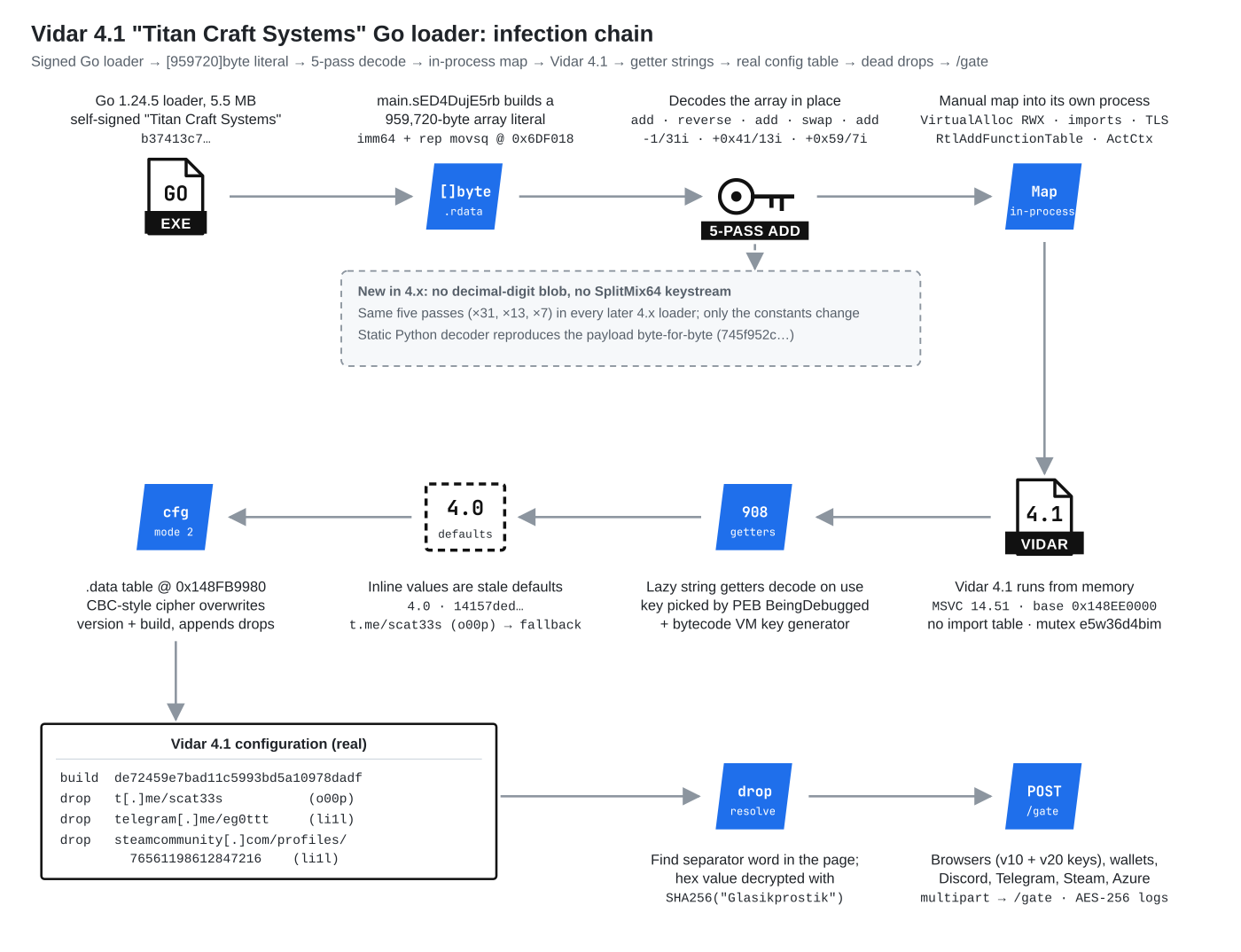
3. Stage 1 - The Go Loader
The file is a 5.5 MB PE32+ GUI executable. Two independent markers identify the toolchain: the go1.24.5 build string, and Detect It Easy’s Compiler: Go(1.18.X-1.24.0). Detect It Easy also flags an Authenticode signature. Extracting the PKCS#7 blob from the security directory shows a self-signed leaf certificate:
subject=C=US, O=Titan Craft Systems, CN=Titan Craft Systems
issuer =C=US, O=Titan Craft Systems, CN=Titan Craft Systems
+ DigiCert Trusted G4 timestamping chain (genuine countersignature)
The DigiCert timestamp countersignature is real, which makes the signature look complete in a quick check. The leaf certificate isn’t trusted by anything. Every Go-loader build of this family I have seen carries a self-signed certificate for a different invented two-word company: QuantumBridgeLabs, Vertex Point Networks, Summit Sphere, Titan Craft Systems, and later Apex Foundry and Frost Metric.
Function names are randomised, but the COFF symbol table is intact, so nm -n gives every function with its address. There’s no need to recover names from the pclntab. Of 4,102 text symbols, 40 are functions in package main. main.main is 9,828 lines of disassembly, almost all of it junk: loops that build strings one character at a time with runtime.intstring and print them with runtime.printstring, and integer arithmetic whose results are never used. Following only the calls whose outputs are used gives this sequence:
| Order | Function | Role |
|---|---|---|
| 1 | LazyProc calls, then main.pFi1vZt3G | process setup; pFi1vZt3G resolves one API with LoadLibrary + GetProcAddress, calls it through SyscallN and converts the UTF-16 result to a string (most likely its own module path) |
| 2 | main.sED4DujE5rb | payload decoder — returns a []byte holding the Vidar PE |
| 3 | main.dfNUzcfa3Rv | PE header parser |
| 4 | main.p08eOFh | VirtualAlloc(ImageBase, SizeOfImage, MEM_COMMIT|MEM_RESERVE, PAGE_EXECUTE_READWRITE) |
| 5 | main.vcyExrZ7bWNPQ … main.fL1VAmylWeH8 | section copy, imports (LoadLibrary/GetProcAddress), relocations, TLS, exception table |
| 6 | syscall.SyscallN (in main.main, 0x57E063) | jump to the payload entry point |
The calls after the jump (main.c4UovjpFsQ5F, main.kxoyLo) are more junk.
Apart from the Go runtime’s own imports, the string pool names the APIs the mapper adds: RtlAddFunctionTable, CreateActCtxW, ActivateActCtx, NtQueryInformationThread, TlsAlloc/TlsSetValue, GetProcessHeap/HeapAlloc and VirtualAlloc/VirtualFree. That is a complete in-process PE loader: it registers the payload’s x64 unwind data and emulates TLS and an activation context so that a full MSVC binary can run inside a Go process. Nothing is injected elsewhere; Vidar runs inside the loader’s own process.
4. Stage 1 - The Five-Pass Crypter
Finding the payload
None of my existing scripts found anything. The earlier builds kept their payload as a 4 MB run of ASCII digits in .rdata, and this binary has no digit run longer than a few hundred bytes. An entropy scan of .rdata in 4 KB windows shows a solid 8.0-bit region from 0x6DF000 to 0x7C9000, about 960 KB. Only one instruction in the whole binary points into it:
; main.sED4DujE5rb
call   runtime.newobject                 ; [959720]uint8
lea    rdi, [rax+8]
movabs rcx, 0x2a0f210fdceff7c0
mov    [rax], rcx                        ; bytes 0..7
lea    rsi, [rip+0xcf3bb]                ; .rdata 0x6DF018
mov    ecx, 0x1d49c
rep movsq                                ; 0x1D49C qwords = 959,712 bytes
This is how Go compiles a large composite literal: the first eight bytes become an immediate store, and the remaining bytes are copied in bulk from read-only data. The array is 8 + 0x1D49C × 8 = 959,720 bytes.
Getting it out
I first recovered the payload by emulating main.sED4DujE5rb under Unicorn. I reused a harness from the 3.x builds that maps the PE, gives the goroutine a fake g in r14, and stubs runtime.newobject, makeslice, memmove, intstring and the print* family in Python. The function ran in 0.4 seconds and returned a slice beginning with MZ.
I had expected main.dfNUzcfa3Rv, the next call in main.main, to be the decryptor, as its position in the old builds suggested. Emulating it returned a 6-byte structure: it’s the PE parser. All of the decoding happens inside main.sED4DujE5rb, after the copy.
The cipher
Of the 3,434 lines in main.sED4DujE5rb, five loops write into the array. Three touch every byte once, and two swap bytes:
; pass 1 @ 0x611325:  b[i] = b[i] - 31*i - 1
movzx esi, byte [rax+rdx] ; mov r8, rax ; shl r8, 5 ; sub r8, rax   ; r8 = 31*i
sub   esi, r8d ; dec esi ; mov [rdx+rax], sil

; pass 2 @ 0x61180A:  reverse the buffer
; pass 3 @ 0x611CE5:  b[i] = b[i] - 13*i + 0x41      (lea r8,[rax+rax*2]; lea r8,[rax+r8*4])
; pass 4 @ 0x6121C7:  swap adjacent byte pairs
; pass 5 @ 0x6126C2:  b[i] = b[i] - 7*i + 0x59       (lea r8,[rax+rax*2]; lea r8,[rax+r8*2])
As a standalone extractor:
import struct

N = 959720
def extract(pe: bytes) -> bytes:
    off = 0x6DF018 - 0x62A000 + 0x229000            # .rdata VA -> file offset
    b = bytearray(struct.pack('<Q', 0x2a0f210fdceff7c0) + pe[off:off + N - 8])
    def addpass(k, step):
        for i in range(N):
            b[i] = (b[i] + k - step * i) & 0xff
    addpass(-1, 31)
    b.reverse()
    addpass(0x41, 13)
    m = N & ~1
    b[0:m:2], b[1:m:2] = b[1:m:2], b[0:m:2]
    addpass(0x59, 7)
    return bytes(b)
This reproduces the emulated output exactly: SHA-256 745f952c3a31bb6b9f7cffe7939e8b39b8089c4b8de4483b504778ae841aa5e0.
The same five passes, with the same multipliers (31, 13, 7) and only the three additive constants changed, appear in every Vidar 4.x loader I have analysed since: two more Go builds and a MinGW cmutil.dll sideload proxy. The constants for each are tabulated in the MSI write-up. For this build they are −1, +0x41 and +0x59.
5. Stage 2 - Vidar 4.1 Strings: 908 Lazy Getters
The decoded PE is a 959,720-byte x64 binary:
| Property | Value |
|---|---|
| Linker | MSVC 14.51 |
| ImageBase | 0x148EE0000 |
| Entry point RVA | 0x65C40 |
| Sections | .text, .rdata, .data, .pdata, .reloc |
| Import table | none — DLL and API names are among the encrypted strings and are resolved at runtime |
| Overlay | 11,496 bytes of random [A-Za-z] filler |
Functions (.pdata) | 1,846 |
The 3.x payloads were linked with MSVC 14.29 and loaded at 0x5B0000000, 0x370000000 or 0x390000000. This is a new build.
What strings shows
Plain strings on the payload gives about 1,450 hits. Almost all of them are instruction-byte noise or a word list of deliberately misspelled identifiers (parser2apropery, layot89handle, seral_library, scannr82dispatcher …) that pads .rdata. Exactly one meaningful string is in the clear: " exe: %s (c2 path)". Everything else is encrypted.
How the getters work
Following references from code to the encrypted .rdata blobs leads to hundreds of small functions with the same shape:
; getter @ 0x148F2CB3C
mov    r9d, 0xac0a99c3
lea    r10, [rip+...]               ; static output buffer in .data
cmp    [rip+guard], r9d             ; already decoded?
je     done
call   0x148F372B4                  ; get string key (cached)
xor    edx, edx
loop:
lea    rcx, [rip+...]               ; ciphertext in .rdata
mov    cl, [rcx+rdx]
ror    cl, 3                        ; per-string transform
mov    [r10+rdx], cl
inc    rdx
cmp    rdx, 0xd
jne    loop
mov    byte [r10+0xd], 0
mov    [rip+guard], r9d             ; mark decoded
done:
mov    rax, r10
ret
Each string has its own getter, guard value and transform (ror, XOR with a key byte, XOR with a shifted 32-bit key, or a call to a stream decryptor at 0x148F372E0 that mixes FNV-1a and golden-ratio constants). The getter decodes the string into a static buffer on first use and returns that buffer every time after.
The key helpers are where the anti-analysis lives:
0x148F372B4→0x148F37408reads the PEB fromgs:[0x60]. IfBeingDebuggedis clear and bothImageBaseAddressandProcessHeapare non-zero, it returns entry 1 of a two-entry table at0x148F666B8; otherwise it returns entry 0. Under a debugger every string decodes with the wrong key, so the sample runs normally but every API name, path and URL comes out as garbage.0x148F1A084is a small bytecode interpreter. On first call it fills a handler table in.datawith pointers to tiny handler functions. Several key-initialiser functions then run 0x25B-byte bytecode programs through it to produce 32-byte keys. It plays the same role as the 14-opcode accumulator VM in the 3.x payloads.
Emulating every getter
There’s no need to understand each transform. Every getter is a function with no arguments that returns a pointer to a NUL-terminated string, so the recovery script:
- walks
.pdatafor every function start (1,846); - keeps the 911 whose first six instructions include a
cmpagainst a RIP-relative guard; - emulates each one under Unicorn with a fake TEB/PEB at
gs:[0x60](BeingDebugged = 0,ImageBaseAddressandProcessHeapset), letting nested calls into the key helpers and VM run natively; - reads the string at the returned pointer as UTF-16LE if the second byte is zero, otherwise as UTF-8.
This recovers 908 strings in a few seconds, 136 of them wide and 55 containing Cyrillic. A selection:
kernel32.dll  ntdll.dll  rstrtmgr.dll  crypt32.dll  dpapi.dll  bcrypt.dll
4.0
14157ded6221bedf1de632abf1bbaa44
https://t.me/scat33s
o00p
Mozilla/5.0 (Windows NT 10.0; Win64; x64; rv:161.0) Gecko/20100101 Firefox/161.0
e5w36d4bim
Glasikprostik
4f8a2b1c9d3e7f6a0b5c1d8e2f9a4b7c6d3e0f1a2b5c8d9e0f1a2b3c4d5e6f7a
/gate
Dead drop: sepword '%s' не найден
Кодовое слово не найдено, пробуем напрямую: %s
ENC domain decrypted OK
"%s" --no-first-run --disable-extensions --headless --disable-logging --log-level=3 --user-data-dir="%s" about:blank
  v20: APC decrypt pid %lu...
  v20: ключ извлечён (pid %lu)
  [etw] patches=%d
  earlybird: spoof parent=%s pid=%lu
This is a VIRUS!!!! Do you want to run the file?\n\nTo remove the window, you must CRYPT FILE!
The first block of inline values (4.0, 14157ded…, t.me/scat33s, o00p) looks like a complete configuration. It isn’t.
6. Stage 2 - The Real Configuration
In the 3.x builds, the inline values are defaults: the real configuration sits in an encrypted table in .data and overwrites them at startup. The same code shape is present here. The table loop multiplies a record index by 0x243:
lea    r14, [rip+0xc4361]       ; 0x148FB9980  table base
lea    r15, [rip+0xa670a]       ; 0x148F9BD30  live endpoint array
imul   rbx, rdi, 0x243          ; record i
...
call   0x148EF5830              ; decrypt field (dst, src, len, key = base+0x10)
The 3.x offsets still apply:
| Offset | Field |
|---|---|
+0x10 | 16-byte key (e4c422a55ffff40e2a395d0e9f233d94) |
+0x20 / +0x40 | version / its length |
+0x41 / +0x81 | build ID / its length |
+0x1057 | record count (capped at 7) |
+i*0x243 + 0x82 / +0x182 | URL / length |
+i*0x243 + 0x183 / +0x1C3 | separator word / length |
+i*0x243 + 0x1C4 / +0x2C4 | User-Agent / length |
+0x1058 | new: cipher mode |
Decoding the table with the old repeating-XOR script gives garbage, so the field decryptor has changed. 0x148EF5830 buries its logic under opaque arithmetic on a global at 0x148FB8688 and an rdtsc whose result is discarded, but its control flow is simple. It branches on the mode byte at +0x1058:
| Mode | Behaviour |
|---|---|
| 0 | plain copy |
| 1 | out[i] = c[i] ^ key[i % 16] — the 3.x cipher |
| 2 | 0x148EF5A4C: CBC-style byte cipher |
This build’s mode byte is 2. The mode-2 routine first expands the 16-byte key into a 32-byte keystream (0x148EF4A18), then chains each output byte on the previous ciphertext byte:
prev   = key[15] ^ key[0]
out[i] = c[i] ^ ks[i & 31] ^ (uint8)(0x9B * i) ^ prev
prev   = c[i]
It finishes by wiping the keystream with a helper that also reads the PEB, so the emulation needs the same fake gs:[0x60] as the string getters. Rather than reimplementing the key expansion, I emulated 0x148EF5830 once per field. As a cross-check, I emulated only the key expansion (keystream 7ad6f007c8f5578ebd10d09dada00970bf58c8a1485636045cf0183ec587a714 for this key). Applying the formula above in plain Python then gives the same output:
{
 "mode": 2,
 "version": "4.1",
 "build_id": "de72459e7bad11c5993bd5a10978dadf",
 "record_count": 2,
 "dead_drops": [
  {"url": "https://telegram.me/eg0ttt", "sepword": "li1l",
   "user_agent": "Mozilla/5.0 (Windows NT 10.0; Win64; x64; rv:161.0) Gecko/20100101 Firefox/161.0"},
  {"url": "https://steamcommunity.com/profiles/76561198612847216", "sepword": "li1l",
   "user_agent": "Mozilla/5.0 (Windows NT 10.0; Win64; x64; rv:161.0) Gecko/20100101 Firefox/161.0"}
 ]
}
What actually runs
The order of initialisation decides which values win:
- The inline-defaults routine zeroes the endpoint counter (
0x148EF505D), copies4.0and14157ded…into the version and build buffers at0x148F9CCF0and0x148F9CD30, and addst.me/scat33s/o00pthrough the add-endpoint helper0x148EF4750. That helper skips empty entries and stops at seven. - The table routine (
0x148EF53F0) decrypts4.1andde72459e…into the same two buffers, overwriting the defaults. It then appends each record through the same counter, without resetting it.
The running configuration is therefore:
| Field | Value |
|---|---|
| Version | 4.1 (inline: 4.0) |
| Build ID | de72459e7bad11c5993bd5a10978dadf (inline: 14157ded6221bedf1de632abf1bbaa44) |
| Endpoint 0 | https://t.me/scat33s, separator o00p (inline fallback, as j88hor was in 3.x) |
| Endpoint 1 | https://telegram.me/eg0ttt, separator li1l |
| Endpoint 2 | https://steamcommunity.com/profiles/76561198612847216, separator li1l |
| User-Agent | Firefox 161 on Windows 10 x64 |
Anyone who stops at the strings gets the wrong version, the wrong build ID and only one of three dead drops.
Dead drop to C2
A record with a separator word is a dead-drop page. Vidar fetches it, finds the separator word in the page and reads the value after it. If that value is a hostname, it’s used directly (https://%s). If it is hex-encoded, Vidar derives a key from SHA256("Glasikprostik") through bcrypt.dll and decrypts it (ENC domain decrypted OK). If no separator word is found, it tries the URL itself as the C2 (Кодовое слово не найдено, пробуем напрямую — “code word not found, trying directly”). The passphrase is the same one used by every 3.x build in this family. I did not fetch any of the three pages.
7. Stage 2 - Capabilities
The decoded strings, including the Russian debug log messages, describe the rest of the payload.
Start-up and evasion
- Single instance: mutex
e5w36d4bim, with retries (Another instance running, waiting (%d attempts)). - “Crypt your build” nag: a message box reading
This is a VIRUS!!!! … you must CRYPT FILE!, aimed at the operator rather than the victim. In 3.x a command-line switch suppressed it; I didn’t trace what controls it in this build. - Anti-VM checks, each logged as
[name] OK/FAIL:- CPU brand and hypervisor vendor (
VMware,VBox,KVMKVM,TCGTCG,Microsoft,prl, Bochs); - ACPI and
Services\VBox*, VirtIO and VMware Tools registry keys; - device names (
\\.\VBoxGuest,\\.\HGFS,\\.\vmciand others); - VM tool processes and DLLs;
- the VBoxTray window class;
- BIOS dates (
06/23/99, BOCHS); - Wine (
wine_get_unix_file_name); - a patched
Sleep.
- CPU brand and hypervisor vendor (
- Analysis tools: a process list covering x64dbg, IDA, Process Hacker, Procmon, Wireshark, Fiddler, Frida, joebox and others.
- AV-aware behaviour: detects Defender, Avast/AVG, ESET, Trend Micro, Kaspersky, Bitdefender, Norton, Malwarebytes and Dr.Web, and skips some techniques under Avast. It also looks for security-product modules by name prefix (
aswh,aswA,klhk,klfp,eamsi,eOPP,atcuf,symam,symef,tmmon). - Native API: a table of 37
Nt*function names resolved fromntdll. - ETW patching:
[etw] patches=%d.
Collection
- Chromium browsers.
Login Data,Cookies,HistoryandWeb Data, plus extension storage (Local/Sync Extension Settings,IndexedDB) for wallet and plugin “rules” pulled from the C2 config.- v10 keys:
encrypted_keyfromLocal State, decrypted with DPAPI. - v20 (App-Bound Encryption) keys: Vidar scans running browser processes for a key pattern (“fork-scan”). If none is running, it launches a headless instance with
--user-data-dirunder%LOCALAPPDATA%\loclAp. It then queues an APC (NtQueueApcThreadEx) that callsCryptUnprotectMemoryinside the browser and reads the decrypted key back. - Process launch: parent-PID spoofing (
spoof: parent=%s pid=%lu → child %lu) and early-bird APC injection.
- v10 keys:
- Firefox.
logins.json,key4.db,cookies.sqlite,places.sqlite,formhistory.sqlite,cert9.dbandmoz-extensionstorage. - Locked files. Restart Manager (
RmStartSession…RmShutdown), file mapping, and stealing open handles to locked databases (%d handle steal). - Applications.
- Discord tokens (browser and Firefox
ls/data.sqlite); - Telegram Desktop
tdataand Telegram Web; - Steam (
ssfn*,config.vdf,SteamID/Personatokens); - FileZilla
recentservers.xml; - Azure CLI tokens (
accessTokens.json,azureProfile.json,msal_token_cache.json,TokenCache.dat).
- Discord tokens (browser and Firefox
- Other. Configurable file grabber “rules” (
maxSize,depth,exclusions,recursive) and a screenshot (screenshot.jpg).
Exfiltration and follow-on
- Upload: files are zipped and sent in parallel as multipart
POST /gate(token,build_id,mode,data,format=json), with log uploads inmode=lg. Logs are encrypted with a static AES-256-GCM key (4f8a2b1c…6f7a) unchanged from 3.x. - Loader task: downloads a PE, checks for
MZ, writes it and runs it withCreateProcessA. - Cleanup:
cmd.exe /c rmdir /s /q "%s"on the headless browser’s user-data directory (cleanup udd: %s).
8. Indicators of Compromise
Files
Go loader                b37413c715212c655c328e99657f9a50bdcaf7366f74935fe232663a5d156698
Vidar 4.1 payload        745f952c3a31bb6b9f7cffe7939e8b39b8089c4b8de4483b504778ae841aa5e0
                         (memory only, never written to disk)
Network
telegram[.]me/eg0ttt                               dead drop, separator li1l
steamcommunity[.]com/profiles/76561198612847216    dead drop, separator li1l
t[.]me/scat33s                                     fallback dead drop, separator o00p
POST /gate                                         exfiltration path on the resolved C2
UA: Mozilla/5.0 (Windows NT 10.0; Win64; x64; rv:161.0) Gecko/20100101 Firefox/161.0
Host / static markers
Signer:              CN=Titan Craft Systems, O=Titan Craft Systems, C=US (self-signed)
Build ID:            de72459e7bad11c5993bd5a10978dadf  (inline default 14157ded6221bedf1de632abf1bbaa44)
Mutex:               e5w36d4bim
Work dir:            %LOCALAPPDATA%\loclAp
Dead-drop key:       SHA256("Glasikprostik")
Log key (AES-256):   4f8a2b1c9d3e7f6a0b5c1d8e2f9a4b7c6d3e0f1a2b5c8d9e0f1a2b3c4d5e6f7a
Crypter constants:   -1 / 31i, reverse, +0x41 / 13i, pair-swap, +0x59 / 7i
Config table:        stage-2 .data 0x148FB9980, mode byte 2
9. Detection Opportunities
- Self-signed Go binaries with a DigiCert timestamp. A genuine DigiCert countersignature on a leaf certificate that chains to nothing is unusual. Track the invented signer names (QuantumBridgeLabs, Vertex Point Networks, Summit Sphere, Titan Craft Systems, Apex Foundry, Frost Metric) as one family.
- A Go process calling
RtlAddFunctionTableon a freshly allocatedPAGE_EXECUTE_READWRITEregion. A Go program has no reason to register x64 unwind data for memory it allocated itself. - The crypter loop shape.
shl reg,5; sub reg,idx; sub byte,reg; dec/add byte,immover a buffer, followed by a full reverse, a ×13 pass, a pair swap and a ×7 pass. This is a YARA-able code pattern that survives rebuilds. - Stage-2 code patterns in memory. A
cmp [rip+X], imm32 / jeguard followed by a short byte-transform loop into.data, repeated hundreds of times, plusimul reg, reg, 0x243in the config loader. - A browser launched headless with
--user-data-dirunder%LOCALAPPDATA%\<random>by a non-browser parent, followed by an APC queued into it. - Requests to
telegram.me/eg0ttt,t.me/scat33sor Steam profile76561198612847216from a process that isn’t a browser, followed by a multipartPOST /gate.
10. MITRE ATT&CK Mapping
| Tactic | Technique |
|---|---|
| Execution | T1204.002 User Execution: Malicious File; T1106 Native API |
| Defense Evasion | T1553.002 Code Signing (self-signed); T1027 Obfuscated Files or Information; T1140 Deobfuscate/Decode; T1620 Reflective Code Loading; T1622 Debugger Evasion; T1497.001 System Checks; T1562.006 Indicator Blocking (ETW patching); T1134.004 Parent PID Spoofing; T1055.004 Asynchronous Procedure Call |
| Discovery | T1518.001 Security Software Discovery; T1082 System Information Discovery; T1057 Process Discovery |
| Credential Access | T1555.003 Credentials from Web Browsers; T1539 Steal Web Session Cookie; T1528 Steal Application Access Token (Azure, Discord); T1552.001 Credentials in Files |
| Collection | T1005 Data from Local System; T1113 Screen Capture; T1560 Archive Collected Data |
| Command and Control | T1071.001 Web Protocols; T1102.001 Dead Drop Resolver; T1105 Ingress Tool Transfer (loader task) |
| Exfiltration | T1041 Exfiltration Over C2 Channel |
Both stages were recovered statically. The Go decoder was first emulated under Unicorn and then reimplemented in Python. Vidar’s 908 strings and its configuration were recovered by emulating its own getter functions and field decryptor with a fake PEB. Nothing was executed, and none of the dead drops or any C2 were contacted.