 CTF WriteUps
purgatory
- Category: rev
- Difficulty: none
- Author: hoover
“We hot patched the validator during business hours. Nothing crashed, which is a good sign.”
There is no native binary in the handout — just two BEAM modules and an Erlang runner. The whole challenge is hot code loading semantics: when two versions of a module are live at once, which version a running process actually executes, decided per call site.
Solution:
1. The runner leaves the worker straddling two versions
run([OldPath, NewPath]) ->
    load(OldPath),
    Worker = purgatory:boot(),
    load(NewPath),
    io:put_chars("purgatory validator\n"),
    prompt(Worker).
boot/0 spawns the worker while old.beam is current, and new.beam is loaded immediately after. Nothing ever purges the old code, so the worker carries on running it. That is the “nothing crashed” of the prompt, and the challenge name — the process is stuck between versions.
2. Only the literals differ
AtU8 Code StrT ImpT ExpT FunT LitT Meta LocT Attr CInf Dbgi Line Type
                              ^^^^           ^^^^
Code : byte-identical between old.beam and new.beam
LitT : differs      (the constants)
Attr : differs      (module vsn hash)
Identical Code means both modules run the same algorithm over different constants. OTP 28 stores LitT uncompressed — flagged by a zero size prefix before the term count — so the literals decode without any zlib step:
- 13 tuples
{0..12, a, b, c} - 12 tuples
{13..24, a, b, c} - a 12-byte list
and the atom table names the algorithm outright:
first_half  second_half  mask  check  loop  resident
*  +  band  =:=  bxor  lists:nth  lists:all  binary:at  byte_size
So it is a 25-character passphrase, each byte checked as (a * ch + b) band 255 =:= c, with the trailing 12 characters XOR-masked before that check. Inverting is straightforward: every a is odd, hence invertible mod 256.
3. The dispatch split decides which constants apply
The symbol tables say exactly which calls cross the version boundary:
LOCALS   check/2   mask/2   first_half/1   loop/0
IMPORTS  erlang:spawn/3 ... purgatory:second_half/2 ... lists:all/2
first_half/1 and mask/2 are local, so a process already running old code stays in old code to reach them. purgatory:second_half/2 appears in the import table, which only happens for a fully-qualified call — and Erlang always routes those to the current version. Its arity is the other half of the story: it takes the binary and the mask, so a value computed by the old module travels into the new one as an argument.
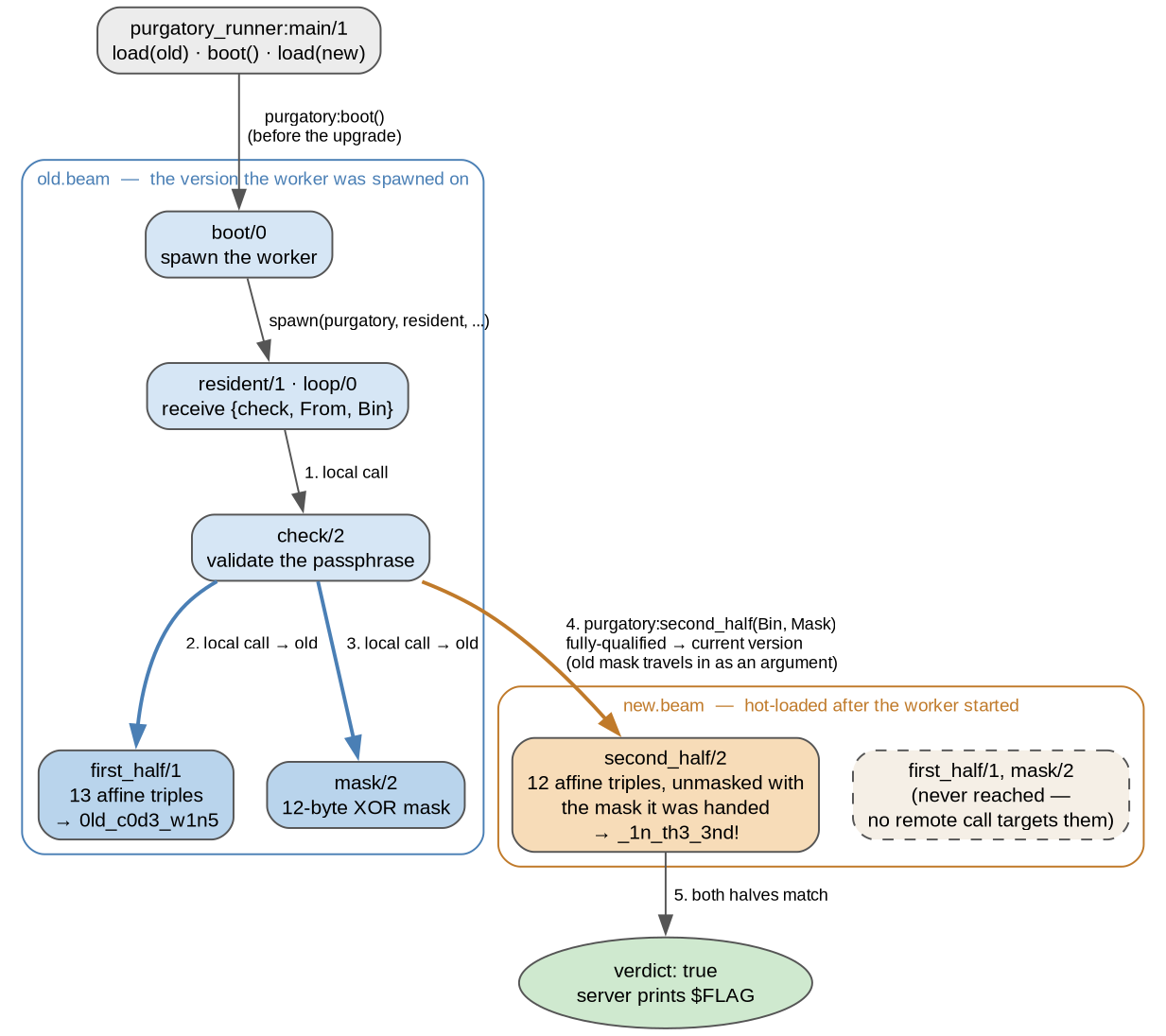
Three components, three origins: old triples for the first half, new triples for the second, and the old mask.
4. Every wrong dataflow is a planted taunt
Solving all the combinations makes the design obvious:
| first_half | second_half triples | mask | result |
|---|---|---|---|
| old | old | old | 0ld_c0d3_w1n5_c0d3x_ch34t |
| new | new | new | cl4ud3_ch34t5_a1_sl0p_l0l |
| old | new | new | 0ld_c0d3_w1n5_a1_sl0p_l0l |
| old | old | new | garbage |
| old | new | old | 0ld_c0d3_w1n5_1n_th3_3nd! |
“codex cheat”, “claude cheats”, “AI slop lol” — the constant tables are salted so that every plausible-but-wrong reading still decodes to fluent, taunting text. Only the correct split reads as a sentence: old code wins in the end.
Full script: solve.py
$ ncat --ssl purgatory-....chall.nnsc.tf 1337
purgatory validator
passphrase> 0ld_c0d3_w1n5_1n_th3_3nd!
NNS{sof7_PUr6e_woUlD_H4V3_reallY_5aV3D_yoU_tHer3}
Flag: NNS{sof7_PUr6e_woUlD_H4V3_reallY_5aV3D_yoU_tHer3}
Takeaways
- Erlang dispatch is the entire vulnerability class: a local call stays in the version the process is already running, a fully-qualified
mod:fun()jumps to the current one. With two versions live, “which code runs” is a property of each call site, not of the process. - Arguments cross the boundary too, and arity is the tell.
second_half/**2**takes the mask as a parameter, so the old module’s data reaches the new module’s code — a finer split than old-half/new-half, and the reason a first, coarser reading got rejected by the server. - A decoy that decodes to plausible text is far more dangerous than one that decodes to garbage. Recovering a clean, meaningful string is not evidence the reading is right; here three separate wrong readings each produced a fluent taunt.
- The flag names the fix:
code:soft_purge/1removes old code only when no process still references it, which would have turned this silent half-upgrade into a visible, all-or-nothing one.