 CTF WriteUps
CatThief
- Category: rev
“One of our stray laboratory felines just pilfered classified contraband from the server room… We’ve tossed the culprit’s executable and a network packet capture into your enclosure so you can reconstruct the heist. Recover what the cat dragged out.”
catthief.exe is a Rust C2 implant; capture.pcapng is the exfil traffic. The stolen files are uploaded RC4-encrypted and run through the challenge’s own custom compressor (compress.rs), so decrypting the pcap is only half the job — the real work is reversing a bespoke Huffman format with no off-the-shelf decompressor. The flag isn’t a string in the traffic; it’s written on a scroll inside one of the recovered images.
Solution
1. The C2 protocol
catthief beacons over plain HTTP POST /exfil to 192.168.56.102:8080. The server replies with a filename to steal; catthief reads that file and POSTs it back. The capture holds one manifest/beacon, five ~3 MB file uploads, and five server responses. Each message is an independent RC4 stream (fresh key schedule per message).
2. The cipher is RC4
The encrypt/keystream routines (sub_1400052e2 = KSA, sub_140005281 = PRGA) are byte-for-byte standard RC4. main builds the 25-byte key by concatenating data_1400c9010 (16 B) ‖ 0x0407576c41004a6c (8 B) ‖ 0x07 (1 B) and XORing every byte with 0x33, giving:
i11_b3_p1und3r1n_y3r_d474 ("ill be plundering yer data")
This is confirmed by decrypting the server responses — they come out as the exact stolen filenames (important.jpg, anothercat.jpg, yetanothercat.jpg, catcatcat.jpg, myfavoritecat.jpg).
3. The wall: a custom compressor
RC4-decrypting the upload bodies does not yield JPEGs, and the payload is not gzip/zlib/deflate/zstd/lzma/bz2/brotli — it is the challenge’s own compress.rs, fully inlined into main. In the HLIL, two loops read a string of '0'/'1' characters (via a UTF-8 reader sub_140001329 that returns the 0x110000 sentinel at end-of-input) and pack them MSB-first into bytes (sub_140079c3d); a bit-writer sub_1400053fe(vec, val, nbits) emits two length headers and a byte-copy sub_140005457 appends the sections. That is a transmitted-tree Huffman coder.
4. Reversing the format with a known-plaintext oracle
Rather than fully statically model it, I ran catthief.exe in a VM against a listener that answered the beacon with a target path I controlled, fed it a known JPEG, captured the upload, and RC4-decrypted it. Matching the output against the input’s byte statistics (and confirming with an exact round-trip) pins the format down to one contiguous MSB-first bitstream:
 11 bits : tree_len   (bytes in the code-length table; always 256)
 32 bits : data_len   (bytes in the Huffman bitstream)
256 bytes: code length for each symbol 0..255   (0 = symbol absent)
data_len bytes: canonical (DEFLATE-style) Huffman codes, MSB-first
The tree is just the 256 per-symbol code lengths; codes are rebuilt canonically (assign increasing codes in order of length, then symbol value). Decoding stops when the data section is consumed.
5. Recover the images
RC4-decrypt each body, parse the header, rebuild the canonical tree from the 256 lengths, decode the bitstream, and trim at the JPEG ff d9. All five uploads recover as valid 2816×1536 pirate-cat JPEGs. Full pipeline: solve.py.
The flag is written on a scroll in the fourth image (myfavoritecat.jpg):
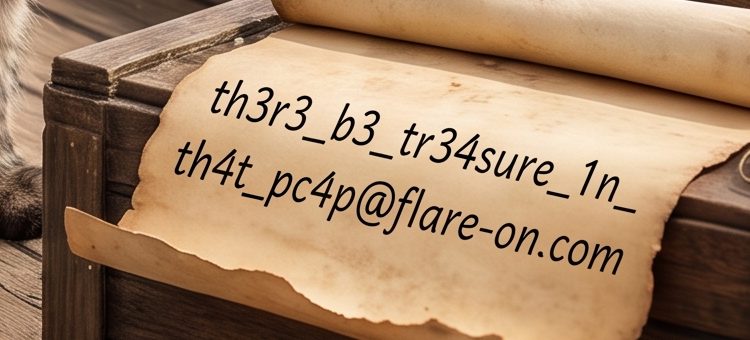
Flag: th3r3_b3_tr34sure_1n_th4t_pc4p@flare-on.com