 CTF WriteUps
Threat Invaders
- Category: rev
“How about a nice retro space-shooter to blow off some steam. Don’t ask why it is over a hundred megabytes, there are sophisticated score-keeping algorithms that need to communicate with our official record keeping servers. Its all very legit. We have provided a pcap file with some communication to the high-score server so you can see what a real gamer looks like.”
ThreatInvaders.exe is a 116 MB .NET 10 self-contained single-file Space Invaders. The trap is that the managed game is a decoy: every byte of the SpaceInvaders DLL is benign, and the malware is compiled into the native apphost, which rewrites the JITted managed telemetry method at runtime so outgoing “feedback” smuggles encrypted exfil to the high-score server. The flag never appears in the binary or the process — it is in the pcap, encrypted by a cipher that only exists in native code. So this “rev” challenge is really: prove the disk image is a lie, find the cipher in the host, and decrypt the capture.
Solution
1. Two binaries in one, and a pcap that can’t come from the decoy
Parsing the single-file bundle and decompiling the managed ThreatInvaders.dll (ilspy and dnSpy agree) gives a completely ordinary highscore client: plain-JSON API, no crypto. It even stores a _machineId (HKLM MachineGuid) field that is written once and never read — a loose thread worth remembering. The only “flag” in the managed code is an obvious decoy in the updater args (..._flag@no-flare.com).
But the provided challenge.pcapng proves the shipped program does something the decoy cannot. The telemetry POSTs carry a feedback_b64 field (base64 of a fixed 4096-byte buffer) and a feedback_length that the benign BuildDocument could never produce:
- a POST with
feedback_length = 0but 4096 non-zero bytes — impossible for the managed code, which sets the length to the buffer size; - a POST with
feedback_length = 8208=(2 << 12) | 16, followed by exactly 16 binary bytes.
That (tag << 12) | len framing is the malware’s signature. The managed IL on disk (and in a full process dump) is identical and benign, so the injection is native.
2. The malware is the apphost, and it hides behind a fake runtime string
The apphost is a .NET 10.0.11 singlefilehost with statically-linked coreclr, but a byte-diff against the stock host shows .text recompiled and ~93 KB larger — malware compiled into the runtime. It imports the hooking primitives a normal host never needs (VirtualProtect, GetProcAddress, CreateThread, CreateThreadpoolTimer): it installs a hook + timer that rewrites the JITted body of managed TelemetryReporter.EncodeFeedbackBuffer.
The whole malicious cluster is reachable statically from one tell. The runtime keeps a table of TieredCompilationManager::… diagnostic strings; wedged into the middle of it is a string that does not belong to coreclr:
0x140755dd0 "ReplaceHighscores"
Its only cross-reference is sub_1400c6099, and from there the cluster around 0x1400c65e0–0x1400c6ba0 unravels — a self-contained set of native functions with their own globals, none of which exist in the stock host.
3. The framing method, and a key hidden in plain sight
sub_1400c6ba0 is the native reimplementation of EncodeFeedbackBuffer. It frames every payload as feedback_length = (tag << 12) | len, and its first-run branch builds the 16-byte tag 2 handshake byte-by-byte:
out[i] = sessionId[15 - i] XOR machineId[i]
where machineId is the 16 raw bytes at 0x1407ffa30 — the very _machineId (HKLM MachineGuid) the decoy stored and “never read”. The native code reads it. That makes the handshake a gift: the pcap gives both out and the session GUID, so the author’s machine GUID falls straight out.
tag2       = 54ae032ea875b0f8cc578a511fe71631
sessionId  = 478b635d-c335-4c12-b1de-16e0565be335
machineId  = tag2[i] ^ sessionId[15-i]
           = 614d587848636e4980454964586c756c
           = GUID 78584d61-6348-496e-8045-4964586c756c
Read as ASCII, those GUID digits spell a …MacHInEId… easter egg — the author confirming the scheme. This 16-byte machineId is the cipher key.
The rest of the cluster is a small pipeline. During gameplay a harvester (sub_1400c6a70) serializes stolen data into a work buffer, encrypts it, and marks a tag 4 payload pending; the framer ships it. A separate hash-gated routine (sub_1400c66f0) encrypts special “reward” leaderboard comments with the same cipher.
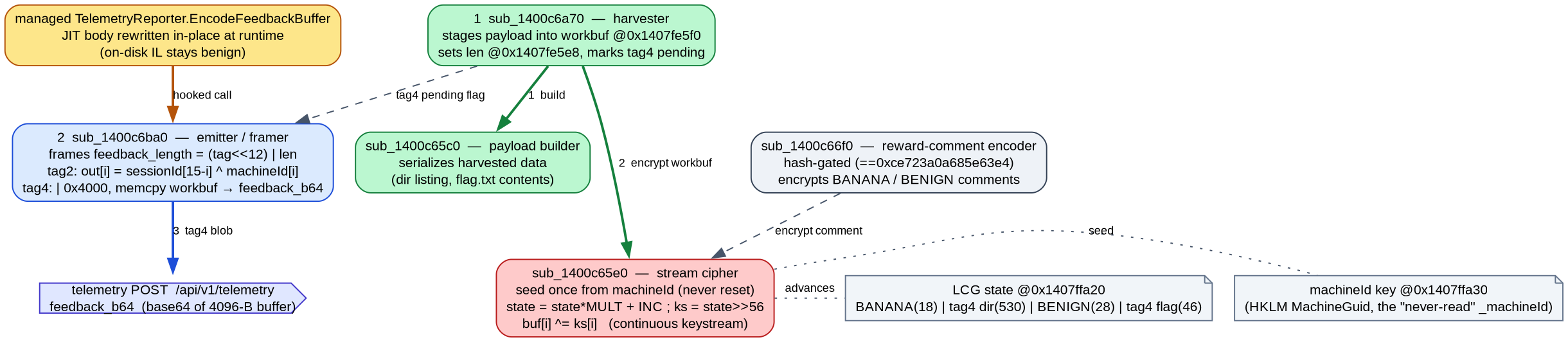
4. The cipher: an LCG keystream seeded from the machineId
The encryptor sub_1400c65e0 XORs the buffer with a keystream from a truncated linear-congruential generator. On the first call it derives a 64-bit seed from the 16-byte machineId — a boost::hash_combine of the two halves, followed by a MurmurHash3-style finalizer (the standard multipliers, but with shifts 33/29/32):
; x = ((a>>2) + 0x9e3779b97f4a7c15 + (a<<6) + b) ^ a      ; hash_combine(a=key[0:8], b=key[8:16])
mov  rax, rdx
shr  rax, 0x21            ; x >> 33
xor  rax, rdx
imul rax, 0xff51afd7ed558ccd
shr  rcx, 0x1d            ; >> 29
...
imul rcx, 0xc4ceb9fe1a85ec53
shr  rax, 0x20            ; >> 32
mov  [0x1407ffa20], rax   ; seed -> LCG state
Then each output byte advances the LCG and takes the top byte:
imul rax, 0x5851f42d4c957f2d   ; state *= MULT   (Knuth/PCG MMIX multiplier)
lea  rdx, [rax + r9]           ; state += 0x14057b7ef767814f
mov  [0x1407ffa20], rdx        ; store state
shr  rdx, 0x38                 ; keystream byte = state >> 56
xor  [rbx + rcx], dl           ; buf[i] ^= ks[i]
For our recovered machineId the seed is 0xc4bfc80d59d86b9b.
5. One continuous keystream, and the flag
The subtlety that defeats a naive attack: the LCG state at 0x1407ffa20 is seeded once and never reset, so every encrypt call in a session draws from a single continuous keystream. Decrypting each tag 4 blob from keystream offset 0 gives garbage; the blobs sit further along the stream, after earlier encryptions consumed keystream.
Sliding the keystream against the two tag 4 payloads pins the offsets exactly — and the gaps between them account for themselves:
offset   0 .. 18    BANANA reward comment   (18 bytes)
offset  18 .. 548   tag4 #1  (530 bytes)
offset 548 .. 576   BENIGN reward comment   (28 bytes)
offset 576 .. 622   tag4 #2  (46 bytes)
The 18- and 28-byte gaps are precisely the two reward comments encrypted during play — the model is self-consistent. Decrypting confirms it: tag 4 #1 is an exfiltrated directory listing, which conveniently names a 46-byte flag.txt; tag 4 #2 is those 46 bytes.
 Directory of Z:\...\SpaceInvaders\bin\Release\net10.0-windows\publish\win-x64
...
30/08/2026  23:23                46 flag.txt
...
Full pipeline (pcap → reassemble → deframe → LCG decrypt): solve.py.
Flag: wh4t_4_l0ng_str4ng3_tr1p_1ts_b33n@flare-on.com